Muluneh Atalay Goshu, Merid Mehari Woldemariam, Gelaye Kassahun Alemu, Tilahun Sewbesew Yitayih, Teshager Nahom Worku, Abereha Aklilu Yiheyis, Sugamo Kalkidan Samuel, Yimer Mulugeta Ayalew, Kassa Getahun Molla
Department of Epidemiology and Biostatistics, Institute of Public Health, College of Medicine and Health Sciences, University of Gondar, Gondar, Ethiopia.
Department of Psychiatry, School of Medicine, College of Medicine and Health Sciences, University of Gondar, Gondar, Ethiopia.
Infect Drug Resist. 2022 May 3;15:2409-2416. doi: 10.2147/IDR.S360605. eCollection 2022.
Ethiopia was using the ChAdOx1 COV-19 vaccine, and health professionals were targets of the first phase of the vaccination strategy. Evidence on the adverse events following immunization (AEFI) was barely available. The study aimed to assess the magnitude and associated factors of adverse events following ChAdOx1 COV-19 immunization among health professionals of the University of Gondar Specialized and Comprehensive Hospital, 2021.
An institution-based cross-sectional study was conducted among health professionals of the University of Gondar Comprehensive and specialized referral hospital. All health professionals who took the ChAdOx1 COV-19 vaccine in the 1st phase were surveyed. A total of 314 health professionals who took the ChAdOx1 COV-19 vaccine were included. The EpiData version 4.6.0.0 and Stata 16 were used for data entry and analysis, respectively. A binary logistic regression was used to identify statistically significant factors associated with AEFI. Chi-square and multicollinearity assumptions were tested. A p-value <0.2 and 0.05 were used as cut-off values of significance in the bi- and multivariable logistic regression models, respectively. An adjusted odds ratio (AOR) with 95% CI was reported for statistically significant variables.
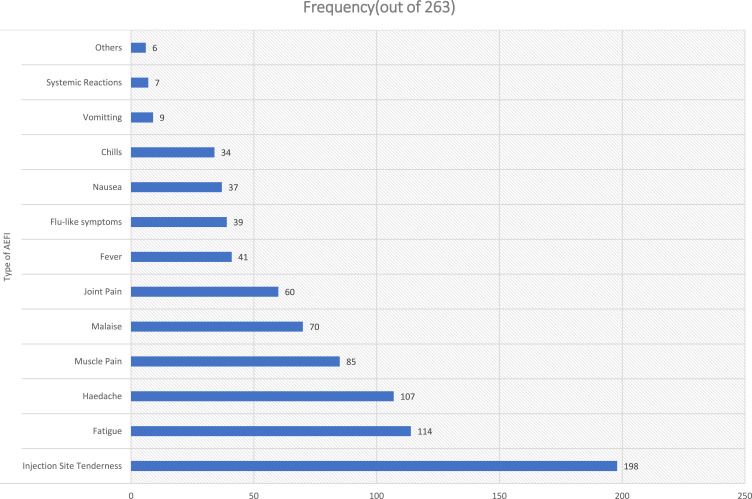
Among 314 study participants, 263 of them had at least one mild to severe AEFI of ChAdOx1 COV-19 with a prevalence of AEFI of 83.76% (95% CI: 79.23, 87.46). The commonest AEFI observed were injection site tenderness (n=198/263), fatigue (114/263), headache (n=107/263), and muscle pain (n=85/263). Females (AOR=2.75, 95% CI: 1.15, 6.58), and participants who felt the vaccine was unsafe (AOR=2.84, 95% CI: 1.03, 7.85) were having nearly three times more odds of AEFI immunization as compared to males and those who felt the vaccine was safe, respectively.
Adverse event following immunization has been a public health problem in Northwest Ethiopia. Being female and having a feeling that the vaccine is unsafe were statistically significantly associated with AEFI.
埃塞俄比亚曾使用ChAdOx1新冠疫苗,卫生专业人员是第一阶段疫苗接种策略的目标人群。关于免疫后不良事件(AEFI)的证据几乎没有。本研究旨在评估2021年贡德尔大学专科医院和综合医院卫生专业人员接种ChAdOx1新冠疫苗后不良事件的发生率及相关因素。
在贡德尔大学综合和专科转诊医院的卫生专业人员中开展了一项基于机构的横断面研究。对第一阶段接种ChAdOx1新冠疫苗的所有卫生专业人员进行了调查。共纳入314名接种ChAdOx1新冠疫苗的卫生专业人员。分别使用EpiData 4.6.0.0版和Stata 16进行数据录入和分析。采用二元逻辑回归来确定与AEFI相关的具有统计学意义的因素。检验了卡方和多重共线性假设。在二元和多变量逻辑回归模型中,分别将p值<0.2和0.05用作显著性的截断值。报告了具有统计学意义变量的调整比值比(AOR)及95%置信区间。
在314名研究参与者中,263人至少出现了一次ChAdOx1新冠疫苗的轻度至重度AEFI,AEFI的患病率为83.76%(95%置信区间:79.23,87.46)。观察到的最常见AEFI是注射部位压痛(n = 198/263)、疲劳(114/263)、头痛(n = 107/263)和肌肉疼痛(n = 85/263)。女性(AOR = 2.75,95%置信区间:1.15,6.58)以及认为疫苗不安全的参与者(AOR = 2.84,95%置信区间:1.03,7.85)接种疫苗后发生AEFI的几率分别是男性和认为疫苗安全的参与者的近三倍。
免疫后不良事件在埃塞俄比亚西北部一直是一个公共卫生问题。女性以及感觉疫苗不安全与AEFI在统计学上显著相关。