Triana Santiago A, Dumberry Mathieu, Cébron David, Vidal Jérémie, Trinh Antony, Gerick Felix, Rekier Jérémy
Royal Observatory of Belgium, Ringlaan 3, BE-1180 Brussels, Belgium.
Department of Physics, University of Alberta, Edmonton, AB T6G 2E1 Canada.
Surv Geophys. 2022;43(1):107-148. doi: 10.1007/s10712-021-09668-y. Epub 2021 Nov 10.
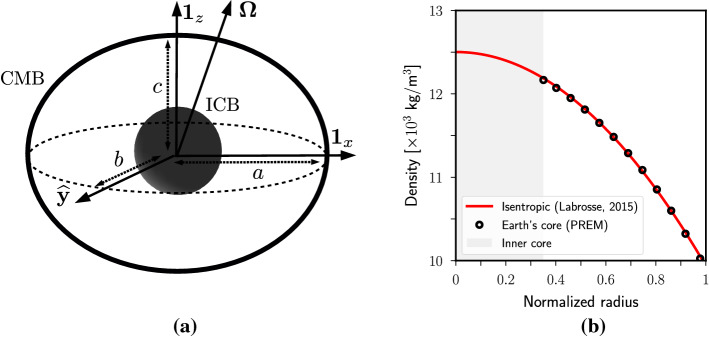
Changes in the Earth's rotation are deeply connected to fluid dynamical processes in the outer core. This connection can be explored by studying the associated Earth eigenmodes with periods ranging from nearly diurnal to multi-decadal. It is essential to understand how the rotational and fluid core eigenmodes mutually interact, as well as their dependence on a host of diverse factors, such as magnetic effects, density stratification, fluid instabilities or turbulence. It is feasible to build detailed models including many of these features, and doing so will in turn allow us to extract more (indirect) information about the Earth's interior. In this article, we present a review of some of the current models, the numerical techniques, their advantages and limitations and the challenges on the road ahead.
地球自转的变化与外核中的流体动力学过程紧密相连。这种联系可以通过研究周期从近昼夜到数十年不等的相关地球本征模来探索。理解旋转本征模和流体核本征模如何相互作用,以及它们如何依赖于一系列不同因素,如磁效应、密度分层、流体不稳定性或湍流,至关重要。构建包含许多这些特征的详细模型是可行的,这样做反过来将使我们能够提取更多关于地球内部的(间接)信息。在本文中,我们对一些当前模型、数值技术、它们的优缺点以及未来面临的挑战进行综述。