Sivacoumarane Sooryabhala, Dutta Souradeep, Dubashi Biswajit, Adithan Subathra, Toi Pampa C, Nelamangala Ramakrishnaiah Vishnu Prasad
Surgery, Jawaharlal Institute of Postgraduate Medical Education and Research, Puducherry, IND.
Medical Oncology, Jawaharlal Institute of Postgraduate Medical Education and Research, Puducherry, IND.
Cureus. 2022 Apr 7;14(4):e23936. doi: 10.7759/cureus.23936. eCollection 2022 Apr.
Neoadjuvant chemotherapy (NACT) in carcinoma stomach was introduced in an effort to eliminate micro-metastasis and to improve resectablity before surgery which improves R0 resection rates. We aimed to study the short term outcomes of neoadjuvant chemotherapy on the Tumor Node Metastasis (TNM) stage and the operative outcomes including R0 resection rate in locally advanced gastric cancer.
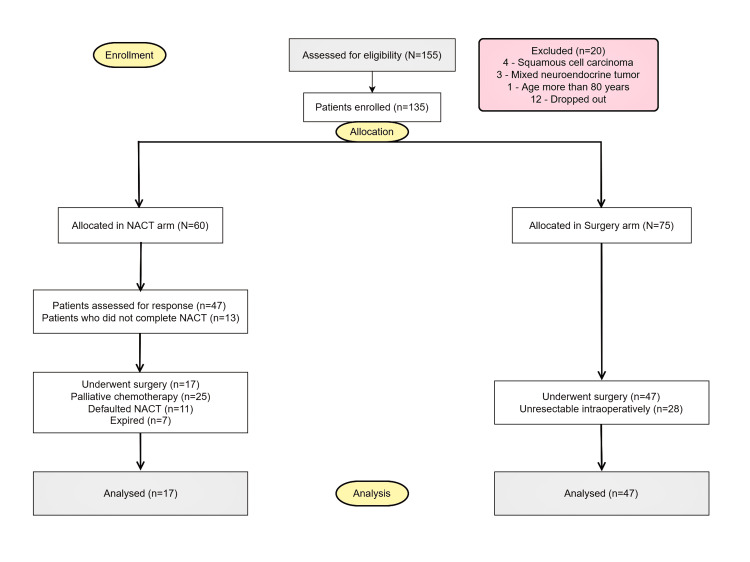
We prospectively included patients with locally advanced adenocarcinoma stomach staged by contrast-enhanced computed tomography (CECT) in our study. Patients in Group I were started on neoadjuvant chemotherapy (epirubicin, oxaliplatin, and capecitabine). Surgery was done following response assessment CECT. Patients in Group II underwent upfront surgery. We assessed R0 resection rate, number of harvested and metastatic lymph nodes, lymph node ratio, duration of surgery, blood loss, hospital stay and complications between two groups. Response to NACT was assessed in Group I.
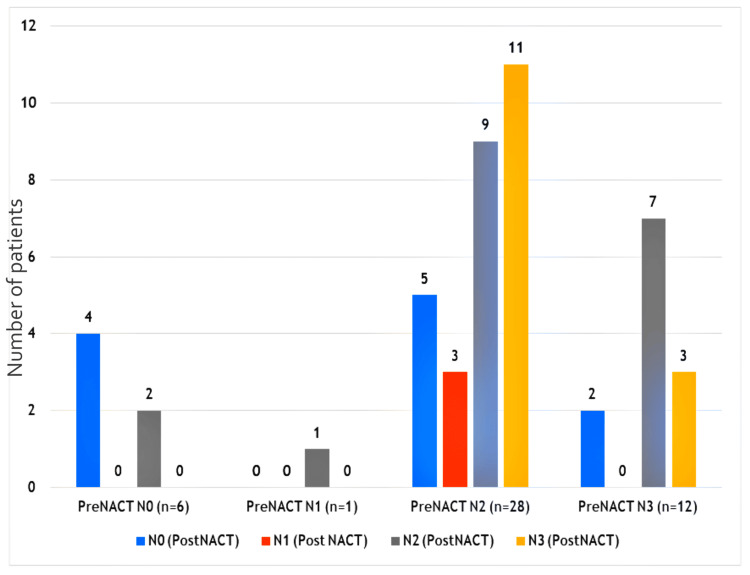
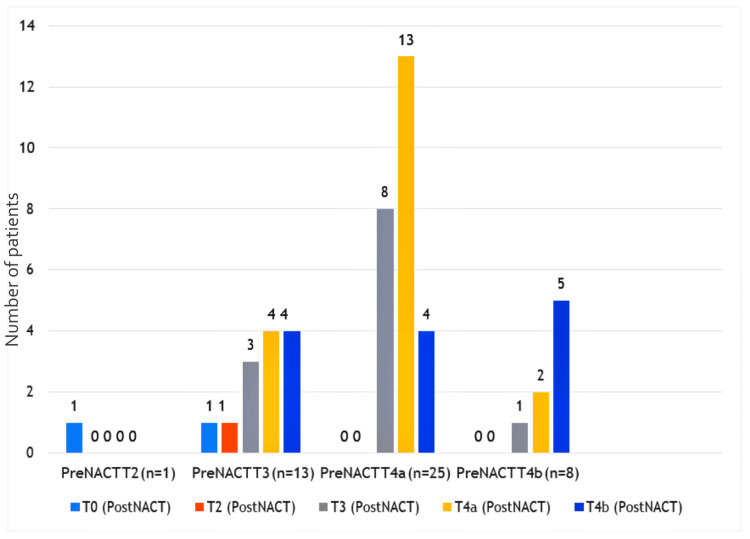
Out of 47 patients who received NACT, two patients had complete response (4.2%), 13 had partial response (27.7%), 10 had stable disease (21.3%) and 22 patients had progressive disease (46.8%). We found no significant difference in the rate of R0 resection between the two groups (88.2% in NACT group vs 85.1% in surgery group, P=0.55).
The rate of R0 resection does not significantly improve with neoadjuvant chemotherapy. In view of high progression rates, patient selection is required when NACT is planned in carcinoma stomach which are surgically resectable at presentation. We await survival analysis to further validate the role of NACT.
胃癌新辅助化疗(NACT)旨在消除微转移并提高手术前的可切除性,从而提高R0切除率。我们旨在研究新辅助化疗对局部晚期胃癌的肿瘤淋巴结转移(TNM)分期和手术结局(包括R0切除率)的短期影响。
我们前瞻性纳入了通过增强计算机断层扫描(CECT)分期的局部晚期胃腺癌患者。第一组患者开始接受新辅助化疗(表柔比星、奥沙利铂和卡培他滨)。在通过CECT进行反应评估后进行手术。第二组患者接受直接手术。我们评估了两组之间的R0切除率、收获的和转移的淋巴结数量、淋巴结比率、手术持续时间、失血量、住院时间和并发症。对第一组评估了NACT的反应。
在47例接受NACT的患者中,2例患者完全缓解(4.2%),13例部分缓解(27.7%),10例病情稳定(21.3%),22例病情进展(46.8%)。我们发现两组之间的R0切除率没有显著差异(NACT组为88.2%,手术组为85.1%,P = 0.55)。
新辅助化疗并未显著提高R0切除率。鉴于高进展率,在计划对初诊时可手术切除的胃癌进行NACT时需要进行患者选择。我们等待生存分析以进一步验证NACT的作用。