Laboratory of Molecular Genetics of Aging and Tumor, Medical School, Kunming University of Science and Technology, Kunming 650500, Yunnan, China.
Aging (Albany NY). 2022 May 10;14(9):3941-3955. doi: 10.18632/aging.204055.
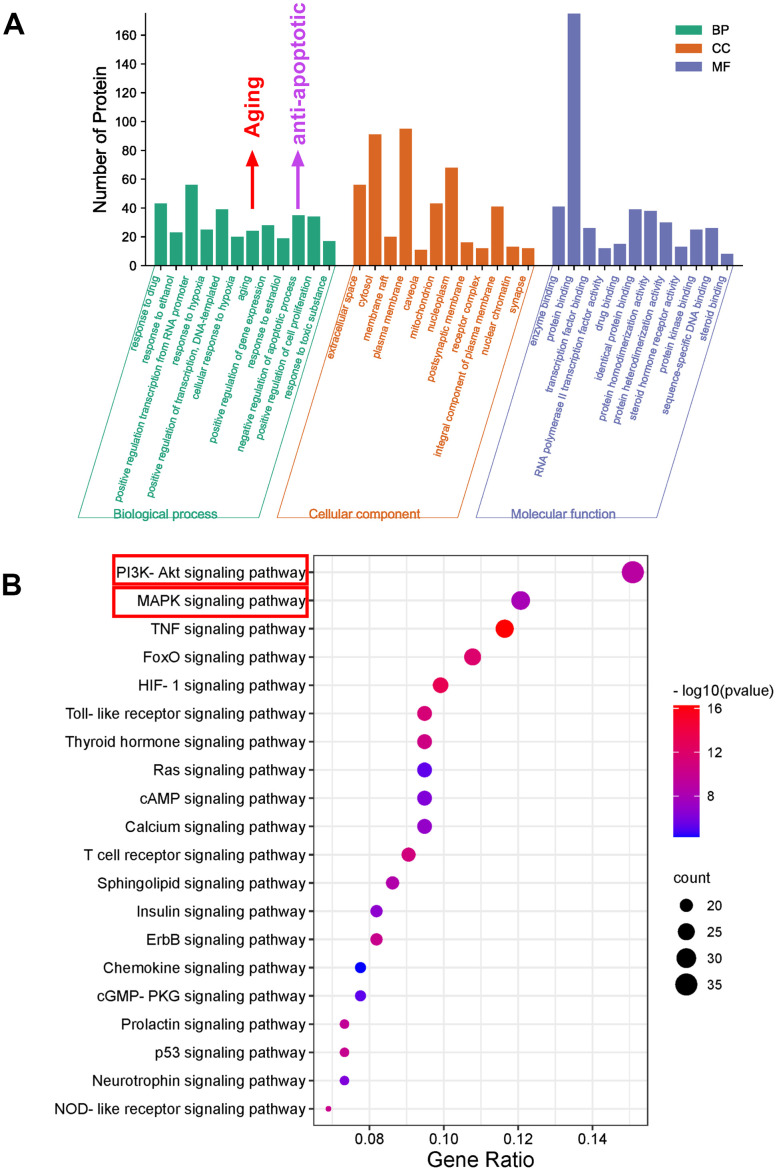
Si Jun Zi Tang (SJZT) is a classic Traditional Chinese Medicine (TCM) prescription used to treat aging-related diseases. However, the potential molecular mechanisms of the anti-aging effects of the bioactive compounds and their targets remain elusive. In this study, we combined network pharmacology and molecular docking with experiments to elucidate the anti-aging molecular mechanism of SJZT. A series of network pharmacology strategies were used to predict potential targets and therapeutic mechanisms of SJZT, including compound screening, pathway enrichment analysis and molecular docking studies. Based on the network pharmacology predictions and observation of outward signs of aging, the expression levels of selected genes and proteins and possible key targets were subsequently validated and analysed using qRT-PCR and immunoblotting. Using a data mining approach, 235 effective targets of SJZT and aging were obtained. AKT1, STAT3, JUN, MAPK3, TP53, MAPK1, TNF, RELA, MAPK14 and IL6 were identified as core genes in the Protein-Protein Interaction Networks (PPI) analysis. The results of the effective target Gene Ontology (Go) functional enrichment analysis suggested that SJZT may be involved aging and antiapoptotic biological processes. The Kyoto Encyclopedia of Genes and Genomes (KEGG) enrichment analysis indicated that the anti-aging mechanism of SJZT may be associated with the PI3K-AKT and P38 MAPK signalling pathways. Molecular docking analysis suggested that kaempferol and quercetin could fit in the binding pockets of the core targets. In addition, SJZT alleviated the aging symptoms of mice such as osteoporosis and hair loss. In conclusion, the anti-aging effect of SJZT was associated with the inhibition of the PI3K-AKT and P38 MAPK signalling pathways, and these findings were consistent with the network pharmacology prediction.
四君子汤(SJZT)是一种经典的中药方剂,用于治疗与衰老相关的疾病。然而,其生物活性化合物的抗衰老作用的潜在分子机制及其靶点仍不清楚。在这项研究中,我们结合网络药理学和分子对接与实验,阐明了 SJZT 的抗衰老分子机制。采用一系列网络药理学策略,预测 SJZT 的潜在靶点和治疗机制,包括化合物筛选、通路富集分析和分子对接研究。基于网络药理学预测和衰老外在表现的观察,使用 qRT-PCR 和免疫印迹法验证和分析了选定基因和蛋白质的表达水平以及可能的关键靶点。通过数据挖掘方法,获得了 SJZT 和衰老的 235 个有效靶点。在蛋白质-蛋白质相互作用网络(PPI)分析中,鉴定出 AKT1、STAT3、JUN、MAPK3、TP53、MAPK1、TNF、RELA、MAPK14 和 IL6 为核心基因。有效靶点基因本体(GO)功能富集分析结果表明,SJZT 可能参与衰老和抗凋亡的生物学过程。京都基因与基因组百科全书(KEGG)富集分析表明,SJZT 的抗衰老机制可能与 PI3K-AKT 和 P38 MAPK 信号通路有关。分子对接分析表明,山奈酚和槲皮素可以与核心靶点的结合口袋结合。此外,SJZT 缓解了小鼠的衰老症状,如骨质疏松症和脱发。综上所述,SJZT 的抗衰老作用与抑制 PI3K-AKT 和 P38 MAPK 信号通路有关,这与网络药理学预测结果一致。