Li Jialin, Luo Hua, Liu Xinkui, Zhang Jingyuan, Zhou Wei, Guo Siyu, Chen Xiuping, Liu Yingying, Jia Shanshan, Wang Haojia, Li Bingbing, Cheng Guoliang, Wu Jiarui
Department of Clinical Chinese Pharmacy, School of Chinese Materia Medica, Beijing University of Chinese Medicine, No. 11 of North Three-ring East Road, Chao Yang District, Beijing, 100102 China.
Institute of Chinese Medical Sciences, State Key Laboratory of Quality Research in Chinese Medicine, University of Macau, Macao, China.
Chin Med. 2020 Oct 23;15:113. doi: 10.1186/s13020-020-00392-0. eCollection 2020.
Yuzhi Zhixue Granule (YZG) is a traditional Chinese patent medicine for treating excessive menstrual flow caused by ovulatory dysfunctional uterine bleeding (ODUB) accompanied by heat syndrome. However, the underlying molecular mechanisms, potential targets, and active ingredients of this prescription are still unknown. Therefore, it is imperative to explore the molecular mechanism of YZG.
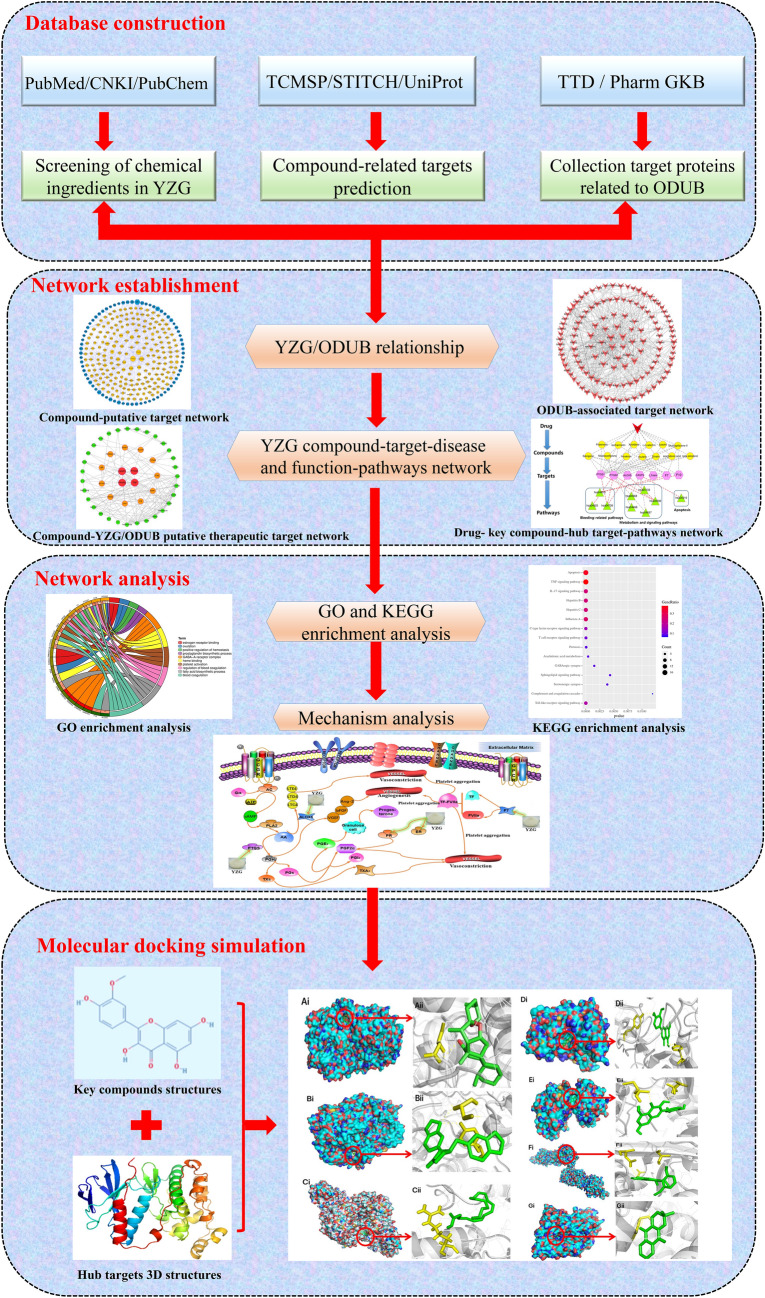
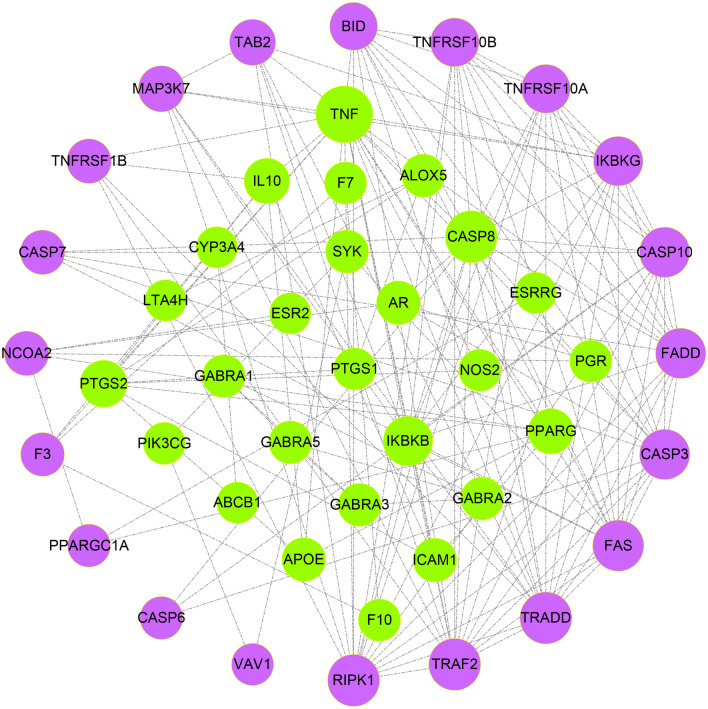
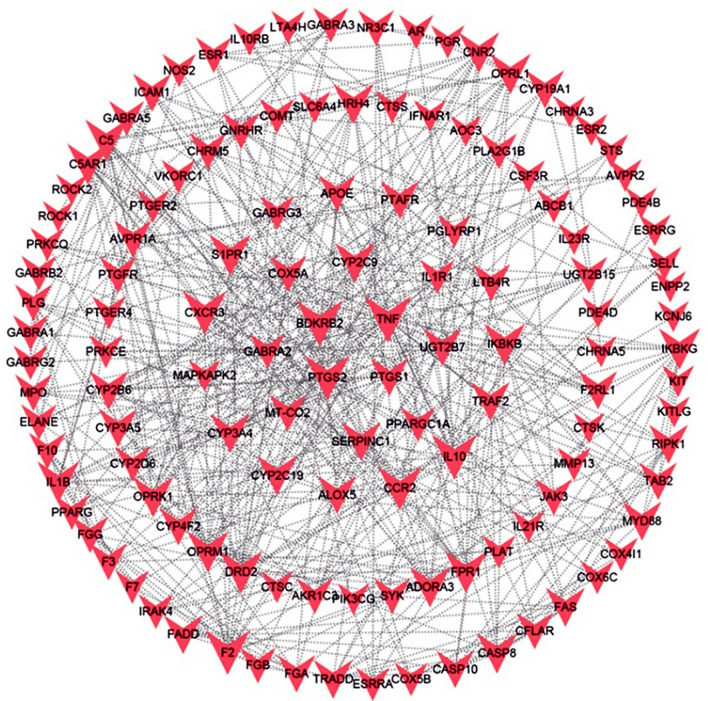
The active compounds in YZG were screened by the Traditional Chinese Medicine Systems Pharmacology Database and Analysis Platform (TCMSP). The putative targets of YZG were collected via TCMSP and Search Tool for Interacting Chemicals (STITCH) databases. The Therapeutic Target Database (TTD) and Pharmacogenomics Knowledgebase (PharmGKB) databases were used to identify the therapeutic targets of ODUB. A protein-protein interaction (PPI) network containing both the putative targets of YZG and known therapeutic targets of ODUB was built. Furthermore, bioinformatics resources from the database for annotation, visualization and integrated discovery (DAVID) were utilized for Gene Ontology (GO) and Kyoto Encyclopedia of Genes and Genomes (KEGG) enrichment analyses. Finally, molecular docking was performed to verify the binding effect between the YZG screened compounds and potential therapeutic target molecules.
The study employed a network pharmacology method, mainly containing target prediction, network construction, functional enrichment analysis, and molecular docking to systematically research the mechanisms of YZG in treating ODUB. The putative targets of YZG that treat ODUB mainly involved PTGS1, PTGS2, ALOX5, CASP3, LTA4H, F7 and F10. The functional enrichment analysis suggested that the produced therapeutic effect of YZG against ODUB is mediated by synergistical regulation of several biological pathways, including apoptosis arachidonic acid (AA) metabolism, serotonergic synapse, complement and coagulation cascades and C-type lectin receptor signaling pathways. Molecular docking simulation revealed good binding affinity of the seven putative targets with the corresponding compounds.
This novel and scientific network pharmacology-based study holistically elucidated the basic pharmacological effects and the underlying mechanisms of YZG in the treatment of ODUB.
毓麟止血颗粒(YZG)是一种用于治疗排卵型功能失调性子宫出血(ODUB)伴热证所致月经过多的中成药。然而,该方剂的潜在分子机制、潜在靶点和活性成分仍不清楚。因此,探索毓麟止血颗粒的分子机制势在必行。
通过中药系统药理学数据库与分析平台(TCMSP)筛选毓麟止血颗粒中的活性化合物。通过TCMSP和化学物质相互作用搜索工具(STITCH)数据库收集毓麟止血颗粒的潜在靶点。利用治疗靶点数据库(TTD)和药物基因组学知识库(PharmGKB)数据库确定排卵型功能失调性子宫出血的治疗靶点。构建一个包含毓麟止血颗粒潜在靶点和排卵型功能失调性子宫出血已知治疗靶点的蛋白质-蛋白质相互作用(PPI)网络。此外,利用来自数据库注释、可视化与综合发现(DAVID)的生物信息学资源进行基因本体(GO)和京都基因与基因组百科全书(KEGG)富集分析。最后,进行分子对接以验证毓麟止血颗粒筛选化合物与潜在治疗靶点分子之间的结合效果。
本研究采用网络药理学方法,主要包括靶点预测、网络构建、功能富集分析和分子对接,系统地研究毓麟止血颗粒治疗排卵型功能失调性子宫出血的机制。毓麟止血颗粒治疗排卵型功能失调性子宫出血的潜在靶点主要涉及PTGS1、PTGS2、ALOX5、CASP3、LTA4H、F7和F10。功能富集分析表明,毓麟止血颗粒对排卵型功能失调性子宫出血产生的治疗作用是通过对多种生物途径的协同调节介导的,包括细胞凋亡、花生四烯酸(AA)代谢、5-羟色胺能突触、补体和凝血级联反应以及C型凝集素受体信号通路。分子对接模拟显示七个潜在靶点与相应化合物具有良好的结合亲和力。
这项基于网络药理学的新颖且科学的研究全面阐明了毓麟止血颗粒治疗排卵型功能失调性子宫出血的基本药理作用和潜在机制。