Department of Experimental Psychology, Crossmodal Research Laboratory, University of Oxford, Oxford, OX2 6GG, UK.
Atten Percept Psychophys. 2022 Jul;84(5):1666-1688. doi: 10.3758/s13414-022-02498-z. Epub 2022 May 10.
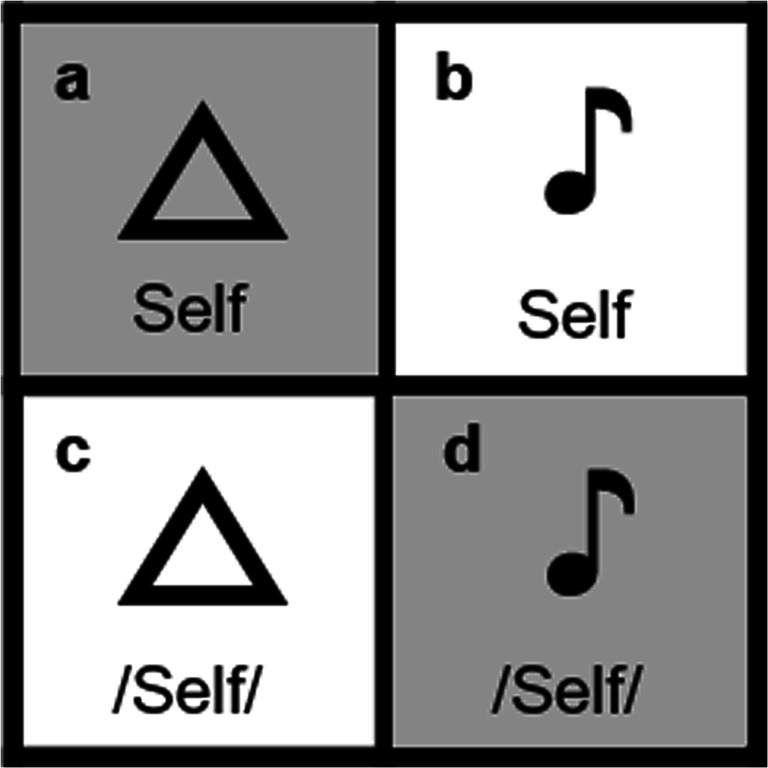
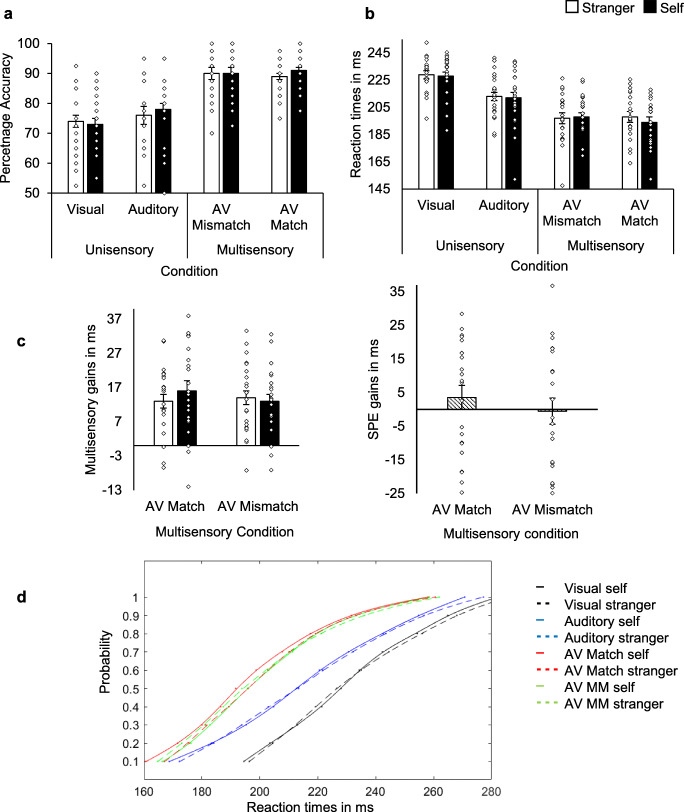
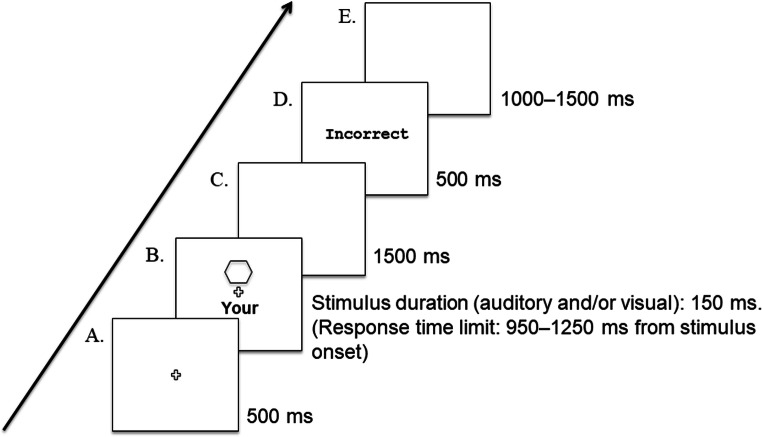
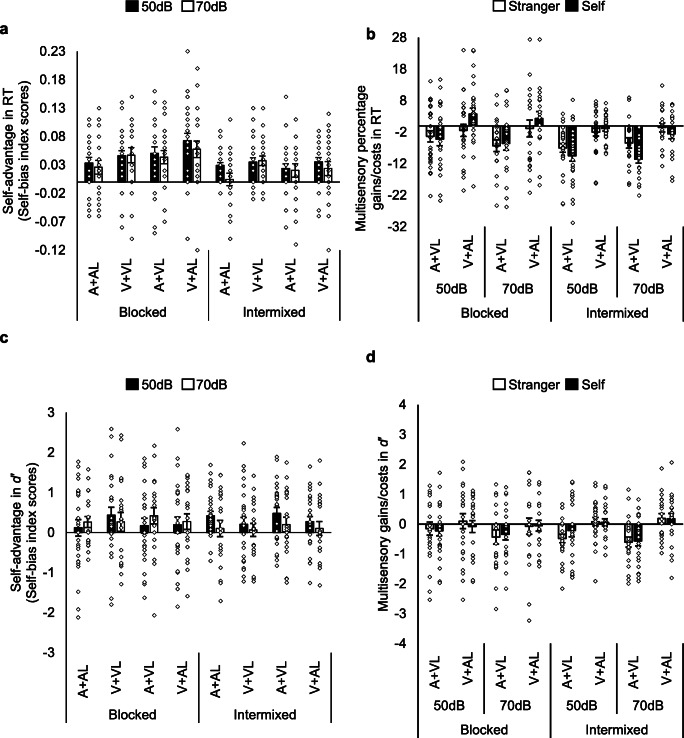
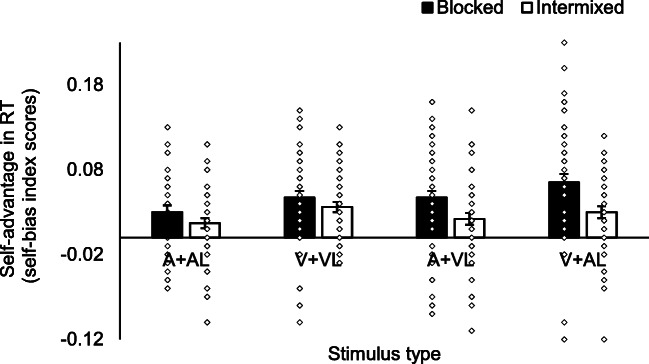
A shape-label matching task is commonly used to examine the self-advantage in motor reaction-time responses (the Self-Prioritization Effect; SPE). In the present study, auditory labels were introduced, and, for the first time, responses to unisensory auditory, unisensory visual, and multisensory object-label stimuli were compared across block-type (i.e., trials blocked by sensory modality type, and intermixed trials of unisensory and multisensory stimuli). Auditory stimulus intensity was presented at either 50 dB (Group 1) or 70 dB (Group 2). The participants in Group 2 also completed a multisensory detection task, making simple speeded motor responses to the shape and sound stimuli and their multisensory combinations. In the matching task, the SPE was diminished in intermixed trials, and in responses to the unisensory auditory stimuli as compared with the multisensory (visual shape+auditory label) stimuli. In contrast, the SPE did not differ in responses to the unisensory visual and multisensory (auditory object+visual label) stimuli. The matching task was associated with multisensory 'costs' rather than gains, but response times to self- versus stranger-associated stimuli were differentially affected by the type of multisensory stimulus (auditory object+visual label or visual shape+auditory label). The SPE was thus modulated both by block-type and the combination of object and label stimulus modalities. There was no SPE in the detection task. Taken together, these findings suggest that the SPE with unisensory and multisensory stimuli is modulated by both stimulus- and task-related parameters within the matching task. The SPE does not transfer to a significant motor speed gain when the self-associations are not task-relevant.
一种形状-标签匹配任务常用于检查运动反应时间反应中的自我优势(自我优先效应;SPE)。在本研究中,引入了听觉标签,并且首次比较了单一感觉听觉、单一感觉视觉和多感觉对象标签刺激在块类型(即,按感觉模态类型块化的试验和单一感觉和多感觉刺激的混合试验)下的反应。听觉刺激强度分别以 50dB(第 1 组)或 70dB(第 2 组)呈现。第 2 组的参与者还完成了一项多感觉检测任务,对形状和声音刺激及其多感觉组合进行简单的快速运动反应。在匹配任务中,与多感觉(视觉形状+听觉标签)刺激相比,混合试验和单一感觉听觉刺激的 SPE 降低。相比之下,单一感觉视觉和多感觉(听觉对象+视觉标签)刺激的 SPE 没有差异。匹配任务与多感觉“成本”而不是收益相关,但自我关联与陌生人关联刺激的反应时间受到多感觉刺激类型(听觉对象+视觉标签或视觉形状+听觉标签)的不同影响。因此,SPE 既受到块类型的调制,也受到对象和标签刺激模态的组合的调制。在检测任务中没有 SPE。总之,这些发现表明,在匹配任务中,单一感觉和多感觉刺激的 SPE 受到刺激和任务相关参数的共同调制。当自我关联与任务无关时,SPE 不会转移到显著的运动速度增益。