• 文献检索
  • 文档翻译
  • 深度研究
  • 学术资讯
  • Suppr Zotero 插件Zotero 插件
  • 邀请有礼
  • 套餐&价格
  • 历史记录
应用&插件
Suppr Zotero 插件Zotero 插件浏览器插件Mac 客户端Windows 客户端微信小程序
定价
高级版会员购买积分包购买API积分包
服务
文献检索文档翻译深度研究API 文档MCP 服务
关于我们
关于 Suppr公司介绍联系我们用户协议隐私条款
关注我们

Suppr 超能文献

核心技术专利:CN118964589B侵权必究
粤ICP备2023148730 号-1Suppr @ 2026

文献检索

告别复杂PubMed语法,用中文像聊天一样搜索,搜遍4000万医学文献。AI智能推荐,让科研检索更轻松。

立即免费搜索

文件翻译

保留排版,准确专业,支持PDF/Word/PPT等文件格式,支持 12+语言互译。

免费翻译文档

深度研究

AI帮你快速写综述,25分钟生成高质量综述,智能提取关键信息,辅助科研写作。

立即免费体验

社会与奖励关联的多感官知觉偏差

Multisensory Perceptual Biases for Social and Reward Associations.

作者信息

Stolte Moritz, Spence Charles, Barutchu Ayla

机构信息

Department of Psychology, University of Vienna, Vienna, Austria.

Department of Experimental Psychology, University of Oxford, Oxford, United Kingdom.

出版信息

Front Psychol. 2021 Mar 11;12:640684. doi: 10.3389/fpsyg.2021.640684. eCollection 2021.

DOI:10.3389/fpsyg.2021.640684
PMID:33776865
原文链接:https://pmc.ncbi.nlm.nih.gov/articles/PMC7990908/
Abstract

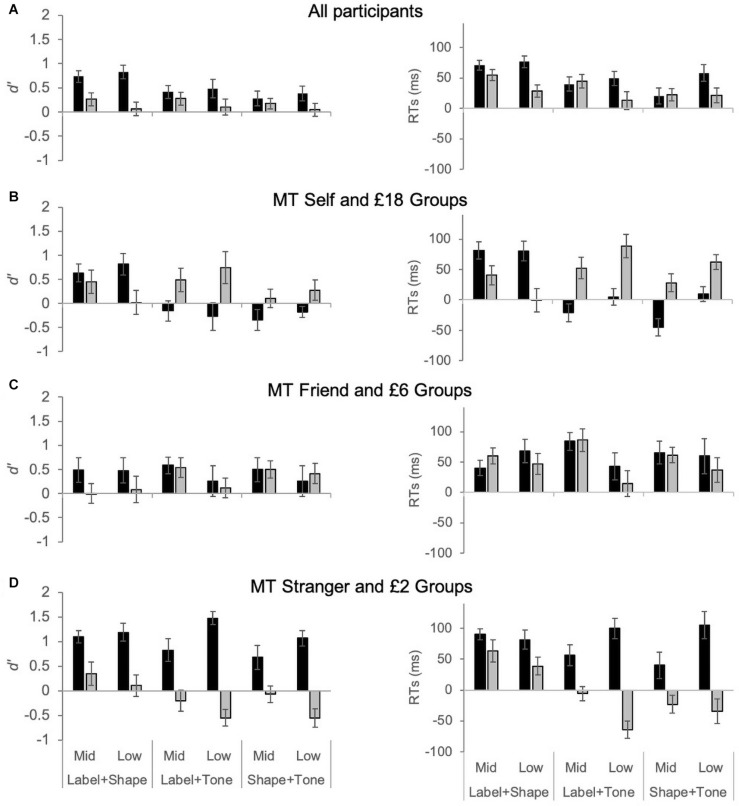
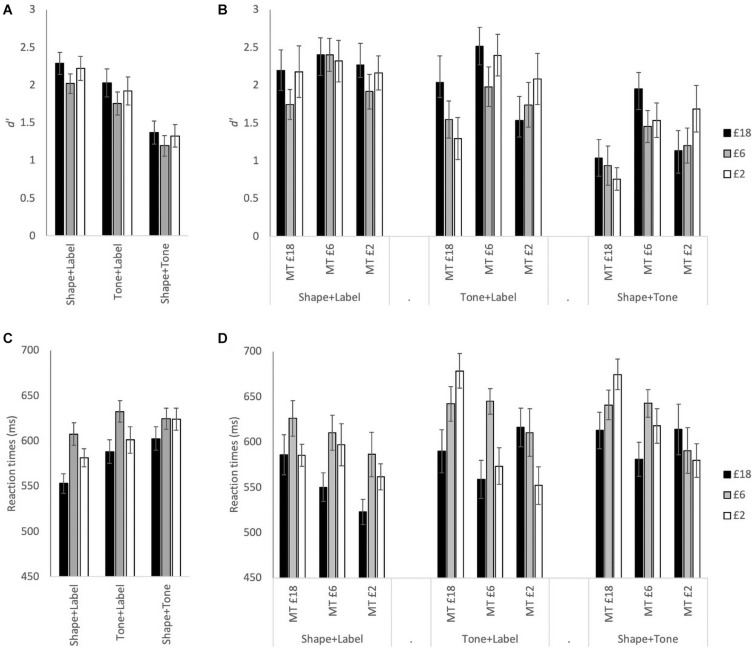
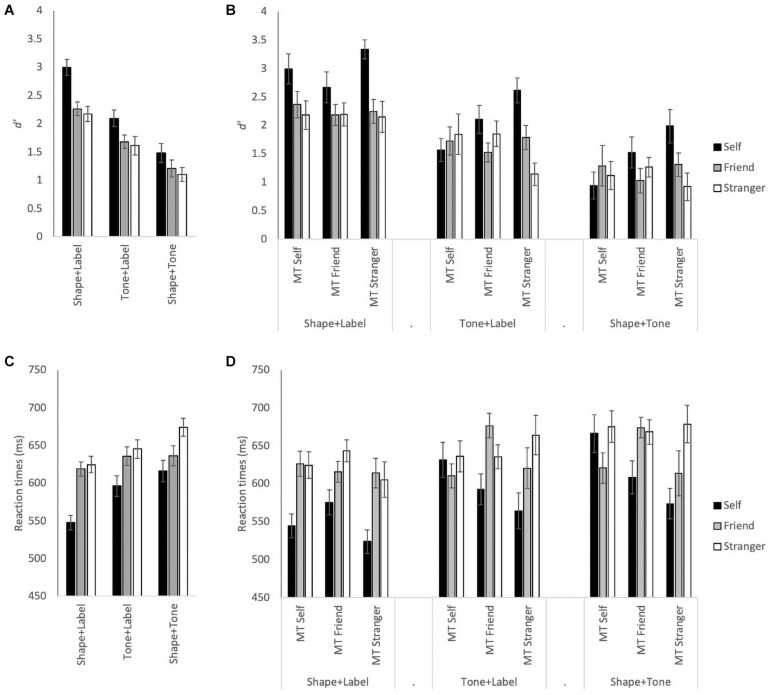
Linking arbitrary shapes (e.g., circles, squares, and triangles) to personal labels (e.g., self, friend, or stranger) or reward values (e.g., £18, £6, or £2) results in immediate processing benefits for those stimuli that happen to be associated with the self or high rewards in perceptual matching tasks. Here we further explored how social and reward associations interact with multisensory stimuli by pairing labels and objects with tones (low, medium, and high tones). We also investigated whether self and reward biases persist for multisensory stimuli with the label removed after an association had been made. Both high reward stimuli and those associated with the self, resulted in faster responses and improved discriminability (i.e., higher ), which persisted for multisensory stimuli even when the labels were removed. However, these self- and reward-biases partly depended on the specific alignment between the physical tones (low, medium, and high) and the conceptual (social or reward) order. Performance for reward associations improved when the endpoints of low or high rewards were paired with low or high tones; meanwhile, for personal associations, there was a benefit when the self was paired with either low or high tones, but there was no effect when the stranger was associated with either endpoint. These results indicate that, unlike reward, social personal associations are not represented along a continuum with two marked endpoints (i.e., self and stranger) but rather with a single reference point (the self vs. other).

摘要

将任意形状(如圆形、方形和三角形)与个人标签(如自我、朋友或陌生人)或奖励价值(如18英镑、6英镑或2英镑)联系起来,会使那些在感知匹配任务中恰好与自我或高奖励相关的刺激立即获得加工优势。在这里,我们通过将标签和物体与音调(低音、中音和高音)配对,进一步探讨了社会和奖励关联如何与多感官刺激相互作用。我们还研究了在建立关联后移除标签的多感官刺激中,自我和奖励偏差是否仍然存在。高奖励刺激以及与自我相关的刺激,都会导致更快的反应和更高的辨别力(即更高的 ),即使移除标签,这种辨别力在多感官刺激中仍然存在。然而,这些自我和奖励偏差部分取决于物理音调(低音、中音和高音)与概念(社会或奖励)顺序之间的特定对应关系。当低奖励或高奖励的端点与低音或高音配对时,奖励关联的表现会得到改善;同时,对于个人关联,当自我与低音或高音配对时会有好处,但当陌生人与任何一个端点相关联时则没有影响。这些结果表明,与奖励不同,社会个人关联不是沿着有两个明显端点(即自我和陌生人)的连续体来表征,而是以一个单一参考点(自我与他人)来表征。
https://cdn.ncbi.nlm.nih.gov/pmc/blobs/28ad/7990908/fd23f81ea9a3/fpsyg-12-640684-g003.jpg
https://cdn.ncbi.nlm.nih.gov/pmc/blobs/28ad/7990908/92eba74e3a21/fpsyg-12-640684-g001.jpg
https://cdn.ncbi.nlm.nih.gov/pmc/blobs/28ad/7990908/0f81368ad65b/fpsyg-12-640684-g002.jpg
https://cdn.ncbi.nlm.nih.gov/pmc/blobs/28ad/7990908/fd23f81ea9a3/fpsyg-12-640684-g003.jpg
https://cdn.ncbi.nlm.nih.gov/pmc/blobs/28ad/7990908/92eba74e3a21/fpsyg-12-640684-g001.jpg
https://cdn.ncbi.nlm.nih.gov/pmc/blobs/28ad/7990908/0f81368ad65b/fpsyg-12-640684-g002.jpg
https://cdn.ncbi.nlm.nih.gov/pmc/blobs/28ad/7990908/fd23f81ea9a3/fpsyg-12-640684-g003.jpg

相似文献

1
Multisensory Perceptual Biases for Social and Reward Associations.社会与奖励关联的多感官知觉偏差
Front Psychol. 2021 Mar 11;12:640684. doi: 10.3389/fpsyg.2021.640684. eCollection 2021.
2
The interaction between self-bias and reward: Evidence for common and distinct processes.自我偏差与奖励之间的相互作用:共同与不同过程的证据。
Q J Exp Psychol (Hove). 2015;68(10):1952-64. doi: 10.1080/17470218.2015.1023207. Epub 2015 Apr 8.
3
Negative mood disrupts self- and reward-biases in perceptual matching.消极情绪会扰乱知觉匹配中的自我偏向和奖励偏向。
Q J Exp Psychol (Hove). 2016;69(7):1438-48. doi: 10.1080/17470218.2015.1122069.
4
Super-size me: self biases increase to larger stimuli.放大自我:自我偏差会随着刺激的增大而增加。
Psychon Bull Rev. 2015 Apr;22(2):550-8. doi: 10.3758/s13423-014-0690-6.
5
Bicultural Minds: A Cultural Priming Approach to the Self-Bias Effect.双文化思维:一种针对自我偏见效应的文化启动方法。
Behav Sci (Basel). 2022 Feb 11;12(2):45. doi: 10.3390/bs12020045.
6
The differential outcomes procedure can overcome self-bias in perceptual matching.差异结果程序可以克服感知匹配中的自我偏见。
Psychon Bull Rev. 2016 Apr;23(2):451-8. doi: 10.3758/s13423-015-0895-3.
7
Try to see it my way: Embodied perspective enhances self and friend-biases in perceptual matching.试着从我的角度看:具身视角增强了感知匹配中的自我和朋友偏向。
Cognition. 2016 Aug;153:108-17. doi: 10.1016/j.cognition.2016.04.015. Epub 2016 May 13.
8
Perceptual effects of social salience: evidence from self-prioritization effects on perceptual matching.社会显著性的知觉效应:来自自我优先化效应对知觉匹配影响的证据。
J Exp Psychol Hum Percept Perform. 2012 Oct;38(5):1105-17. doi: 10.1037/a0029792. Epub 2012 Sep 10.
9
More of me! Distinguishing self and reward bias using redundancy gains.更多的自我!利用冗余增益区分自我与奖励偏差。
Atten Percept Psychophys. 2015 Nov;77(8):2549-61. doi: 10.3758/s13414-015-0970-x.
10
Self-prioritization of fully unfamiliar stimuli.完全陌生刺激的自我优先排序。
Q J Exp Psychol (Hove). 2019 Aug;72(8):2110-2120. doi: 10.1177/1747021819832981. Epub 2019 Mar 5.

引用本文的文献

1
The relationship between self, value-based reward, and emotion prioritisation effects.自我、基于价值的奖励与情绪优先化效应之间的关系。
Q J Exp Psychol (Hove). 2023 Apr;76(4):942-960. doi: 10.1177/17470218221102887. Epub 2022 Jun 28.
2
Self-prioritization with unisensory and multisensory stimuli in a matching task.在匹配任务中对单感觉和多感觉刺激进行自我优先化。
Atten Percept Psychophys. 2022 Jul;84(5):1666-1688. doi: 10.3758/s13414-022-02498-z. Epub 2022 May 10.
3
Neural Connectivity Underlying Reward and Emotion-Related Processing: Evidence From a Large-Scale Network Analysis.

本文引用的文献

1
An Experimenter's Influence on Motor Enhancements: The Effects of Letter Congruency and Sensory Switch-Costs on Multisensory Integration.实验者对运动增强的影响:字母一致性和感觉转换成本对多感觉整合的作用
Front Psychol. 2020 Dec 1;11:588343. doi: 10.3389/fpsyg.2020.588343. eCollection 2020.
2
The relations between temporal and social perceptual biases: Evidence from perceptual matching.时间感知偏差与社会感知偏差之间的关系:来自感知匹配的证据。
Atten Percept Psychophys. 2019 Apr;81(3):599-606. doi: 10.3758/s13414-018-01662-8.
3
The Interplay Between Multisensory Associative Learning and IQ in Children.
奖励与情绪相关加工背后的神经连接:来自大规模网络分析的证据。
Front Syst Neurosci. 2022 Apr 7;16:833625. doi: 10.3389/fnsys.2022.833625. eCollection 2022.
儿童的多感觉联想学习与智商的相互作用。
Child Dev. 2020 Mar;91(2):620-637. doi: 10.1111/cdev.13210. Epub 2019 Jan 8.
4
Self-reference in action: Arm-movement responses are enhanced in perceptual matching.实际中的自我参照:在知觉匹配中手臂运动反应得到增强。
Acta Psychol (Amst). 2018 Oct;190:258-266. doi: 10.1016/j.actpsy.2018.08.009. Epub 2018 Aug 25.
5
Intertwining personal and reward relevance: evidence from the drift-diffusion model.交织个人和奖励相关性:来自漂移扩散模型的证据。
Psychol Res. 2020 Feb;84(1):32-50. doi: 10.1007/s00426-018-0979-6. Epub 2018 Jan 24.
6
An anterior-posterior axis within the ventromedial prefrontal cortex separates self and reward.腹内侧前额皮质的前后轴将自我和奖励分开。
Soc Cogn Affect Neurosci. 2017 Dec 1;12(12):1859-1868. doi: 10.1093/scan/nsx112.
7
Self-prioritization in vision, audition, and touch.视觉、听觉和触觉中的自我优先级
Exp Brain Res. 2016 Aug;234(8):2141-50. doi: 10.1007/s00221-016-4616-6. Epub 2016 Mar 15.
8
Dissociating biases towards the self and positive emotion.区分对自我的偏见和积极情绪。
Q J Exp Psychol (Hove). 2017 Jun;70(6):1011-1022. doi: 10.1080/17470218.2015.1101477. Epub 2016 Feb 29.
9
The interaction between self-bias and reward: Evidence for common and distinct processes.自我偏差与奖励之间的相互作用:共同与不同过程的证据。
Q J Exp Psychol (Hove). 2015;68(10):1952-64. doi: 10.1080/17470218.2015.1023207. Epub 2015 Apr 8.
10
Super-capacity me! Super-capacity and violations of race independence for self- but not for reward-associated stimuli.超强能力的我!超强能力以及自我对与奖励相关刺激的种族独立性的违背,但不是为了奖励相关刺激。 (这段英文表述似乎不太清晰准确,翻译出来的内容可能较难理解其确切含义)
J Exp Psychol Hum Percept Perform. 2015 Apr;41(2):441-52. doi: 10.1037/a0038288. Epub 2015 Jan 19.