Chaudhary Shikhar, Soman Biju
Achutha Menon Centre for Health Science Studies, Sree Chitra Tirunal Institute for Medical Sciences and Technology, Thiruvananthapuram, India.
Osong Public Health Res Perspect. 2022 Apr;13(2):123-132. doi: 10.24171/j.phrp.2021.0304. Epub 2022 Mar 31.
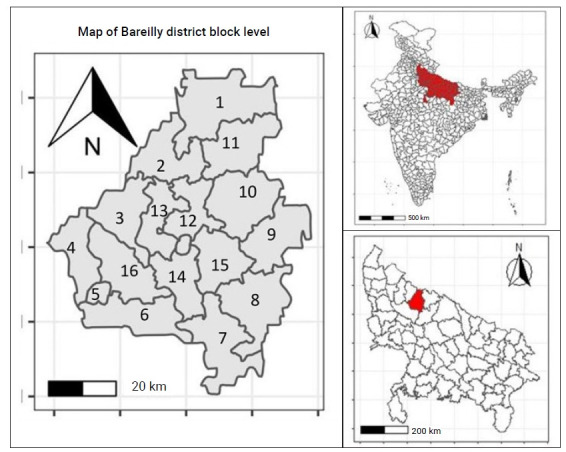
The aim of this study was to explore the spatiotemporal clustering of reported malaria cases and to study the effects of various environmental and physiographic factors on malaria incidence in Bareilly district, Uttar Pradesh, India.
Malaria surveillance data were collected from the state health department and cleaned into an analyzable format. These data were analyzed along with meteorological, physiographic, and 2019 population data, which were obtained from the Indian Meteorological Department, National Aeronautics and Space Administration web portal, the Bhuvan platform of the Indian Space Research Organization, and the 2011 Census of India.
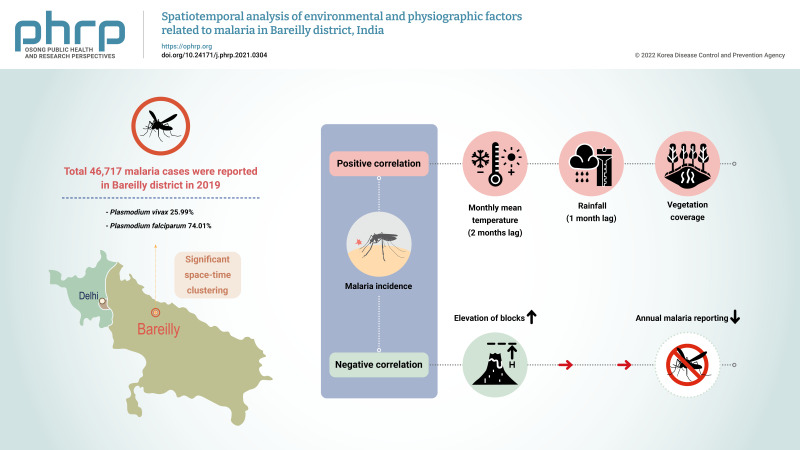
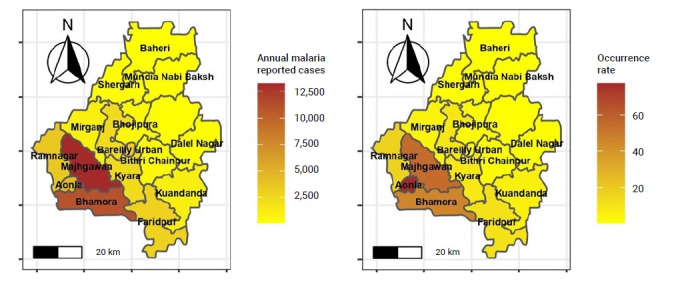
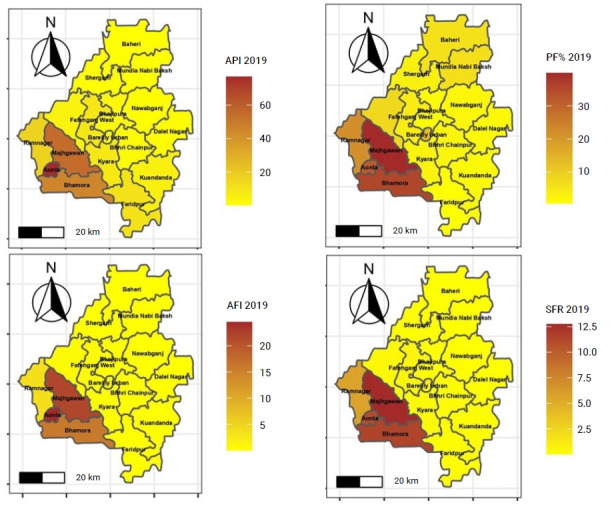
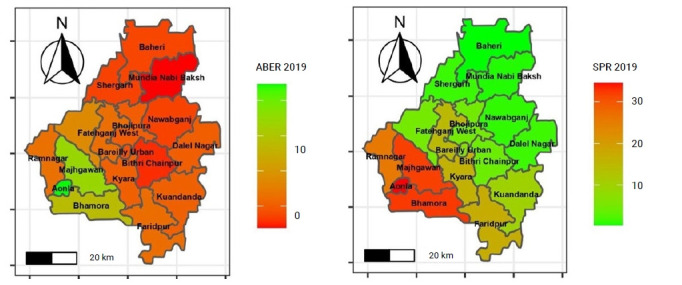
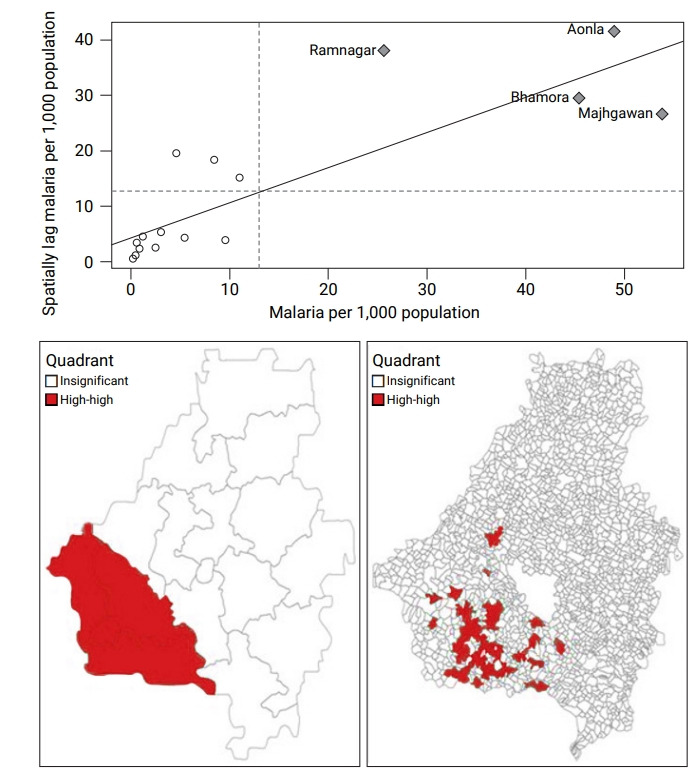
In total, 46,717 malaria cases were reported in Bareilly district in 2019, of which 25.99% were Plasmodium vivax cases and 74.01% were P. falciparum cases. The reported malaria cases in the district showed clustering, with significant spatial autocorrelation (Moran's I value=0.63), and space-time clustering (p<0.01). A significant positive correlation was found between monthly malaria incidence and the monthly mean temperature (with a lag of 1-2 months) and rainfall (with a lag of 1 month). A significant negative correlation was detected between the elevation of blocks (i.e., intermediate-level administrative districts) and annual malaria reporting.
The presence of space-time clustering of malaria cases and its correlation with meteorological and physiographic factors indicate that routine spatial analysis of the surveillance data could help control and manage malaria outbreaks in the district.
本研究旨在探讨印度北方邦巴雷利地区报告的疟疾病例的时空聚集情况,并研究各种环境和自然地理因素对疟疾发病率的影响。
从该邦卫生部门收集疟疾监测数据,并清理成可分析的格式。这些数据与气象、自然地理和2019年人口数据一起进行分析,这些数据分别来自印度气象部门、美国国家航空航天局门户网站、印度空间研究组织的Bhuvan平台以及2011年印度人口普查。
2019年巴雷利地区共报告了46717例疟疾病例,其中间日疟病例占25.99%,恶性疟病例占74.01%。该地区报告的疟疾病例呈现聚集性,具有显著的空间自相关性(莫兰指数I值 = 0.63)和时空聚集性(p < 0.01)。发现每月疟疾发病率与月平均温度(滞后1 - 2个月)和降雨量(滞后1个月)之间存在显著正相关。在街区(即中级行政区)海拔与年度疟疾报告之间检测到显著负相关。
疟疾病例的时空聚集及其与气象和自然地理因素的相关性表明,对监测数据进行常规空间分析有助于该地区疟疾疫情的控制和管理。