• 文献检索
  • 文档翻译
  • 深度研究
  • 学术资讯
  • Suppr Zotero 插件Zotero 插件
  • 邀请有礼
  • 套餐&价格
  • 历史记录
应用&插件
Suppr Zotero 插件Zotero 插件浏览器插件Mac 客户端Windows 客户端微信小程序
定价
高级版会员购买积分包购买API积分包
服务
文献检索文档翻译深度研究API 文档MCP 服务
关于我们
关于 Suppr公司介绍联系我们用户协议隐私条款
关注我们

Suppr 超能文献

核心技术专利:CN118964589B侵权必究
粤ICP备2023148730 号-1Suppr @ 2026

文献检索

告别复杂PubMed语法,用中文像聊天一样搜索,搜遍4000万医学文献。AI智能推荐,让科研检索更轻松。

立即免费搜索

文件翻译

保留排版,准确专业,支持PDF/Word/PPT等文件格式,支持 12+语言互译。

免费翻译文档

深度研究

AI帮你快速写综述,25分钟生成高质量综述,智能提取关键信息,辅助科研写作。

立即免费体验

泰国达府疟疾的时空流行病学、环境相关性和人口统计学研究(2012-2015 年)。

Spatiotemporal epidemiology, environmental correlates, and demography of malaria in Tak Province, Thailand (2012-2015).

机构信息

Mahidol Oxford Tropical Medicine Research Unit (MORU), Faculty of Tropical Medicine, Mahidol University, Bangkok, Thailand.

Department of Tropical Hygiene, Faculty of Tropical Medicine, Mahidol University, Bangkok, Thailand.

出版信息

Malar J. 2019 Jul 16;18(1):240. doi: 10.1186/s12936-019-2871-2.

DOI:10.1186/s12936-019-2871-2
PMID:31311606
原文链接:https://pmc.ncbi.nlm.nih.gov/articles/PMC6636027/
Abstract

BACKGROUND

Tak Province, at the Thai-Myanmar border, is one of three high malaria incidence areas in Thailand. This study aimed to describe and identify possible factors driving the spatiotemporal trends of disease incidence from 2012 to 2015.

METHODS

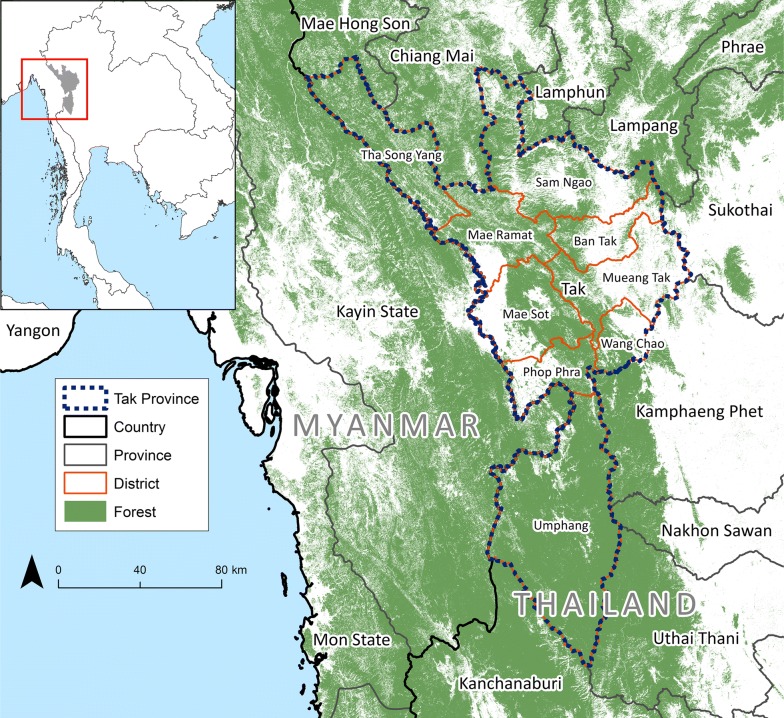
Climate variables and forest cover were correlated with malaria incidence using Pearson's r. Statistically significant clusters of high (hot spots) and low (cold spots) annual parasite incidence per 1000 population (API) were identified using Getis-Ord Gi* statistic.

RESULTS

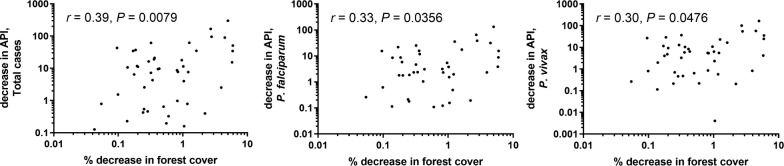
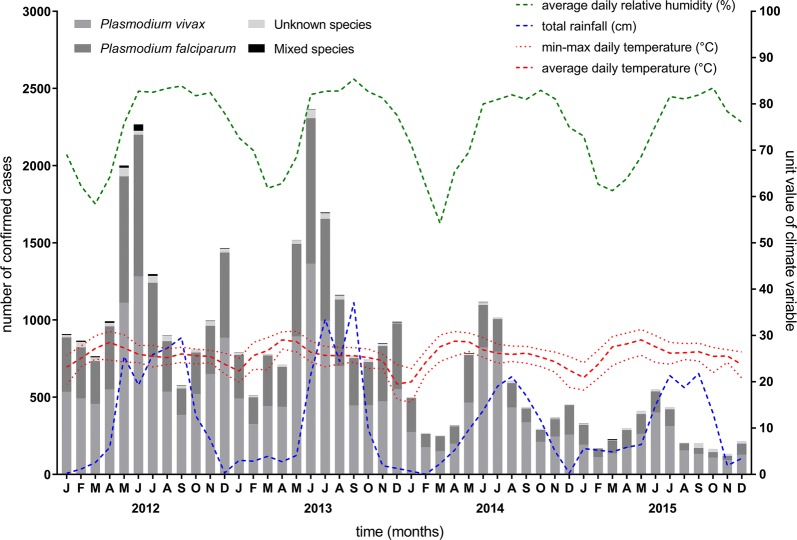
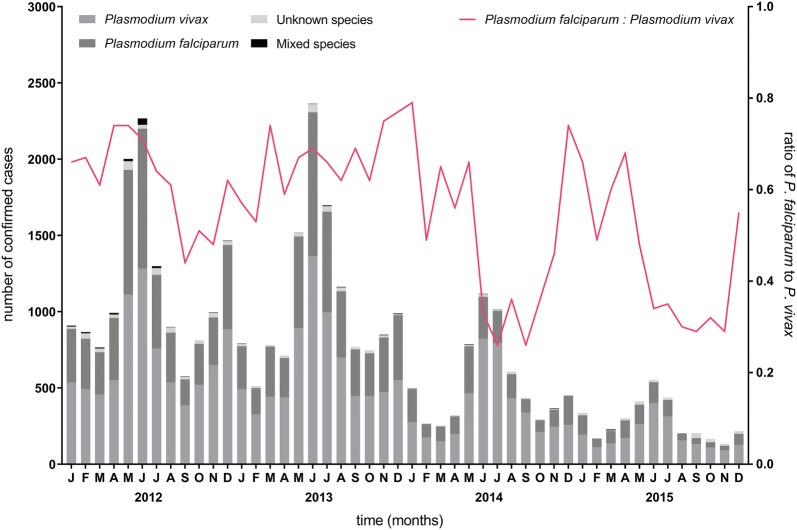
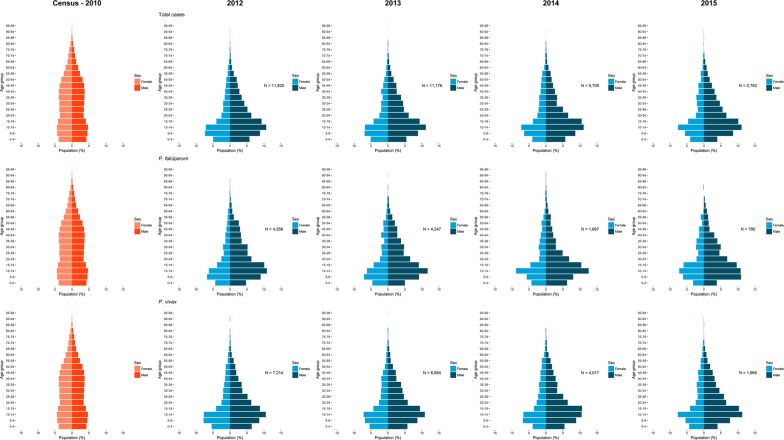
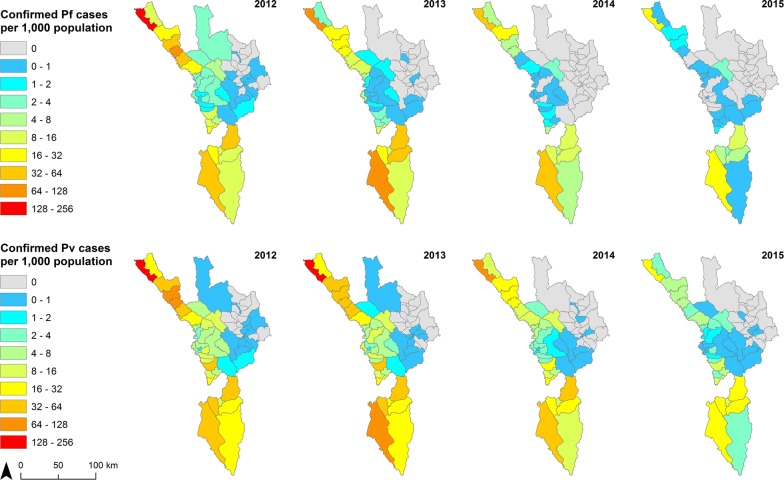
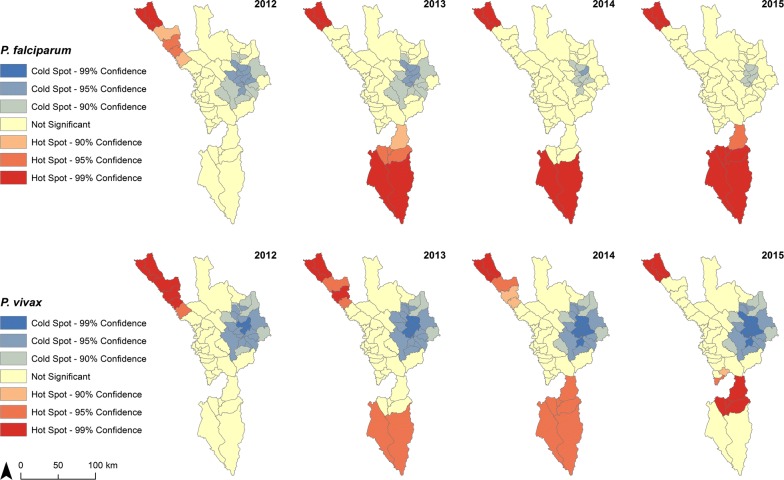
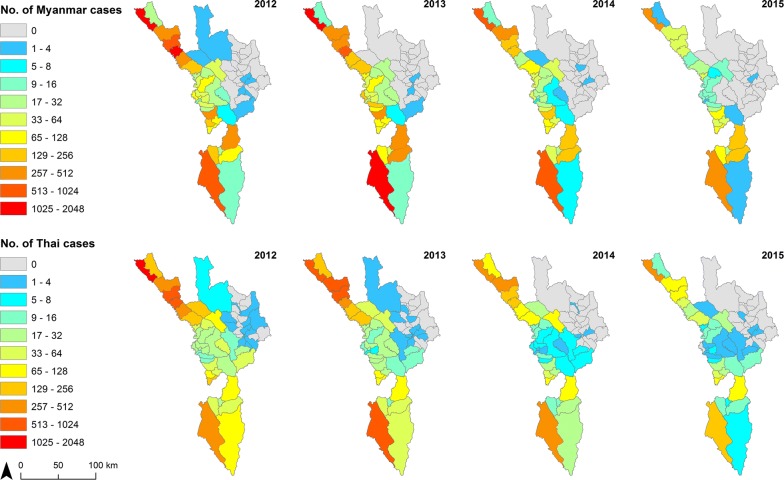
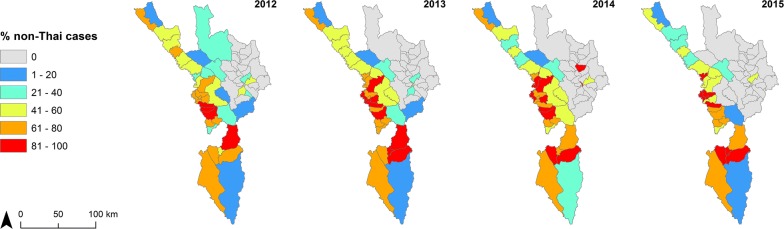
The total number of confirmed cases declined by 76% from 2012 to 2015 (Plasmodium falciparum by 81%, Plasmodium vivax by 73%). Incidence was highly seasonal with two main annual peaks. Most cases were male (62.75%), ≥ 15 years (56.07%), and of Myanmar (56.64%) or Thai (39.25%) nationality. Median temperature (1- and 2-month lags), average temperature (1- and 2-month lags) and average relative humidity (2- and 3-month lags) correlated positively with monthly total, P. falciparum and P. vivax API. Total rainfall in the same month correlated with API for total cases and P. vivax but not P. falciparum. At sub-district level, percentage forest cover had a low positive correlation with P. falciparum, P. vivax, and total API in most years. There was a decrease in API in most sub-districts for both P. falciparum and P. vivax. Sub-districts with the highest API were in the Tha Song Yang and Umphang Districts along the Thai-Myanmar border. Annual hot spots were mostly in the extreme north and south of the province.

CONCLUSIONS

There has been a large decline in reported clinical malaria from 2012 to 2015 in Tak Province. API was correlated with monthly climate and annual forest cover but these did not account for the trends over time. Ongoing elimination interventions on one or both sides of the border are more likely to have been the cause but it was not possible to assess this due to a lack of suitable data. Two main hot spot areas were identified that could be targeted for intensified elimination activities.

摘要

背景

泰国达府位于泰缅边境,是该国三个疟疾高发地区之一。本研究旨在描述并确定 2012 年至 2015 年期间疾病发病率的时空趋势的可能驱动因素。

方法

使用 Pearson's r 相关分析气候变量和森林覆盖与疟疾发病率的关系。使用 Getis-Ord Gi* 统计识别具有高(热点)和低(冷点)年寄生虫发病率每 1000 人口(API)的统计学显著聚类。

结果

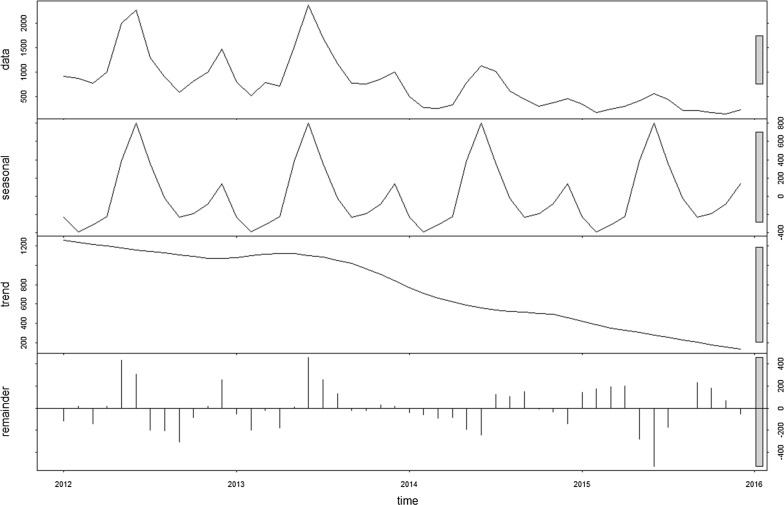
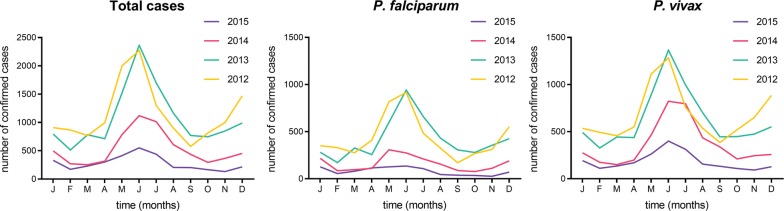
2012 年至 2015 年期间,确诊病例总数下降了 76%(间日疟原虫下降了 81%,卵形疟原虫下降了 73%)。发病率具有很强的季节性,有两个主要的年度高峰。大多数病例为男性(62.75%)、≥15 岁(56.07%)、缅甸(56.64%)或泰国(39.25%)国籍。中位数温度(1 个月和 2 个月滞后)、平均温度(1 个月和 2 个月滞后)和平均相对湿度(2 个月和 3 个月滞后)与每月总 API、间日疟原虫 API 和卵形疟原虫 API 呈正相关。同月总降雨量与总病例 API 以及卵形疟原虫 API 相关,但与间日疟原虫 API 不相关。在分区一级,大多数年份森林覆盖率的百分比与间日疟原虫、卵形疟原虫和总 API 呈低正相关。间日疟原虫和卵形疟原虫的 API 大多数分区都有所下降。API 最高的分区位于泰缅边境的 Tha Song Yang 和 Umphang 区。年度热点主要分布在该省的最北部和最南部。

结论

2012 年至 2015 年期间,达府报告的临床疟疾病例大幅下降。API 与每月气候和年度森林覆盖相关,但这些因素并不能解释随时间的趋势。边界两侧正在进行的消除干预措施更有可能是导致这种情况的原因,但由于缺乏合适的数据,无法对此进行评估。确定了两个主要的热点地区,可以针对这些地区开展强化消除活动。
https://cdn.ncbi.nlm.nih.gov/pmc/blobs/4742/6636027/9c9353ac359a/12936_2019_2871_Fig12_HTML.jpg
https://cdn.ncbi.nlm.nih.gov/pmc/blobs/4742/6636027/2156b4761e82/12936_2019_2871_Fig1_HTML.jpg
https://cdn.ncbi.nlm.nih.gov/pmc/blobs/4742/6636027/0296f5e4ffc1/12936_2019_2871_Fig2_HTML.jpg
https://cdn.ncbi.nlm.nih.gov/pmc/blobs/4742/6636027/23ec6091a5d0/12936_2019_2871_Fig3_HTML.jpg
https://cdn.ncbi.nlm.nih.gov/pmc/blobs/4742/6636027/cbe4c918471c/12936_2019_2871_Fig4_HTML.jpg
https://cdn.ncbi.nlm.nih.gov/pmc/blobs/4742/6636027/42a1db658ee0/12936_2019_2871_Fig5_HTML.jpg
https://cdn.ncbi.nlm.nih.gov/pmc/blobs/4742/6636027/6407236b7f93/12936_2019_2871_Fig6_HTML.jpg
https://cdn.ncbi.nlm.nih.gov/pmc/blobs/4742/6636027/390c15c537f1/12936_2019_2871_Fig7_HTML.jpg
https://cdn.ncbi.nlm.nih.gov/pmc/blobs/4742/6636027/27d2933f7ee7/12936_2019_2871_Fig8_HTML.jpg
https://cdn.ncbi.nlm.nih.gov/pmc/blobs/4742/6636027/3c2f99f0bb0c/12936_2019_2871_Fig9_HTML.jpg
https://cdn.ncbi.nlm.nih.gov/pmc/blobs/4742/6636027/f7e33902afd3/12936_2019_2871_Fig10_HTML.jpg
https://cdn.ncbi.nlm.nih.gov/pmc/blobs/4742/6636027/a2a331e05fc9/12936_2019_2871_Fig11_HTML.jpg
https://cdn.ncbi.nlm.nih.gov/pmc/blobs/4742/6636027/9c9353ac359a/12936_2019_2871_Fig12_HTML.jpg
https://cdn.ncbi.nlm.nih.gov/pmc/blobs/4742/6636027/2156b4761e82/12936_2019_2871_Fig1_HTML.jpg
https://cdn.ncbi.nlm.nih.gov/pmc/blobs/4742/6636027/0296f5e4ffc1/12936_2019_2871_Fig2_HTML.jpg
https://cdn.ncbi.nlm.nih.gov/pmc/blobs/4742/6636027/23ec6091a5d0/12936_2019_2871_Fig3_HTML.jpg
https://cdn.ncbi.nlm.nih.gov/pmc/blobs/4742/6636027/cbe4c918471c/12936_2019_2871_Fig4_HTML.jpg
https://cdn.ncbi.nlm.nih.gov/pmc/blobs/4742/6636027/42a1db658ee0/12936_2019_2871_Fig5_HTML.jpg
https://cdn.ncbi.nlm.nih.gov/pmc/blobs/4742/6636027/6407236b7f93/12936_2019_2871_Fig6_HTML.jpg
https://cdn.ncbi.nlm.nih.gov/pmc/blobs/4742/6636027/390c15c537f1/12936_2019_2871_Fig7_HTML.jpg
https://cdn.ncbi.nlm.nih.gov/pmc/blobs/4742/6636027/27d2933f7ee7/12936_2019_2871_Fig8_HTML.jpg
https://cdn.ncbi.nlm.nih.gov/pmc/blobs/4742/6636027/3c2f99f0bb0c/12936_2019_2871_Fig9_HTML.jpg
https://cdn.ncbi.nlm.nih.gov/pmc/blobs/4742/6636027/f7e33902afd3/12936_2019_2871_Fig10_HTML.jpg
https://cdn.ncbi.nlm.nih.gov/pmc/blobs/4742/6636027/a2a331e05fc9/12936_2019_2871_Fig11_HTML.jpg
https://cdn.ncbi.nlm.nih.gov/pmc/blobs/4742/6636027/9c9353ac359a/12936_2019_2871_Fig12_HTML.jpg

相似文献

1
Spatiotemporal epidemiology, environmental correlates, and demography of malaria in Tak Province, Thailand (2012-2015).泰国达府疟疾的时空流行病学、环境相关性和人口统计学研究(2012-2015 年)。
Malar J. 2019 Jul 16;18(1):240. doi: 10.1186/s12936-019-2871-2.
2
Mapping malaria transmission foci in Northeast Thailand from 2011 to 2021: approaching elimination in a hypoendemic area.2011年至2021年泰国东北部疟疾传播病灶的测绘:在低流行地区接近消除疟疾
Malar J. 2024 Jul 17;23(1):212. doi: 10.1186/s12936-024-05026-6.
3
Imported Plasmodium falciparum and locally transmitted Plasmodium vivax: cross-border malaria transmission scenario in northwestern Thailand.输入性恶性疟原虫和本地传播的间日疟原虫:泰国西北部的跨境疟疾传播情况
Malar J. 2017 Jun 21;16(1):258. doi: 10.1186/s12936-017-1900-2.
4
Microgeography and molecular epidemiology of malaria at the Thailand-Myanmar border in the malaria pre-elimination phase.疟疾消除前阶段泰国-缅甸边境疟疾的微观地理学与分子流行病学
Malar J. 2015 May 13;14:198. doi: 10.1186/s12936-015-0712-5.
5
Impact of climate variability on Plasmodium vivax and Plasmodium falciparum malaria in Yunnan Province, China.气候变化对云南省间日疟原虫和恶性疟原虫疟疾的影响。
Parasit Vectors. 2013 Dec 17;6:357. doi: 10.1186/1756-3305-6-357.
6
Spatio-temporal distribution of Plasmodium falciparum and p. Vivax malaria in Thailand.泰国恶性疟原虫和间日疟原虫疟疾的时空分布
Am J Trop Med Hyg. 2005 Mar;72(3):256-62.
7
Spatiotemporal dynamics of malaria in Banmauk Township, Sagaing region of Northern Myanmar: characteristics, trends, and risk factors.缅甸北部实皆地区班茂镇疟疾的时空动态:特征、趋势和危险因素。
BMC Infect Dis. 2022 Jul 28;22(1):653. doi: 10.1186/s12879-022-07634-6.
8
Highly heterogeneous residual malaria risk in western Thailand.泰国西部高度异质的疟疾残留风险。
Int J Parasitol. 2019 May;49(6):455-462. doi: 10.1016/j.ijpara.2019.01.004. Epub 2019 Apr 4.
9
From control to elimination: a spatial-temporal analysis of malaria along the China-Myanmar border.从控制到消除:中缅边境地区疟疾的时空分析。
Infect Dis Poverty. 2020 Nov 19;9(1):158. doi: 10.1186/s40249-020-00777-1.
10
Prevalence and seroprevalence of Plasmodium infection in Myanmar reveals highly heterogeneous transmission and a large hidden reservoir of infection.缅甸疟原虫感染的流行率和血清阳性率显示出高度异质性的传播和大量隐藏的感染库。
PLoS One. 2021 Jun 9;16(6):e0252957. doi: 10.1371/journal.pone.0252957. eCollection 2021.

引用本文的文献

1
Community acceptance of Ivermectin mass drug administration for malaria in Southern Thailand.泰国南部社区对伊维菌素大规模药物管理用于疟疾防治的接受度。
Sci Rep. 2025 Aug 8;15(1):29026. doi: 10.1038/s41598-025-14575-y.
2
Spatio-temporal characterization of malaria prevalence in a peri-urban resource limited setting of Western Kenya Highlands.肯尼亚西部高地城郊资源有限地区疟疾流行情况的时空特征分析
Afr Health Sci. 2024 Sep;24(3):98-111. doi: 10.4314/ahs.v24i3.14.
3
Slide positivity, trends, and risk factors of febrile Plasmodium vivax malaria along the Thailand-Myanmar border, 2018-2023.

本文引用的文献

1
Mapping imported malaria in Bangladesh using parasite genetic and human mobility data.利用寄生虫遗传和人类流动数据绘制孟加拉国输入性疟疾图。
Elife. 2019 Apr 2;8:e43481. doi: 10.7554/eLife.43481.
2
Impact of Weekly Climatic Variables on Weekly Malaria Incidence throughout Thailand: A Country-Based Six-Year Retrospective Study.泰国每周气候变量对每周疟疾发病率的影响:一项基于国家的六年回顾性研究。
J Environ Public Health. 2018 Dec 4;2018:8397815. doi: 10.1155/2018/8397815. eCollection 2018.
3
Mapping malaria by combining parasite genomic and epidemiologic data.
2018 - 2023年泰国-缅甸边境间发热性间日疟原虫疟疾的玻片阳性率、趋势及风险因素
Infect Dis Poverty. 2025 Aug 6;14(1):82. doi: 10.1186/s40249-025-01350-4.
4
Adolescents' Knowledge on Climate Change: A Nationwide Study in Indonesia.青少年对气候变化的认知:印度尼西亚的一项全国性研究。
Int J Environ Res Public Health. 2025 Apr 5;22(4):571. doi: 10.3390/ijerph22040571.
5
Epidemiological Changes in Acute Febrile Diseases after the COVID-19 Pandemic in Thailand.泰国新冠疫情大流行后急性发热性疾病的流行病学变化
Am J Trop Med Hyg. 2024 Nov 19;112(2):414-421. doi: 10.4269/ajtmh.24-0017. Print 2025 Feb 5.
6
Early warning systems for malaria outbreaks in Thailand: an anomaly detection approach.泰国疟疾疫情爆发的预警系统:异常检测方法。
Malar J. 2024 Jan 8;23(1):11. doi: 10.1186/s12936-024-04837-x.
7
Assessment of malaria risk in Southeast Asia: a systematic review.东南亚疟疾风险评估:系统综述。
Malar J. 2023 Nov 8;22(1):339. doi: 10.1186/s12936-023-04772-3.
8
Gametocyte prevalence and risk factors of P. falciparum malaria patients admitted at the Hospital for Tropical Diseases, Thailand: a 20-year retrospective study.在泰国热带病医院住院的疟疾病人疟原虫配子体患病率和风险因素:一项 20 年回顾性研究。
Malar J. 2023 Oct 23;22(1):321. doi: 10.1186/s12936-023-04728-7.
9
The relationship between climate change and malaria in South-East Asia: A systematic review of the evidence.气候变化与东南亚疟疾的关系:系统评价证据。
F1000Res. 2023 Jul 21;11:1555. doi: 10.12688/f1000research.125294.2. eCollection 2022.
10
'Forest malaria' in Myanmar? Tracking transmission landscapes in a diversity of environments.缅甸的“森林疟疾”?在多样化环境中追踪传播景观。
Parasit Vectors. 2023 Sep 12;16(1):324. doi: 10.1186/s13071-023-05915-w.
结合寄生虫基因组和流行病学数据绘制疟疾分布图。
BMC Med. 2018 Oct 18;16(1):190. doi: 10.1186/s12916-018-1181-9.
4
Prevalence of asymptomatic Plasmodium infections with sub-microscopic parasite densities in the northwestern border of Thailand: a potential threat to malaria elimination.无症状的疟原虫感染在泰国西北部边境的流行情况:对疟疾消除的潜在威胁。
Malar J. 2018 Sep 12;17(1):329. doi: 10.1186/s12936-018-2476-1.
5
Mapping the stability of malaria hotspots in Bangladesh from 2013 to 2016.绘制孟加拉国 2013 年至 2016 年疟疾热点地区的稳定性图谱。
Malar J. 2018 Jul 11;17(1):259. doi: 10.1186/s12936-018-2405-3.
6
Effect of generalised access to early diagnosis and treatment and targeted mass drug administration on Plasmodium falciparum malaria in Eastern Myanmar: an observational study of a regional elimination programme.缅甸东部普遍获得早期诊断和治疗以及有针对性的大规模药物治疗对恶性疟原虫疟疾的影响:区域消除规划的观察性研究。
Lancet. 2018 May 12;391(10133):1916-1926. doi: 10.1016/S0140-6736(18)30792-X. Epub 2018 Apr 24.
7
Imported Plasmodium falciparum and locally transmitted Plasmodium vivax: cross-border malaria transmission scenario in northwestern Thailand.输入性恶性疟原虫和本地传播的间日疟原虫:泰国西北部的跨境疟疾传播情况
Malar J. 2017 Jun 21;16(1):258. doi: 10.1186/s12936-017-1900-2.
8
Insecticide resistance in malaria vectors along the Thailand-Myanmar border.泰国-缅甸边境地区疟疾传播媒介的杀虫剂抗性
Parasit Vectors. 2017 Mar 31;10(1):165. doi: 10.1186/s13071-017-2102-z.
9
An assessment of national surveillance systems for malaria elimination in the Asia Pacific.亚太地区疟疾消除国家监测系统评估
Malar J. 2017 Mar 21;16(1):127. doi: 10.1186/s12936-017-1774-3.
10
Plasmodium vivax Malaria in Cambodia.柬埔寨的间日疟原虫疟疾
Am J Trop Med Hyg. 2016 Dec 28;95(6 Suppl):97-107. doi: 10.4269/ajtmh.16-0208. Epub 2016 Oct 5.