Xue Mei, Xiang An, Guo Yanhai, Wang Li, Wang Rou, Wang Wenwen, Ji Gang, Lu Zifan
Center for Translational Medicine, The First Affiliated Hospital of Xi'an Jiaotong University Xi'an 710061 Shaanxi People's Republic of China.
Department of Biopharmaceutics, School of Pharmacy, Air Force Medical University (The Fourth Military Medical University) Xi'an 710032 Shaanxi People's Republic of China
RSC Adv. 2019 Nov 25;9(66):38496-38504. doi: 10.1039/c9ra08285a.
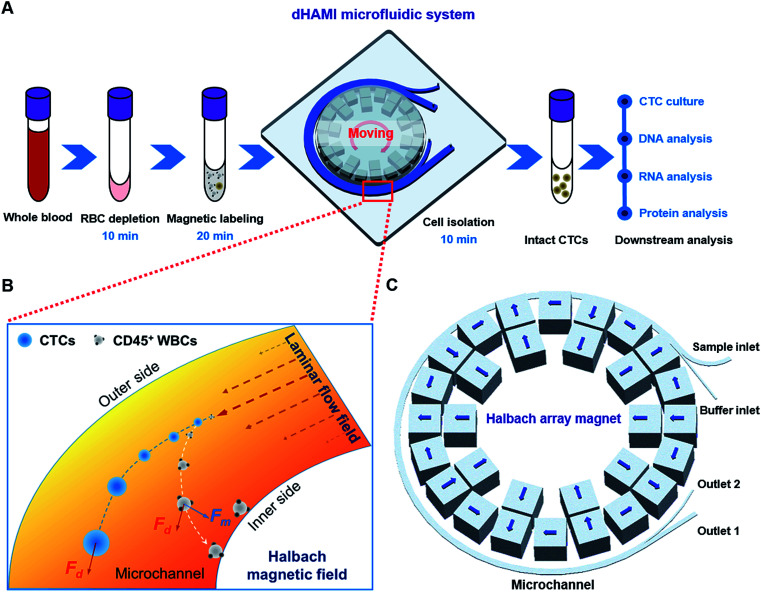
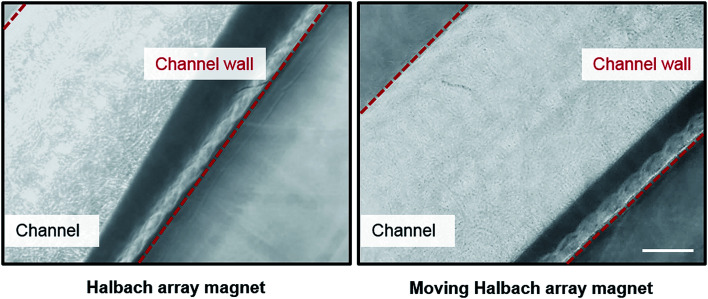
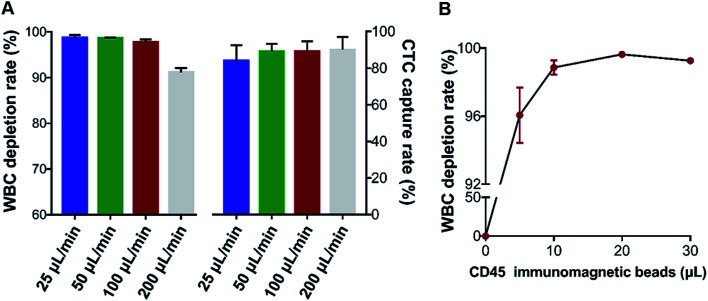
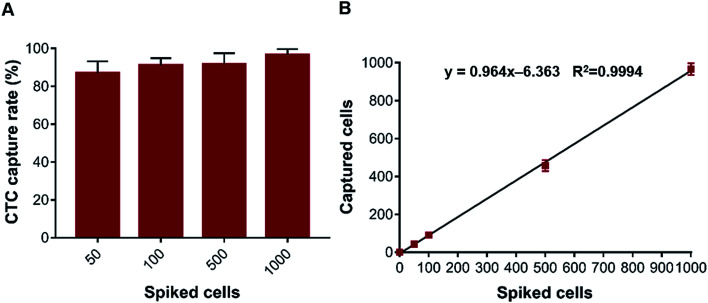
Circulating tumor cells (CTCs), the most representative rare cells in peripheral blood, have received great attention due to their clinical utility in liquid biopsy. The downstream analysis of intact CTCs isolated from peripheral blood provides important clinical information for personalized medicine. However, current CTC isolation and detection methods have been challenged by their extreme rarity and heterogeneity. In this study, we developed a novel microfluidic system with a continuously moving Halbach array magnet (dHAMI microfluidic system) for negative isolation CTCs from whole blood, which aimed to capture non-target white blood cells (WBCs) and elute target CTCs. The dynamic and continuous movement of the Halbach array magnet generated a continuous magnetic force acting on the magnetic bead-labelled WBCs in the continuous-flow fluid to negatively exclude the WBCs from the CTCs. Furthermore, the continuously moving magnetic field effectively eliminated the effect of magnetic bead aggregation on the fluid flow to realize the continuous-flow separation of the CTCs without a sample loading volume limitation. The experimental procedure for CTC negative isolation using the dHAMI microfluidic system could be completed within 40 min. Under the optimized experimental conditions of the dHAMI microfluidic system, including the flow rate and concentration of the immunomagnetic bead, the average CTC capture rate over a range of spiked cell numbers (50-1000 cancer cells per mL) was up to 91.6% at a flow rate of 100 μL min. Finally, the CTCs were successfully detected in 10 of 10 (100%) blood samples from patients with cancer. Therefore, the dHAMI microfluidic system could effectively isolate intact and heterogeneous CTCs for downstream cellular and molecular analyses, and this robust microfluidic platform with an excellent magnetic manipulation performance also has great application potential for the separation of other rare cells.
循环肿瘤细胞(CTCs)是外周血中最具代表性的稀有细胞,因其在液体活检中的临床应用价值而备受关注。从外周血中分离出完整的CTCs进行下游分析可为个性化医疗提供重要的临床信息。然而,目前的CTCs分离和检测方法因其极端稀有性和异质性而面临挑战。在本研究中,我们开发了一种新型微流控系统,该系统配备连续移动的哈尔巴赫阵列磁体(dHAMI微流控系统),用于从全血中阴性分离CTCs,其目的是捕获非靶标白细胞(WBCs)并洗脱靶标CTCs。哈尔巴赫阵列磁体的动态连续移动在连续流动的流体中产生连续的磁力,作用于磁珠标记的WBCs,从而从CTCs中阴性排除WBCs。此外,连续移动的磁场有效消除了磁珠聚集对流体流动的影响,实现了CTCs的连续流动分离,且无样品加载体积限制。使用dHAMI微流控系统进行CTCs阴性分离的实验过程可在40分钟内完成。在dHAMI微流控系统的优化实验条件下,包括免疫磁珠的流速和浓度,在一系列加标细胞数(每毫升50 - 1000个癌细胞)范围内,流速为100 μL/min时,平均CTCs捕获率高达91.6%。最后,在10例癌症患者的10份血样(100%)中成功检测到CTCs。因此,dHAMI微流控系统可有效分离完整且异质的CTCs用于下游细胞和分子分析,这种具有出色磁操控性能的强大微流控平台在分离其他稀有细胞方面也具有巨大的应用潜力。