Wang Hua, Hu Jia-Hui, Liu Cui-Chai, Liu Min, Liu Zheng, Sun Li-Xin
Department of Pharmaceutical Analysis, School of Pharmacy, Shenyang Pharmaceutical University Shenyang 110016 China
GLP Center, School of Life Science and Biopharmaceutics, Shenyang Pharmaceutical University Shenyang China.
RSC Adv. 2018 May 8;8(30):16645-16656. doi: 10.1039/c8ra00242h. eCollection 2018 May 3.
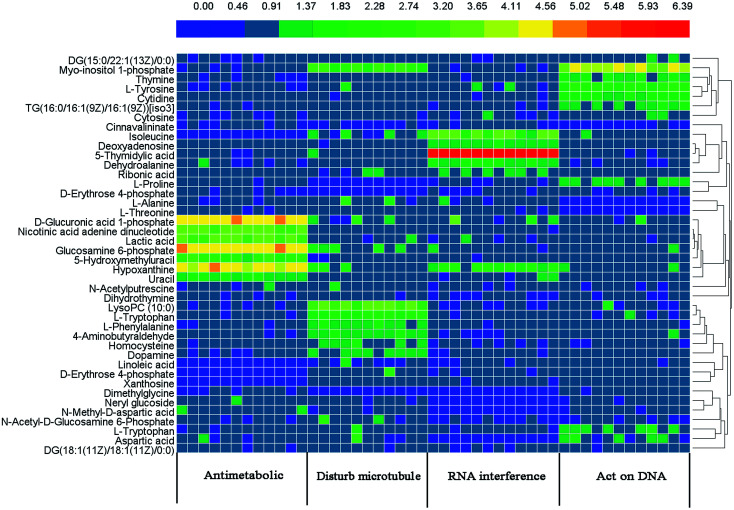
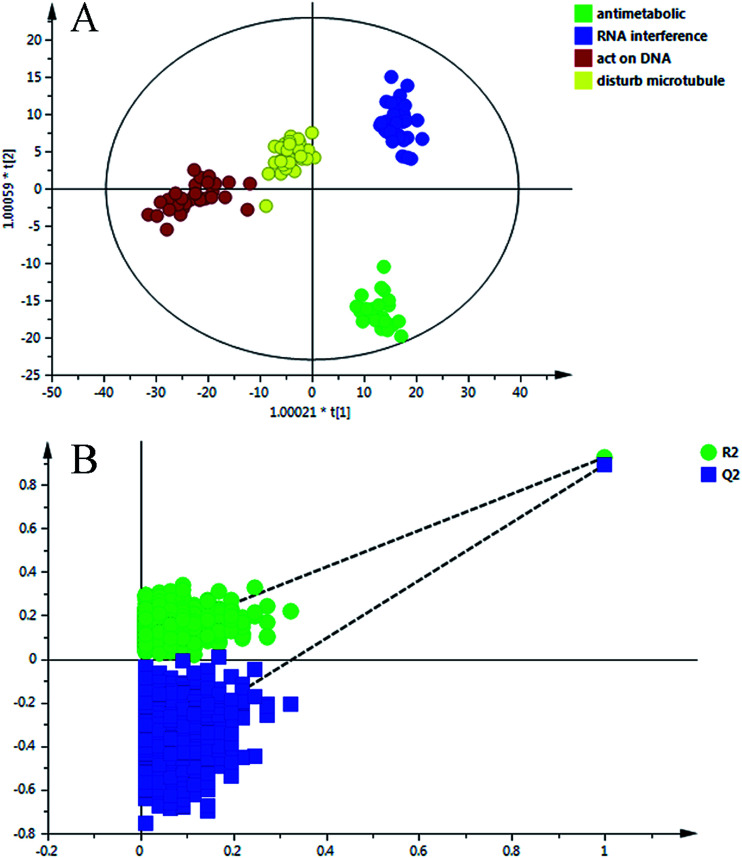
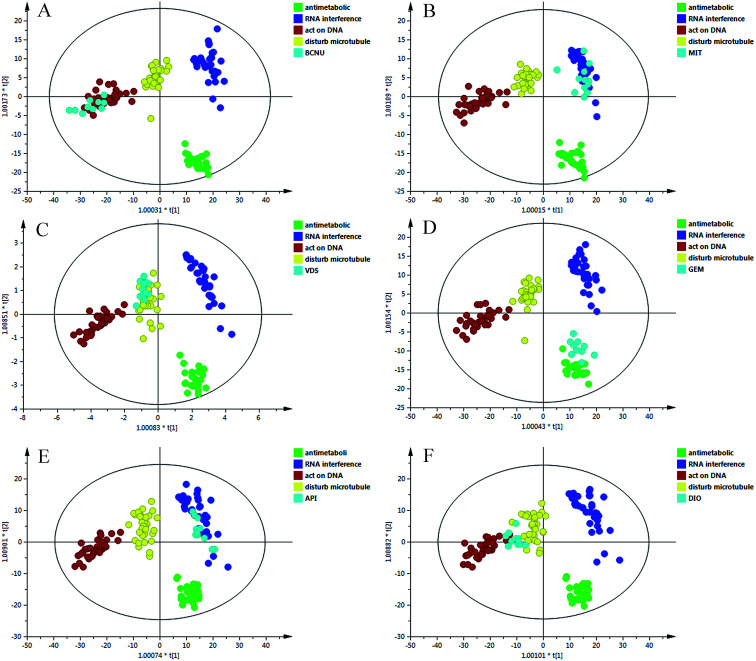
In the process of anticancer drug development, research on the mechanism of action remains a major obstacle. In the present study, a cell metabolic profiling based discriminatory model was designed to give general direction on anticancer candidate mechanisms. Firstly, ultra-performance liquid chromatography in tandem with high-definition mass spectrometry was applied to obtain a comprehensive metabolic view of 12 human tumor cells. Secondly, multivariate data analysis was used to assess the metabolites' variations, and 42 metabolites were identified as the main contributors to the discrimination of different groups. Then a metabolite-based prediction model was constructed for the first time and verified by cross validation ( = 0.909 and = 0.869) and a permutation test ( = 0.0871 and = -0.4360). To validate if the model can be applied for mechanism prediction, 4 independent sample sets were used to train the model and the data dots of different drugs were located in different regions. Finally, the model was applied to predict the anticancer mechanism of two natural compounds and the results were consistent with several other studies. Overall, this is the first experimental evidence which reveals that a metabolic profiling based prediction model has good performance in anticancer mechanism research, and thus it may be a new method for rapid mechanism screening.
在抗癌药物研发过程中,作用机制的研究仍然是一个主要障碍。在本研究中,设计了一种基于细胞代谢谱的判别模型,为抗癌候选机制提供总体方向。首先,采用超高效液相色谱串联高分辨质谱法,获得了12种人类肿瘤细胞的全面代谢图谱。其次,运用多变量数据分析评估代谢物的变化,确定了42种代谢物是区分不同组别的主要贡献因素。然后首次构建了基于代谢物的预测模型,并通过交叉验证( = 0.909和 = 0.869)和置换检验( = 0.0871和 = -0.4360)进行验证。为验证该模型是否可用于机制预测,使用4个独立样本集训练模型,不同药物的数据点位于不同区域。最后,将该模型应用于预测两种天然化合物的抗癌机制,结果与其他几项研究一致。总体而言,这是首个实验证据,表明基于代谢谱的预测模型在抗癌机制研究中具有良好性能,因此可能是一种快速机制筛选的新方法。