Kim Kiho, Lee Jinseong, Ryu Seokgyu, Kim Jooheon
School of Chemical Engineering & Materials Science, Chung-Ang University Seoul 06974 Republic of Korea
DREAMTECH Co., Ltd Gunpo 15849 Republic of Korea.
RSC Adv. 2018 Mar 12;8(18):9933-9940. doi: 10.1039/c8ra00967h. eCollection 2018 Mar 5.
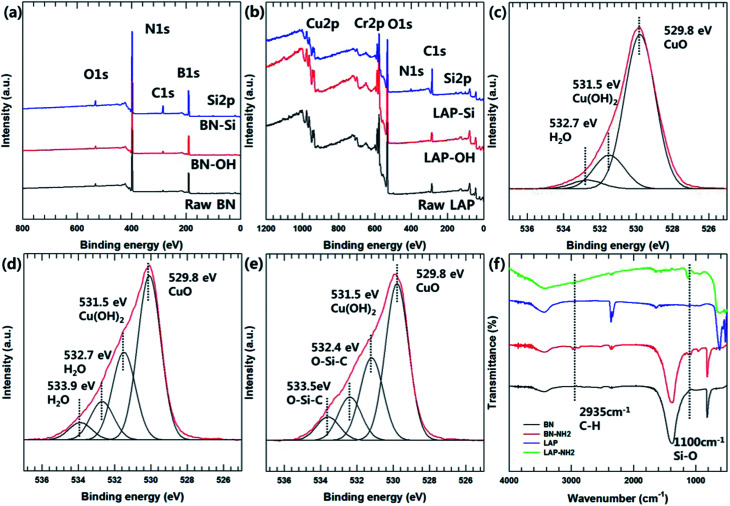
Boron nitride (BN) and laser activate particles (LAPs) were surface-modified base treatment and by using a silane coupling agent in order to confer functionality and enhance the interfacial affinity of these particles for a polymer matrix. The introduction of LAP and BN caused severe deterioration of the mechanical properties of the filler-polymer composite by acting as defects and due to the poor interface with polyphenylene sulfide (PPS), used as the polymeric matrix. As expected, the thermal and mechanical properties were enhanced surface modification, whereas the tensile strength of the composites with the surface-modified fillers remained lower than that of neat PPS. The BN/LAP binary filler system showed little influence on the mechanical properties of the composite. However, the incorporation of a small amount of LAP into the BN composite produced a slight improvement of the thermal conductivity when the total filler content was maintained. Moreover, LAP leads the metal plating at the laser irradiated surface. Thus, the BN/LAP/PPS composite was used to fabricate a circuit board laser direct structuring (LDS) and electroless plating for potential light emitting diode (LED) application.
通过碱处理并使用硅烷偶联剂对氮化硼(BN)和激光活化颗粒(LAPs)进行表面改性,以赋予这些颗粒功能性并增强它们与聚合物基体的界面亲和力。LAP和BN的引入,由于充当缺陷以及与用作聚合物基体的聚苯硫醚(PPS)界面较差,导致填充聚合物复合材料的机械性能严重恶化。正如预期的那样,表面改性提高了热性能和机械性能,然而,具有表面改性填料的复合材料的拉伸强度仍低于纯PPS的拉伸强度。BN/LAP二元填料体系对复合材料的机械性能影响很小。然而,当保持总填料含量不变时,向BN复合材料中加入少量LAP会使热导率略有提高。此外,LAP会导致激光照射表面金属镀覆。因此,BN/LAP/PPS复合材料被用于通过激光直接结构化(LDS)和化学镀来制造电路板,用于潜在的发光二极管(LED)应用。