Kadi Adnan A, Attwa Mohamed W, Darwish Hany W
Department of Pharmaceutical Chemistry, College of Pharmacy, King Saud University P. O. Box 2457 Riyadh 11451 Kingdom of Saudi Arabia
Analytical Chemistry Department, Faculty of Pharmacy, Cairo University Kasr El-Aini St. Cairo 11562 Egypt.
RSC Adv. 2018 Jan 3;8(3):1182-1190. doi: 10.1039/c7ra10533a. eCollection 2018 Jan 2.
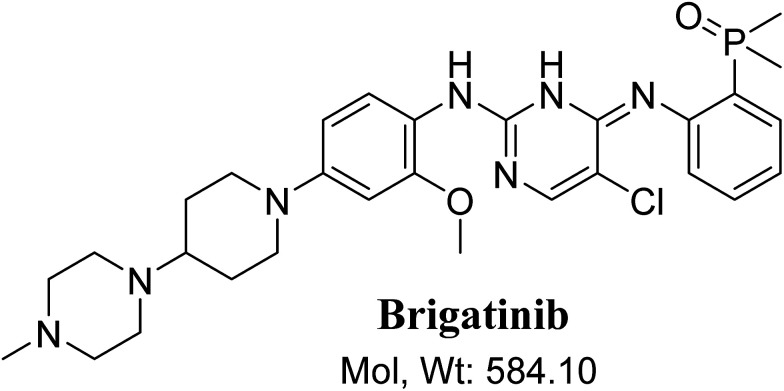
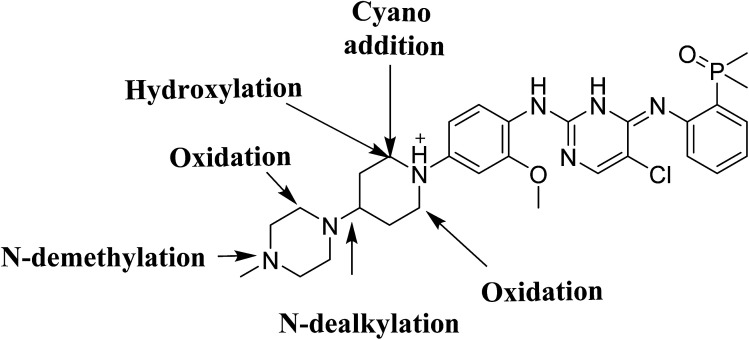
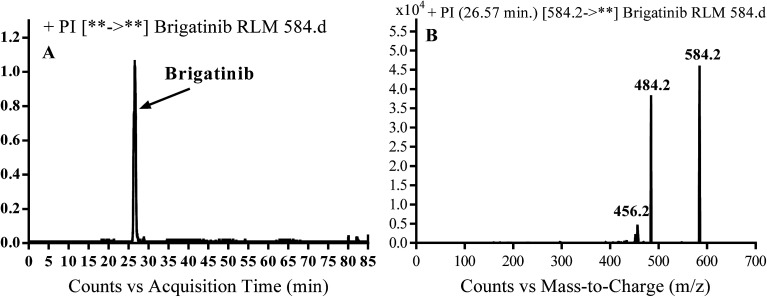
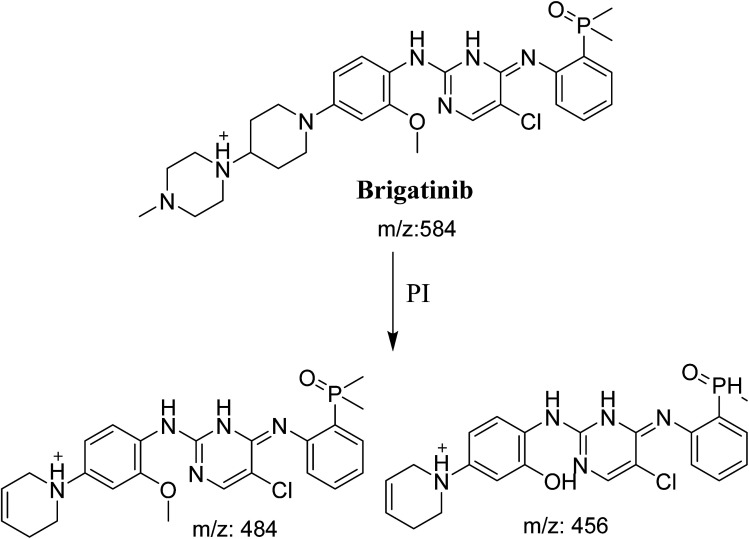
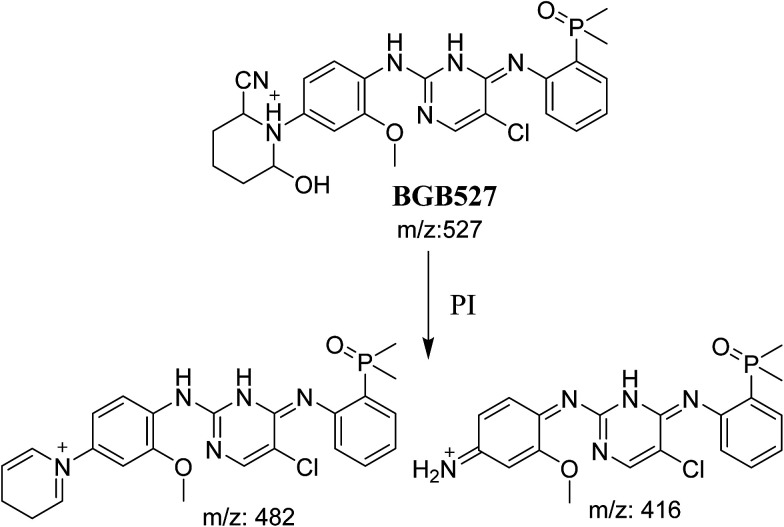
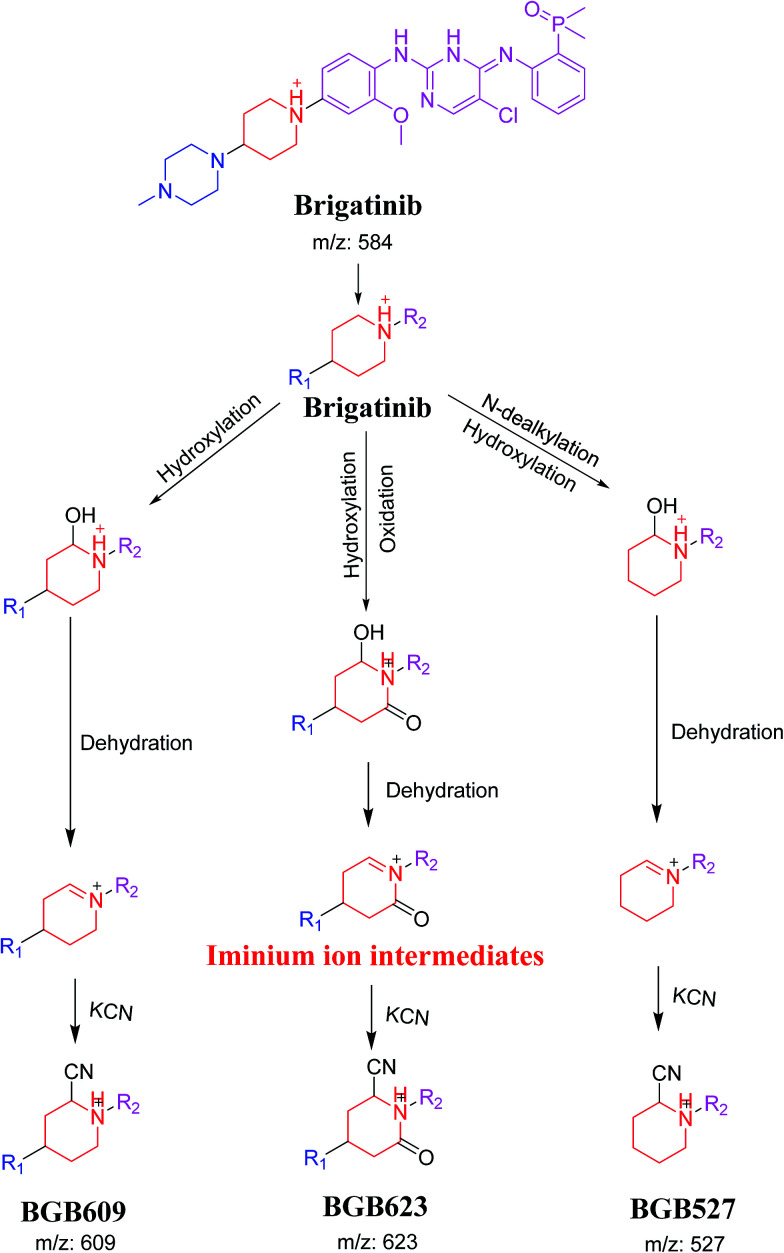
Brigatinib (BGB) is a newly approved anaplastic lymphoma kinase (ALK) inhibitor. On April 28, 2017, BGB was approved by the U.S. FDA for the treatment of metastatic anaplastic lymphoma kinase-positive non-small cell lung cancer. The toxicity profile of BGB includes nausea, fatigue, diarrhea, elevated lipase, dyspnoea, hypertension, hypoxia, pneumonia, elevated amylase, pulmonary embolism, elevated ALT, hyponatraemia and hypophosphatemia. Using LC-MS/MS, we investigated the phase I metabolism of for BGB in rat liver microsomes (RLMs). In the metabolism of BGB, iminium reactive intermediates were trapped by potassium cyanide forming a stable complex that can be characterized by LC-MS/MS. Four BGB phase I metabolites were identified. phase I metabolic pathways were -dealkylation, α hydroxylation and α oxidation. Additionally, three iminium reactive metabolites were found and the bioactivation mechanisms were proposed. A piperidine ring was found to be responsible for BGB bioactivation. The presence of these three reactive metabolites may be the main reason for BGB side effects. A literature review showed no previous article reported the phase I metabolism study of BGB or structural identification of the formed reactive metabolites.
布加替尼(BGB)是一种新获批的间变性淋巴瘤激酶(ALK)抑制剂。2017年4月28日,BGB被美国食品药品监督管理局(FDA)批准用于治疗转移性间变性淋巴瘤激酶阳性非小细胞肺癌。BGB的毒性特征包括恶心、疲劳、腹泻、脂肪酶升高、呼吸困难、高血压、低氧血症、肺炎、淀粉酶升高、肺栓塞、谷丙转氨酶升高、低钠血症和低磷血症。我们使用液相色谱-串联质谱法(LC-MS/MS)研究了BGB在大鼠肝微粒体(RLMs)中的I期代谢。在BGB的代谢过程中,亚胺活性中间体被氰化钾捕获,形成一种可通过LC-MS/MS表征的稳定复合物。鉴定出了四种BGB的I期代谢产物。I期代谢途径为N-去烷基化、α-羟基化和α-氧化。此外,还发现了三种亚胺活性代谢产物,并提出了生物活化机制。发现哌啶环是BGB生物活化的原因。这三种活性代谢产物的存在可能是BGB产生副作用的主要原因。文献综述表明,此前没有文章报道过BGB的I期代谢研究或所形成的活性代谢产物的结构鉴定。