de Silva Udaka K, Brown Jennifer L, Lapitsky Yakov
Department of Chemical Engineering, University of Toledo Toledo Ohio 43606 USA
School of Green Chemistry and Engineering, University of Toledo Toledo Ohio 43606 USA.
RSC Adv. 2018 May 25;8(35):19409-19419. doi: 10.1039/c8ra02588f.
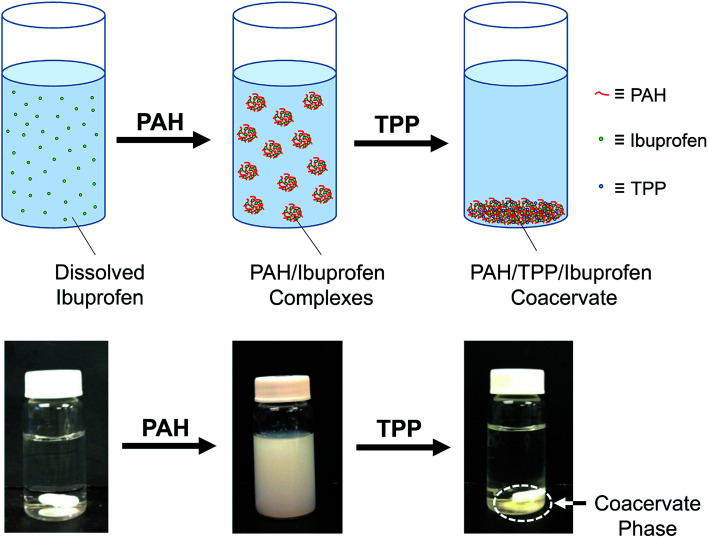
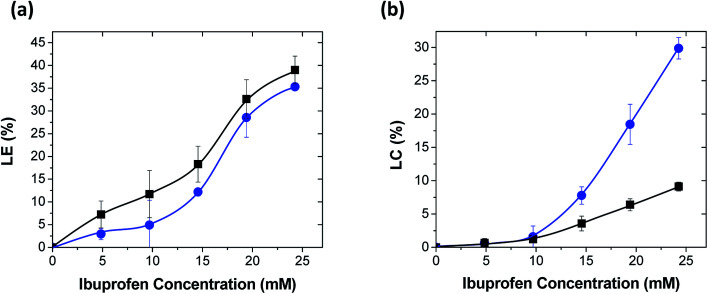
When synthetic polyamines, such poly(allylamine hydrochloride) (PAH), are mixed with crosslink-forming multivalent anions, they can undergo complex coacervation. This phenomenon has recently been exploited in various applications, ranging from inorganic material synthesis, to underwater adhesion, to multiple-month release of small, water-soluble molecules. Here, using ibuprofen as a model drug molecule, we show that these coacervates may be especially effective in the long-term release of weakly amphiphilic anionic drugs. Colloidal amphiphile/polyelectrolyte complex dispersions are first prepared by mixing the amphiphilic drug (ibuprofen) with PAH. Pentavalent tripolyphosphate (TPP) ions are then added to these dispersions to form ibuprofen-loaded PAH/TPP coacervates (where the strongly-binding TPP displaces the weaker-bound ibuprofen from the PAH amine groups). The initial ibuprofen/PAH binding leads to extremely high drug loading capacities (LC-values), where the ibuprofen comprises up to roughly 30% of the coacervate mass. Conversely, the dense ionic crosslinking of PAH by TPP results in very slow release rates, where the release of ibuprofen (a small, water-soluble drug) is extended over timescales that exceed 6 months. When ibuprofen is replaced with strong anionic amphiphiles, however (, sodium dodecyl sulfate and sodium dodecylbenzenesulfonate), the stronger amphiphile/polyelectrolyte binding disrupts PAH/TPP association and sharply increases the coacervate solute permeability. These findings suggest that: (1) as sustained release vehicles, PAH/TPP coacervates might be very attractive for the encapsulation and multiple-month release of weakly amphiphilic anionic payloads; and (2) strong amphiphile incorporation could be useful for tailoring PAH/TPP coacervate properties.
当合成聚胺,如聚(烯丙胺盐酸盐)(PAH)与形成交联的多价阴离子混合时,它们会发生复合凝聚。这种现象最近已被应用于各种领域,从无机材料合成到水下粘附,再到小分子水溶性分子的数月释放。在这里,我们以布洛芬作为模型药物分子,表明这些凝聚物在弱两亲性阴离子药物的长期释放中可能特别有效。首先通过将两亲性药物(布洛芬)与PAH混合制备胶体两亲物/聚电解质复合分散体。然后将五价三聚磷酸钠(TPP)离子添加到这些分散体中,以形成负载布洛芬的PAH/TPP凝聚物(其中强结合的TPP从PAH胺基团取代弱结合的布洛芬)。最初的布洛芬/PAH结合导致极高的药物负载能力(LC值),其中布洛芬占凝聚物质量的约30%。相反,TPP对PAH的密集离子交联导致非常缓慢的释放速率,其中布洛芬(一种小分子水溶性药物)的释放在超过6个月的时间尺度上延长。然而,当布洛芬被强阴离子两亲物(十二烷基硫酸钠和十二烷基苯磺酸钠)取代时,更强的两亲物/聚电解质结合会破坏PAH/TPP缔合,并急剧增加凝聚物溶质的渗透性。这些发现表明:(1)作为缓释载体,PAH/TPP凝聚物对于弱两亲性阴离子负载物的包封和数月释放可能非常有吸引力;(2)强两亲物的掺入可能有助于调整PAH/TPP凝聚物的性质。