Li Wanyan, Xu Danning, Li Bingxin, Cao Nan, Guo Sixuan, Jiang Qingyan, Tian Yunbo
Guangdong Province Key Laboratory of Waterfowl Healthy Breeding Guangzhou 510225 P. R. China
Guangdong Provincial Key Laboratory of Animal Nutrition Control, College of Animal Science, South China Agricultural University Guangzhou 510642 P. R. China.
RSC Adv. 2018 Jul 27;8(47):26837-26848. doi: 10.1039/c8ra00368h. eCollection 2018 Jul 24.
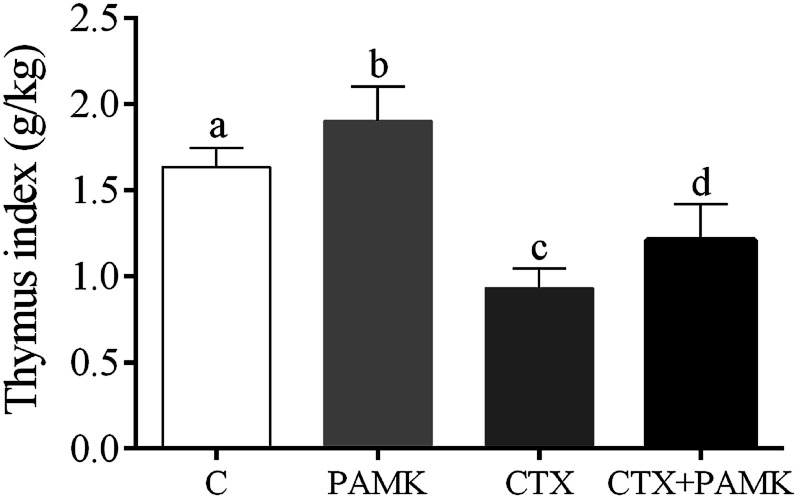
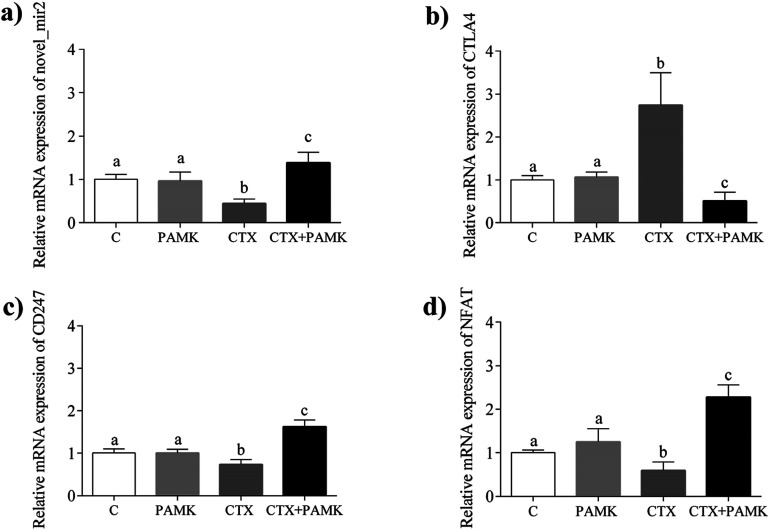
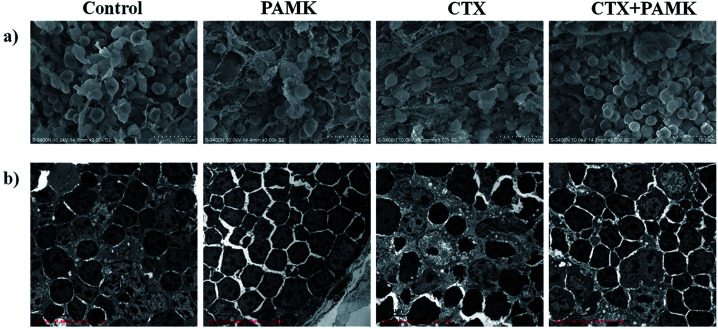
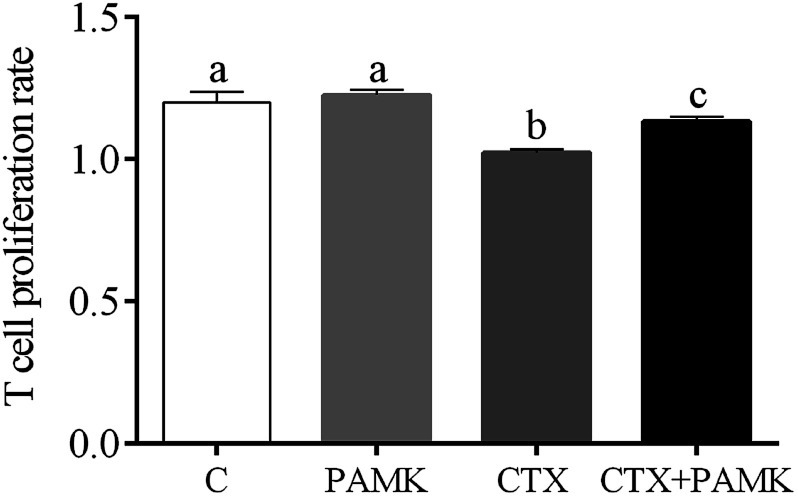
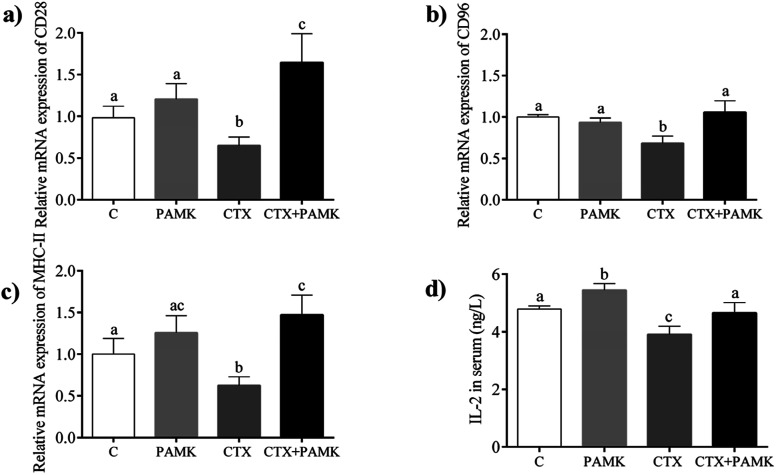
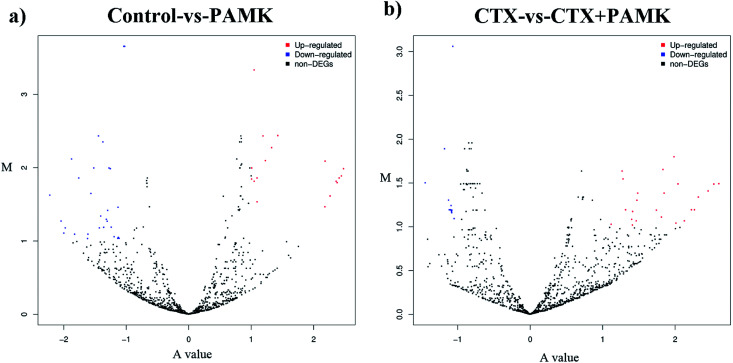
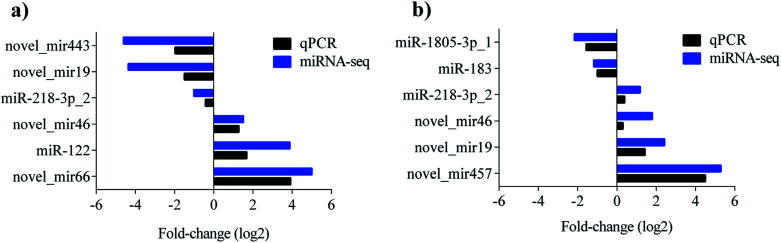
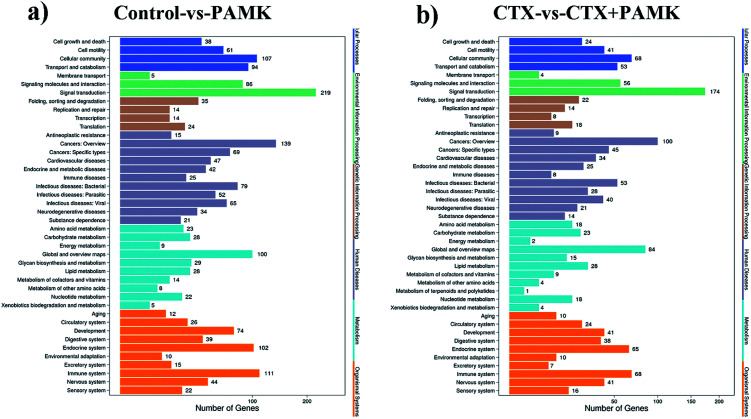
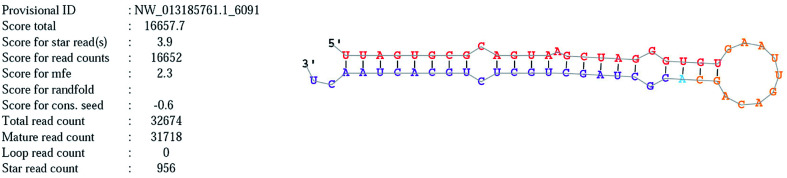
The polysaccharide of (PAMK) has been proved to have antioxidant, anti-inflammatory, antiviral, and immunity promoting effects. MicroRNAs (miRNAs) have also been shown to participate in the regulation of immune function by negatively regulating the expression of target genes. However, little is known about how PAMK alleviates the immunosuppression the miRNA pathway in geese. The aim of this study is to evaluate the influence of PAMK on immunosuppression. Magang geese (1 day old, = 200) were randomly divided into groups, namely, the control group (normal feeding), PAMK (fed 400 mg kg PAMK), CTX (injected 40 mg kg BW cyclophosphamide), and CTX + PAMK (40 mg kg BW cyclophosphamide + 400 mg kg PAMK) groups. Thymus development was examined by the thymus index, transmission electron microscopy and scanning electron microscopy. The T cell proliferation rate was stimulated by phytoagglutinin (PHA), and T cell activation related genes (CD28, CD96, MHC-II), and IL-2 levels in serum were detected. Differentially expressed miRNAs of geese to regulate T cell activation were found by miRNA sequencing technologies. The results showed that PAMK could alleviate thymus damage and the decrease in the T lymphocyte proliferation rate, T cell activation, and IL-2 levels that were induced by CTX. MiRNA sequencing found that the combination of PAMK and CTX significantly promoted T cell activation upregulation of novel_mir2 ( < 0.05), which inhibited cytotoxic T lymphocyte antigen 4 (CTLA4) expressions, thereby promoting the TCR-NFAT signaling pathway. It can be concluded that PAMK, through novel_mir2 targeting of CTLA4 to upregulate TCR pathway, finally alleviated immunosuppression induced by CTX in geese.
已证明[具体名称]的多糖(PAMK)具有抗氧化、抗炎、抗病毒和促进免疫的作用。微小RNA(miRNAs)也已显示通过负调控靶基因的表达参与免疫功能的调节。然而,关于PAMK如何通过miRNA途径减轻鹅的免疫抑制作用,目前所知甚少。本研究的目的是评估PAMK对免疫抑制的影响。将1日龄的马岗鹅(n = 200)随机分为几组,即对照组(正常饲养)、PAMK组(饲喂400 mg/kg PAMK)、CTX组(注射40 mg/kg体重的环磷酰胺)和CTX + PAMK组(40 mg/kg体重的环磷酰胺 + 400 mg/kg PAMK)。通过胸腺指数、透射电子显微镜和扫描电子显微镜检查胸腺发育情况。用植物血凝素(PHA)刺激T细胞增殖率,并检测血清中T细胞活化相关基因(CD28、CD96、MHC-II)和IL-2水平。通过miRNA测序技术发现鹅中差异表达的调节T细胞活化的miRNAs。结果表明,PAMK可减轻CTX诱导的胸腺损伤以及T淋巴细胞增殖率、T细胞活化和IL-2水平的降低。miRNA测序发现,PAMK与CTX联合使用通过上调新型_mir2(P < 0.05)显著促进T细胞活化,新型_mir2抑制细胞毒性T淋巴细胞抗原4(CTLA4)的表达,从而促进TCR-NFAT信号通路。可以得出结论,PAMK通过新型_mir2靶向CTLA4上调TCR途径,最终减轻了CTX诱导的鹅的免疫抑制。