Wang Yabin, Hu Keke, Zhang Yantu, Ding Xiuping
Shaanxi Key Laboratory of Chemical Reaction Engineering, College of Chemistry and Chemical Engineering, Yan'an University Yan'an 716000 Shaanxi P. R. China
Key Laboratory of Comprehensive and Highly Efficient Utilization of Salt Lake Resources, Salt Lake Chemistry Analysis and Test Center, Qinghai Institute of Salt Lakes, Chinese Academy of Sciences Xining 810008 P. R. China.
RSC Adv. 2019 Dec 2;9(68):39622-39630. doi: 10.1039/c9ra08152f.
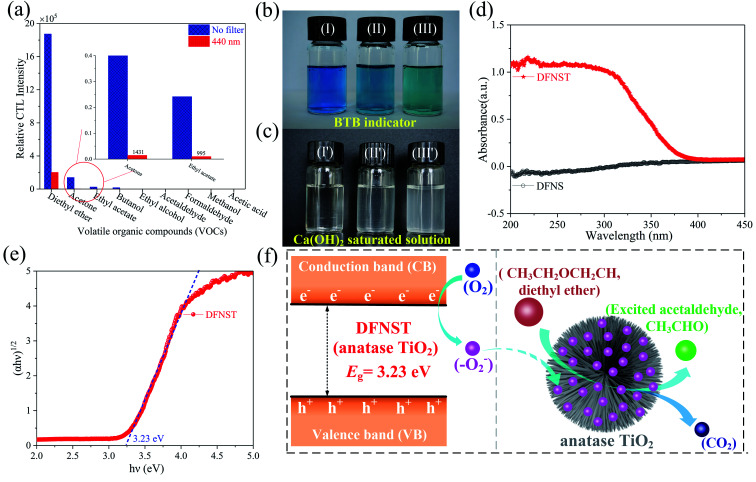
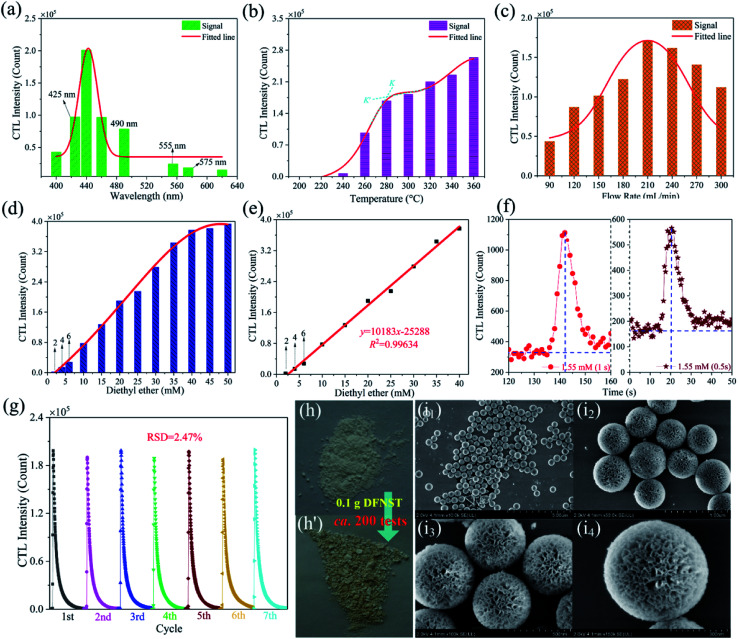
Selective and controllable cataluminescence (CTL) sensors for volatile organic compounds (VOCs) are significant for chemical safety, environmental monitoring, health effects on human beings, and so forth. Most of the exploited CTL-based sensors suffer relatively low response and poor selectivity because of their high sensitivities to interferential substances. In this investigation, dendritic fibrous nano-silica & titania (DFNST) spheres have been synthesized as novel sensing materials and the corresponding DFNST-based CTL sensor has been fabricated to detect diethyl ether with high selectivity a method of utilizing one 440 nm bandpass filter. The as-prepared DFNST hybrids not only keep the excellent dendritic fibrous morphology but also bear 21 wt% catalytic titanium oxide of anatase crystalline structure. The DFNST-based sensor exhibits extremely strong CTL emission at 440 nm toward diethyl ether against other VOCs like acetone, ethyl acetate, butanol, and so forth. The high response can be attributed to the unique architectural texture of DFNST. Under the optimum parameters, ether could be easily detected in a wide range from 2.0 to 40.0 mM with a fine detection limit of 1.55 mM (S/N = 3). Furthermore, the working life of this CTL sensor is satisfactory with outstanding stability and durability, far from damaging the morphology and activity of the DFNST sensing material. In conclusion, it is expected that this novel sensing material, the relevant CTL sensor, and the approach of employing the bandpass filter will be significant for the detection of diethyl ether in actual applications.
用于挥发性有机化合物(VOCs)的选择性和可控催化发光(CTL)传感器对于化学安全、环境监测、对人类健康的影响等方面具有重要意义。大多数已开发的基于CTL的传感器由于对干扰物质的高灵敏度而表现出相对较低的响应和较差的选择性。在本研究中,合成了树枝状纤维纳米二氧化硅和二氧化钛(DFNST)球作为新型传感材料,并制备了相应的基于DFNST的CTL传感器,利用一个440 nm带通滤波器高选择性地检测乙醚。所制备的DFNST杂化物不仅保持了优异的树枝状纤维形态,还含有21 wt%的锐钛矿晶体结构的催化氧化钛。基于DFNST的传感器在440 nm处对乙醚表现出极强的CTL发射,相对于丙酮、乙酸乙酯、丁醇等其他VOCs。高响应可归因于DFNST独特的结构纹理。在最佳参数下,乙醚在2.0至40.0 mM的宽范围内易于检测,检测限低至1.55 mM(S/N = 3)。此外,该CTL传感器的工作寿命令人满意,具有出色的稳定性和耐久性,不会损害DFNST传感材料的形态和活性。总之,预计这种新型传感材料、相关的CTL传感器以及采用带通滤波器的方法在实际应用中对乙醚的检测具有重要意义。