Guo Linlin, Wang Aifen, Hu Pengfei, Tian Aihua, Hao Rui, Yu Dandan, Yang Jie, Chen Dezhi, Wang Hua
School of Chemistry, Beihang University Beijing 100191 PR China
School of Science, Hangzhou Dianzi University Hangzhou 310018 PR China.
RSC Adv. 2018 Jan 9;8(4):2077-2081. doi: 10.1039/c7ra12489a. eCollection 2018 Jan 5.
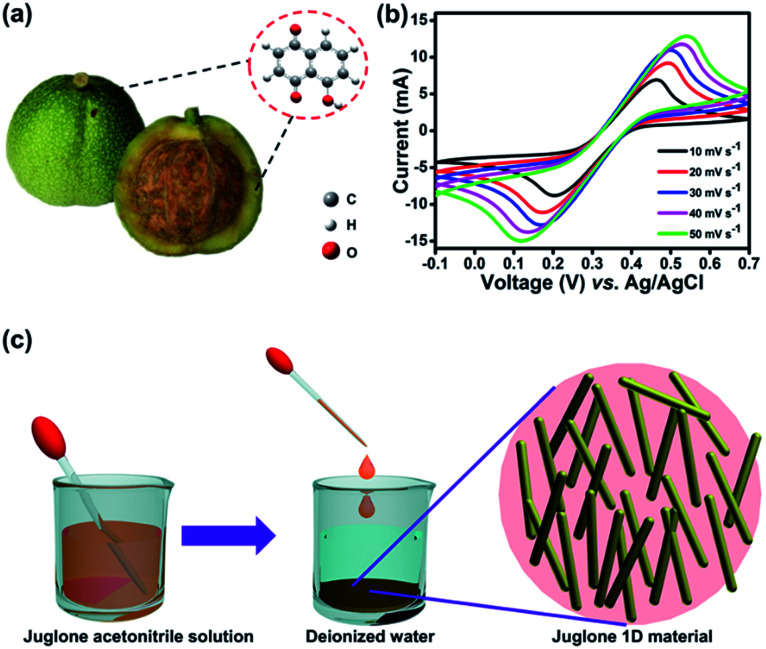
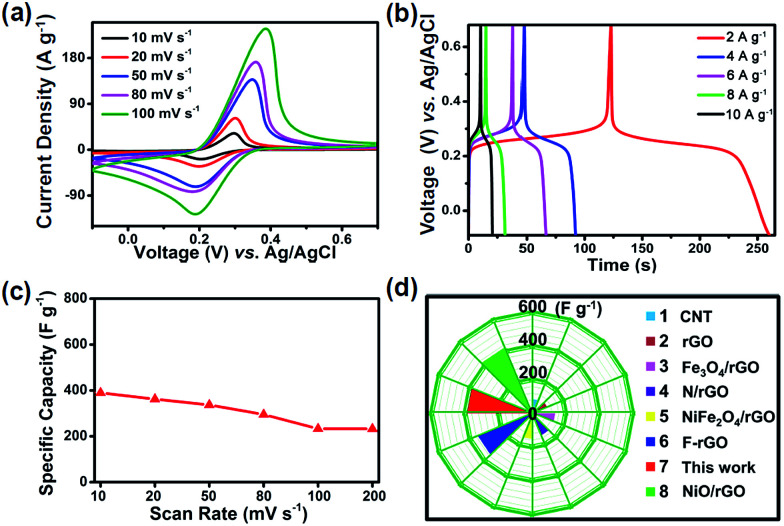
Inspired by the biological metabolic process, some biomolecules with reversible redox functional groups have been used as promising electrode materials for rechargeable batteries, supercapacitors and other charge-storage devices. Although these biomolecule-based electrode materials possess remarkable beneficial properties, their controllable synthesis and morphology-related properties have been rarely studied. Herein, one dimensional nanostructures based on juglone biomolecules have been successfully fabricated by an antisolvent crystallization and self-assembly method. Moreover, the size effect on their electrochemical charge-storage properties has been investigated. It reveals that the diameters of the one dimensional nanostructure determine their electron/ion transport properties, and the juglone nanowires achieve a higher specific capacitance and rate capability. This work will promote the development of environmentally friendly and high-efficiency energy storage electrode materials.
受生物代谢过程的启发,一些具有可逆氧化还原官能团的生物分子已被用作可充电电池、超级电容器和其他电荷存储装置的有前景的电极材料。尽管这些基于生物分子的电极材料具有显著的有益特性,但它们的可控合成以及与形态相关的特性却鲜有研究。在此,基于胡桃醌生物分子的一维纳米结构已通过反溶剂结晶和自组装方法成功制备。此外,还研究了尺寸对其电化学电荷存储性能的影响。结果表明,一维纳米结构的直径决定了它们的电子/离子传输性能,并且胡桃醌纳米线具有更高的比电容和倍率性能。这项工作将推动环保型高效储能电极材料的发展。