Isobe Noriyuki, Kasuga Takaki, Nogi Masaya
R&D Center for Marine Biosciences, Japan Agency for Marine-Earth Science and Technology (JAMSTEC) 2-15 Natsushima-cho Yokosuka 237-0061 Japan
The Institute of Scientific and Industrial Research, Osaka University Mihogaoka 8-1 Ibaraki Osaka 567-0047 Japan.
RSC Adv. 2018 Jan 8;8(4):1833-1837. doi: 10.1039/c7ra12672g. eCollection 2018 Jan 5.
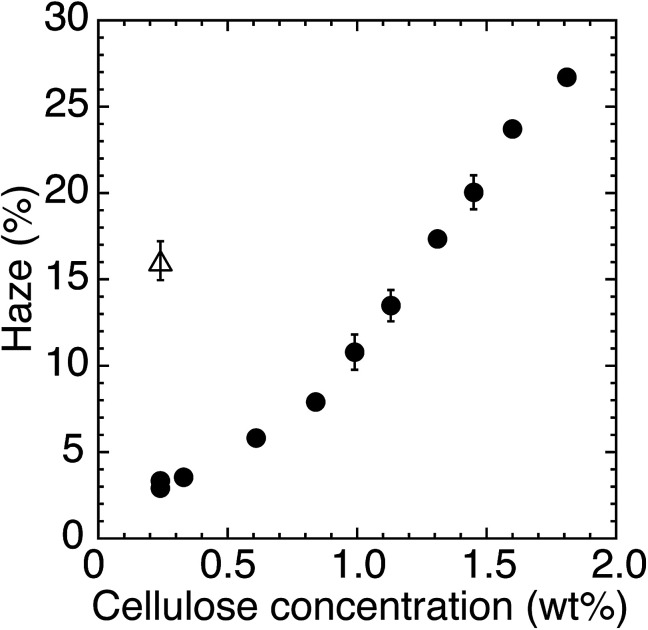
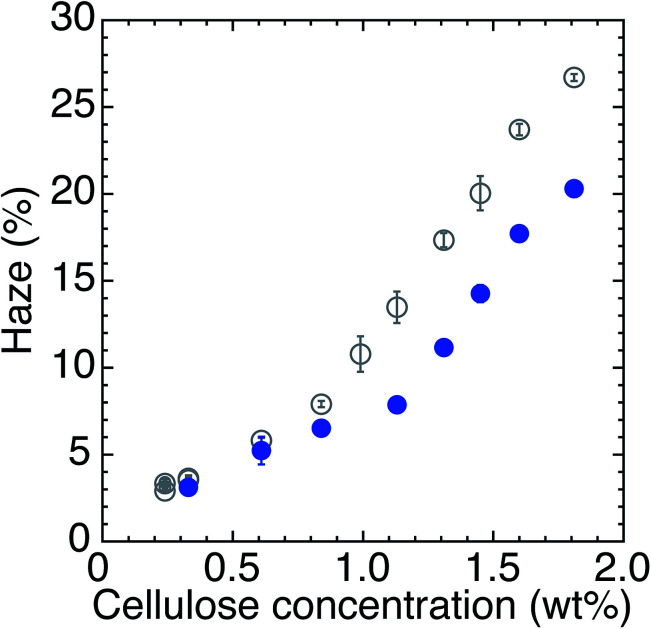
Optically transparent cellulose nanopaper is a promising candidate for flexible device substrates because of its light weight, surface smoothness, and high dimensional stability with respect to temperature. Conventionally, clear transparent nanopaper has been fabricated from cellulose nanofiber dispersions with quite low concentration: less than 0.5 wt%. However, this diluteness leads to several problems, such as huge energy consumption and long operation time for drying. Therefore, nanopaper should be fabricated from a concentrated dispersion to mitigate these problems. In this study, transparent nanopaper was fabricated from cellulose nanofiber dispersions with various concentrations (0.24-1.81 wt%). Optical experiments revealed that the haze of the transparent nanopaper increased monotonically with cellulose nanofiber dispersion concentration, when the cellulose nanofiber dispersion was prepared from holocellulose pulp and conventional over-drying was applied. Based on our insight into the origin of this increase in the haze of transparent nanopaper, we developed high-humidity drying, which successfully produced clear transparent nanopaper from a concentrated dispersion without prolonged drying time.
光学透明纤维素纳米纸因其重量轻、表面光滑以及在温度方面具有高尺寸稳定性,是柔性器件基板的一个有前途的候选材料。传统上,透明纳米纸是由浓度相当低(小于0.5 wt%)的纤维素纳米纤维分散体制备而成。然而,这种低浓度会导致几个问题,比如巨大的能量消耗和较长的干燥操作时间。因此,应该用浓缩分散体制备纳米纸以缓解这些问题。在本研究中,透明纳米纸是由不同浓度(0.24 - 1.81 wt%)的纤维素纳米纤维分散体制备而成。光学实验表明,当纤维素纳米纤维分散体由全纤维素纸浆制备并采用传统过度干燥时,透明纳米纸的雾度随纤维素纳米纤维分散体浓度单调增加。基于我们对透明纳米纸雾度增加原因的深入了解,我们开发了高湿度干燥方法,该方法成功地从浓缩分散体中制备出了透明的透明纳米纸,且无需延长干燥时间。