Xiang Qian, Huang Jingyun, Huang Huiyao, Mao Weiwei, Ye Zhizhen
School of Materials Science and Engineering, Zhejiang University of China Hangzhou 310027 China
RSC Adv. 2018 Jan 8;8(4):1820-1825. doi: 10.1039/c7ra11945c. eCollection 2018 Jan 5.
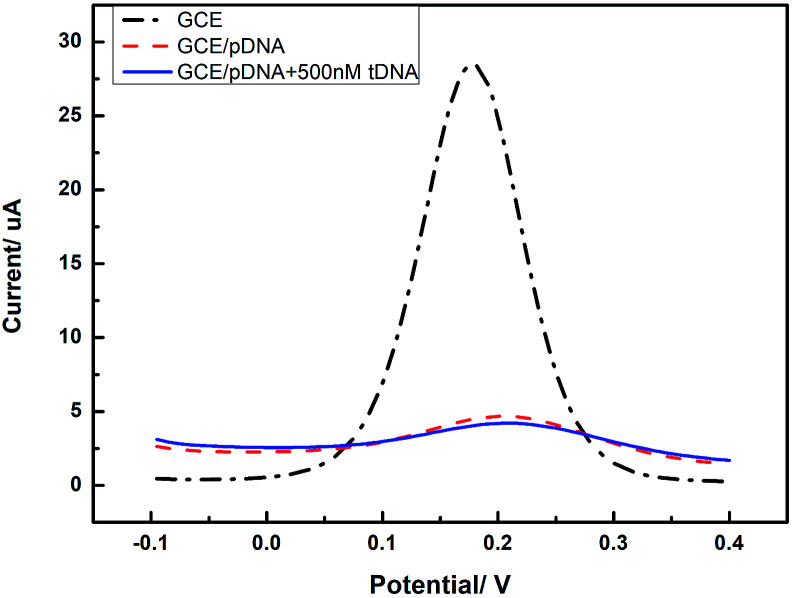
Based on the strong interaction between single-stranded DNA and graphene material, we have designed a simple but smart electrochemical platform to detect HBV-DNA by using a graphene quantum dot (GQD) modified glassy carbon electrode coupled with specific sequence DNA molecules as probes. The probe DNA is designed to be complementary to the HBV-DNA, when the probe DNA is strongly bound to the surface of the GQD modified electrode the transfer of an electron from the electrode to the electrochemically active species K[Fe(CN)] will become difficult. Nevertheless, if the target HBV-DNA is found in the test solution, the probe DNA will bind with the target HBV-DNA instead of GQDs. As a result, the obtained peak currents of K[Fe(CN)] will have a different degree of increase with the different concentrations of the target HBV-DNA. In particular, the proposed sensor exhibits high sensitivity with a detection limit of 1 nM, and the linear detection range is from 10 nM to 500 nM. Additionally, the sensor could be used in detecting other probe DNA, which may have potential applications in the future.
基于单链DNA与石墨烯材料之间的强相互作用,我们设计了一个简单而巧妙的电化学平台,通过使用石墨烯量子点(GQD)修饰的玻碳电极与特定序列的DNA分子作为探针来检测HBV-DNA。探针DNA被设计为与HBV-DNA互补,当探针DNA牢固地结合在GQD修饰电极的表面时,电子从电极转移到电化学活性物质K[Fe(CN)]就会变得困难。然而,如果在测试溶液中发现目标HBV-DNA,探针DNA将与目标HBV-DNA结合而不是与GQDs结合。结果,随着目标HBV-DNA浓度的不同,所获得的K[Fe(CN)]的峰值电流会有不同程度的增加。特别是,所提出的传感器具有高灵敏度,检测限为1 nM,线性检测范围为10 nM至500 nM。此外,该传感器可用于检测其他探针DNA,未来可能具有潜在应用。