Department of Nanotechnology, Faculty of Chemistry, Urmia University, Urmia, Iran.
Institute of Nanotechnology, Urmia University, Urmia, Iran.
Sci Rep. 2023 Jan 27;13(1):1557. doi: 10.1038/s41598-023-28872-x.
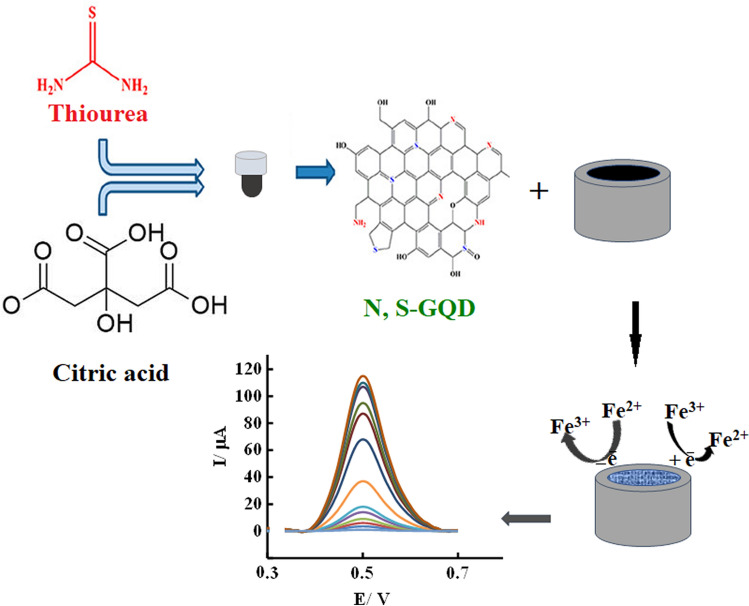
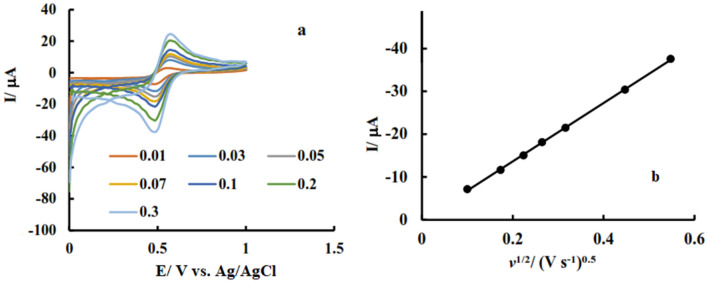
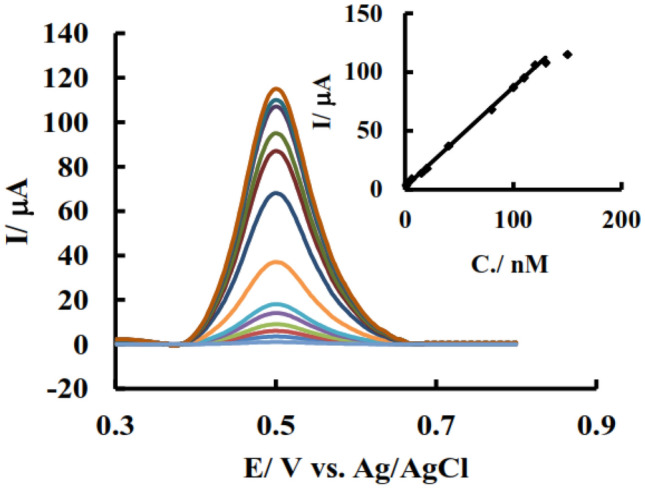
In this work, nitrogen and sulfur co-doped graphene quantum dot-modified glassy carbon electrodes (N, S-GQD/GCE) were used for the recognition of iron cations in aqueous solutions. The dissolved cations are detected based on the faradaic reduction or oxidation current of Fe(III) and Fe(II) obtained at the N, S-GQD/GCE surface. Cyclic voltammetry (CV), square wave voltammetry (SWV), and hydrodynamic amperometry are used as suitable electrochemical techniques for studying electrochemical behavior and determination of Fe cations. Based on the obtained results, it is concluded that the presence of free electrons in the structure of N, S-GQD could facilitate electron transfer reaction between Fe(III) and electrode surface which with increased surface area results in increased sensitivity and lower limit of detection. By performing suitable experiments, the best condition for preparing the modified electrode and determining Fe(III) was selected. Under optimized conditions, the amperometric response is linear from 1 to 100 nM of Fe(III) with a detection limit of 0.23 nM. The validity of the method and applicability of the sensor is successfully tested by the determination of Fe(III) in drug and water real samples. This sensor opened a new platform based on doped nanoparticles for highly sensitive and selective detection of analytes.
在这项工作中,氮硫共掺杂石墨烯量子点修饰玻碳电极(N,S-GQD/GCE)被用于水溶液中铁阳离子的识别。通过在 N,S-GQD/GCE 表面获得的 Fe(III)和 Fe(II)的法拉第还原或氧化电流来检测溶解的阳离子。循环伏安法(CV)、方波伏安法(SWV)和动电流安培法被用作研究电化学行为和测定 Fe 阳离子的合适电化学技术。基于获得的结果,可以得出结论,N,S-GQD 结构中的自由电子可以促进 Fe(III)和电极表面之间的电子转移反应,增加了表面积,从而提高了灵敏度和检测下限。通过进行合适的实验,选择了制备修饰电极和测定 Fe(III)的最佳条件。在最佳条件下,Fe(III)的电流响应在 1 至 100 nM 范围内呈线性,检测限为 0.23 nM。通过测定药物和水样中的 Fe(III),成功地验证了该方法的有效性和传感器的适用性。该传感器为基于掺杂纳米粒子的高灵敏度和选择性分析物检测开辟了一个新的平台。