Gautam Swetlana, Singh Priyanka, Singh Manjari, Roy Subhadeep, Rawat Jitendra K, Yadav Rajnish K, Devi Uma, Gupta Pushpraj S, Saraf Shubhini A, Kaithwas Gaurav
Department of Pharmaceutical Sciences, School of Biosciences and Biotechnology, Babasaheb Bhimrao Ambedkar University (A Central University) Vidya vihar, Raebareli Road Lucknow-226 025 UP India
Department of Pharmaceutical Sciences, Faculty of Health Medical Sciences Indigenous and Alternative Medicine, SHIATS-Deemed to be University, Formerly Allahabad Agricultural Institute Naini Allahabad UP India.
RSC Adv. 2018 Jan 17;8(7):3512-3521. doi: 10.1039/c7ra09689e. eCollection 2018 Jan 16.
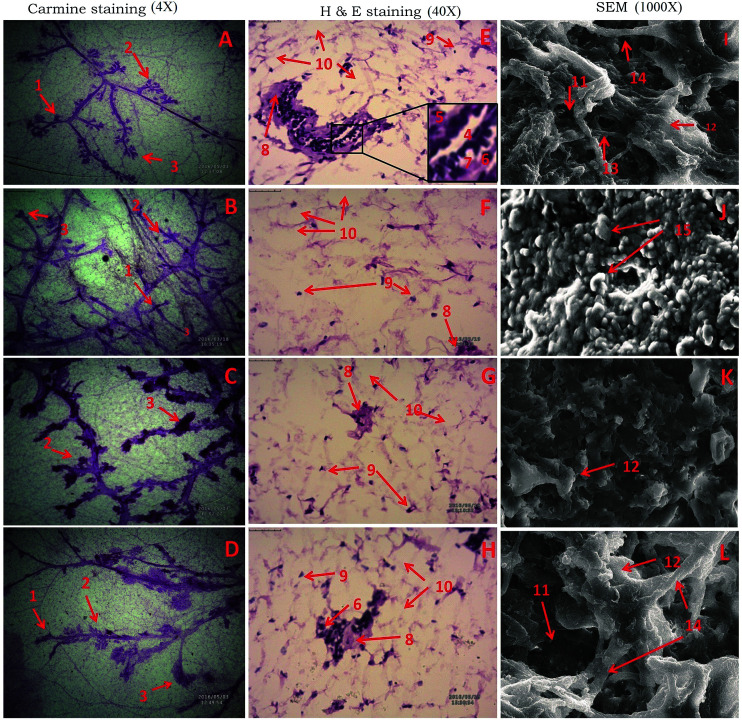
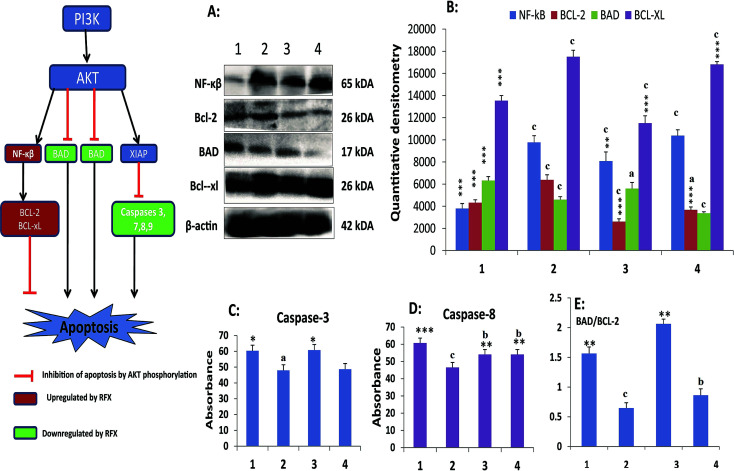
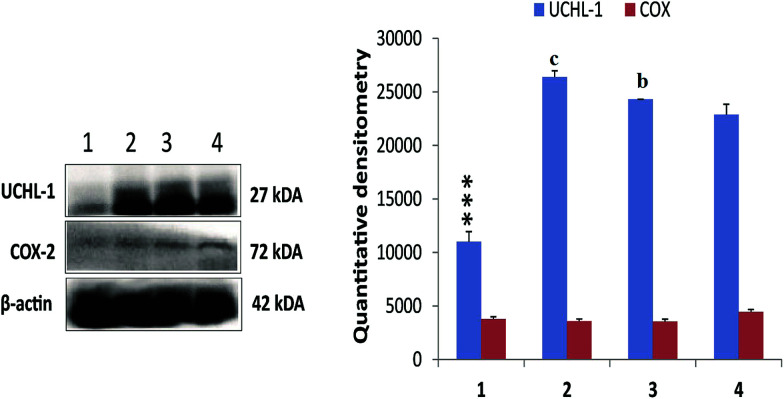
The present study was proposed to investigate the effect of rifaximin (RFX) on methyl nitrosourea (MNU) induced mammary gland carcinoma in albino wistar rats. Animals were randomized and divided among four groups of six animals each. Group I (control 0.9% normal saline, 3 ml kg, p.o.); Group II (toxic control, MNU 47 mg kg, i.v.); Group III (RFX, 25 mg kg, p.o.); Group IV (RFX, 50 mg kg, p.o.). Toxicity was induced by single i.v. injection of MNU. MNU treatment was evident with increased alveolar bud count, differentiation score, up-regulated inflammatory enzyme markers (COX, LOX, NO and HS) and oxidative stress markers (TBAR's, protein carbonyl, SOD, catalase and Ach). The mammary gland surface architecture was studied using SEM, carmine staining and H&E staining. The treatment with RFX elicited noticeable restoration of the overall histological architecture in the experimental animals similar to the control. In the MNU treated toxic group, the levels of oxidative stress markers significantly increased in comparison to the control, which was subsequently restored after RFX treatment. Furthermore, RFX up regulated the levels of caspase 3 and caspase 8, when compared to the MNU treated animals. MNU associated toxicity was also ascertained, when determined for UCHL-1, COX, NF-κBp65, BAD, and BCL-xl expression, while RFX demonstrated modulation of the same.
本研究旨在探讨利福昔明(RFX)对白消安(MNU)诱导的白化Wistar大鼠乳腺癌的影响。将动物随机分为四组,每组六只。第一组(对照组,0.9%生理盐水,3 ml/kg,口服);第二组(毒性对照组,MNU 47 mg/kg,静脉注射);第三组(RFX,25 mg/kg,口服);第四组(RFX,50 mg/kg,口服)。通过单次静脉注射MNU诱导毒性。MNU治疗表现为肺泡芽计数增加、分化评分增加、炎症酶标志物(COX、LOX、NO和HS)上调以及氧化应激标志物(TBAR's、蛋白质羰基、SOD、过氧化氢酶和乙酰胆碱)上调。使用扫描电子显微镜(SEM)、胭脂红染色和苏木精-伊红(H&E)染色研究乳腺表面结构。RFX治疗使实验动物的整体组织学结构恢复到与对照组相似的显著水平。在MNU处理的毒性组中,与对照组相比,氧化应激标志物水平显著升高,RFX治疗后随后恢复。此外,与MNU处理的动物相比,RFX上调了半胱天冬酶3和半胱天冬酶8的水平。当测定UCHL-1、COX、NF-κBp65、BAD和BCL-xl表达时,也确定了MNU相关的毒性,而RFX表现出对其的调节作用。