Jeffrey Cummings, MD, ScD, 1380 Opal Valley Street, Henderson, NV 89052, USA,
J Prev Alzheimers Dis. 2022;9(2):221-230. doi: 10.14283/jpad.2022.34.
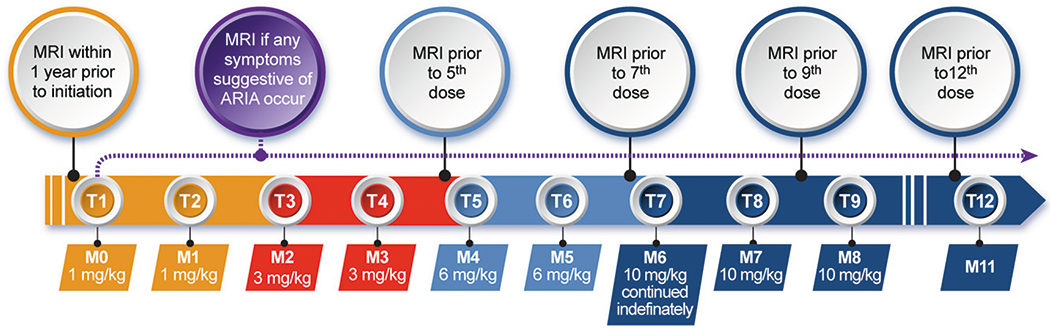
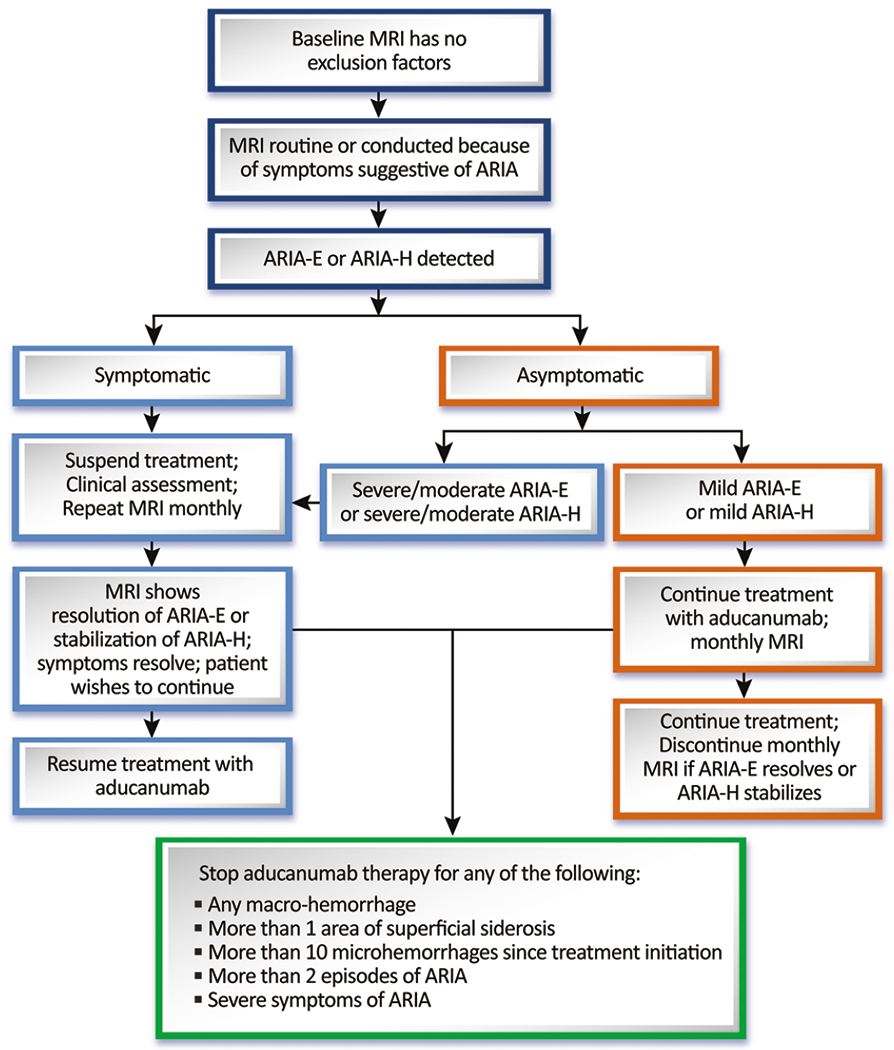
Aducanumab (Aduhelm) is approved in the United States for the treatment of patients with mild cognitive impairment due to Alzheimer's disease or mild AD dementia. Aducanumab Appropriate Use Recommendations (AURs) have been published and have helped guide best practices for use of aducanumab. As real-world use has occurred and more information has accrued, the AURs require refinement. We update the AURs to better inform appropriate patient selection and improve shared decision-making, safety monitoring, and risk mitigation in treated patients. Based on evolving experience we emphasize the importance of detecting past medical conditions that may predispose to amyloid related imaging abnormalities (ARIA) or may increase the likelihood of ARIA complications including autoimmune or inflammatory conditions, seizures, or disorders associated with extensive white matter pathology. The apolipoprotein E ε4 (APOE4) genotype is strongly associated with ARIA and exhibits a gene dose effect. We recommend that clinicians perform APOE genotyping to better inform patient care decisions, discussions regarding risk, and clinician vigilance concerning ARIA. As most ARIA occurs during the titration period of aducanumab, we suggest performing MRI before the 5th, 7th, 9th, and 12th infusions to improve detection. Uncommonly, ARIA may be recurrent or serious; we suggest additional parameters for treatment discontinuation taking these observations into account. It is important to continue to learn from the real-world use of aducanumab and the AURs will continue to evolve as new information becomes available. This AUR update does not address efficacy, price, or insurance coverage and is provided to assist clinicians to establish best practices for use of aducanumab in the treatment of patients with mild cognitive impairment and mild Alzheimer's dementia.
阿杜卡努单抗(Aduhelm)已获美国批准,用于治疗因阿尔茨海默病或轻度 AD 痴呆而导致轻度认知障碍的患者。已发布阿杜卡努单抗适当使用建议(AUR),以帮助指导阿杜卡努单抗的最佳使用方法。随着实际应用的开展和更多信息的积累,AUR 需要进一步细化。我们更新了 AUR,以更好地告知合适的患者选择,并在接受治疗的患者中改进共同决策、安全性监测和风险缓解。基于不断发展的经验,我们强调了检测可能导致淀粉样蛋白相关成像异常(ARIA)或增加 ARIA 并发症可能性的既往疾病的重要性,包括自身免疫或炎症性疾病、癫痫发作或与广泛白质病理学相关的疾病。载脂蛋白 E ε4(APOE4)基因型与 ARIA 密切相关,并表现出基因剂量效应。我们建议临床医生进行 APOE 基因分型,以更好地为患者护理决策、风险讨论以及 ARIA 的临床医生警惕性提供信息。由于大多数 ARIA 发生在阿杜卡努单抗的滴定期,我们建议在第 5、7、9 和 12 次输注前进行 MRI,以提高检测率。不常见的是,ARIA 可能是复发性或严重的;我们建议考虑到这些观察结果,增加停药的附加参数。重要的是要继续从阿杜卡努单抗的实际应用中学习,随着新信息的出现,AUR 将继续发展。此 AUR 更新不涉及疗效、价格或保险覆盖范围,旨在帮助临床医生为治疗轻度认知障碍和轻度阿尔茨海默病患者建立阿杜卡努单抗的最佳使用实践。