Department of Cardiology, New Tokyo Hospital, 1271 Wanagaya, Matsudo, Chiba, 270-2232, Japan.
Division of Cardiology, Department of Internal Medicine, St. Marianna University School of Medicine, Kanagawa, Japan.
ESC Heart Fail. 2022 Aug;9(4):2474-2483. doi: 10.1002/ehf2.13946. Epub 2022 May 11.
Data on B-type natriuretic peptide (BNP) levels and adverse outcomes in patients with moderate mixed aortic valve disease (MAVD), defined as moderate aortic stenosis (AS) and regurgitation (AR), are scarce. Therefore, this study investigated the impact of BNP on the clinical outcomes in such patients.
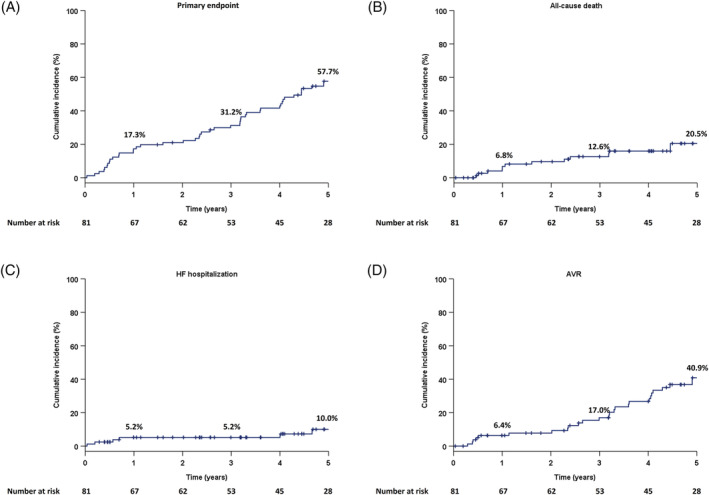
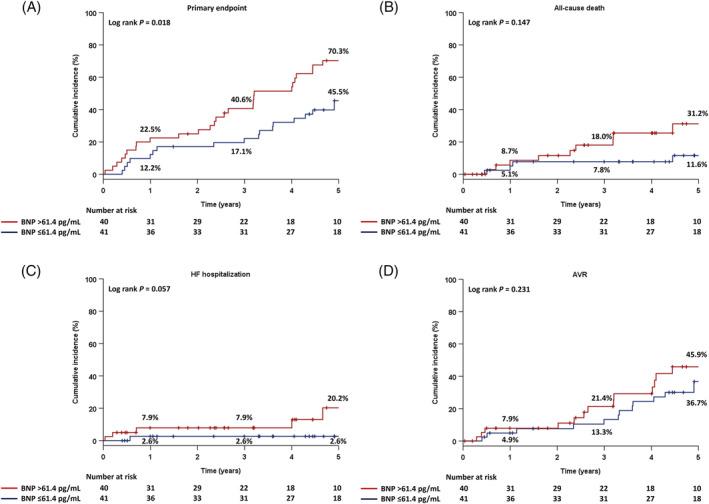
Clinical data from 81 patients (mean age, 74.1 ± 6.8 years; 50.6%, men) treated for moderate MAVD and left ventricular ejection fraction (LVEF) ≥ 50% during 2010-2018 were retrospectively analysed. Specific echocardiographic data of the study patients were LVEF of 57.8 ± 5.0%, aortic valve index of 0.64 ± 0.04 cm /m , peak aortic valve velocity of 3.38 ± 0.29 m/s, and AR vena contracta width of 4.2 ± 0.7 mm. The median BNP level was 61.4 pg/mL (interquartile range, 29.7-109.9). The primary endpoint was a composite of all-cause death, heart failure hospitalization, and aortic valve replacement, and its cumulative incidence at 5 years was 57.7%. Multivariable analysis revealed that age (hazard ratio, 1.079; 95% confidence interval, 1.028-1.133; P = 0.002) and BNP levels (hazard ratio, 1.028; 95% confidence interval, 1.003-1.053; P = 0.027) were significantly related to the endpoint; specifically, BNP > 61.4 pg/mL had significantly higher incidence rates of the endpoint than those with a BNP ≤ 61.4 pg/mL (70.3% vs. 45.5% at 5 years; P = 0.018). Compared with patients with BNP ≤ 61.4 pg/mL, those with BNP > 61.4 pg/mL had significantly worse left ventricular global longitudinal strain (-17.1 ± 3.6% vs. -18.7 ± 2.6%; P = 0.029), along with higher left ventricular mass index (116.9 ± 27.8 g/m vs. 103.5 ± 19.7 g/m ; P = 0.014), relative wall thickness (0.45 ± 0.07 vs. 0.42 ± 0.05; P = 0.022), left atrial volume index (46.0 ± 28.4 mL/m vs. 31.4 ± 10.3 mL/m ; P = 0.003), pulmonary artery systolic pressure (32.6 ± 9.7 mmHg vs. 28.2 ± 4.7 mmHg; P = 0.011), and prevalence of moderate or greater tricuspid regurgitation (15.0% vs. 0.0%; P = 0.012).
Patients with moderate MAVD are at higher risk of unfavourable clinical outcomes, and age and BNP are independently related to the occurrence of adverse events. High BNP levels may reflect extravalvular cardiac damage in patients with moderate MAVD.
关于中度混合性主动脉瓣疾病(MAVD)患者的 B 型利钠肽(BNP)水平和不良结局的数据很少。因此,本研究调查了 BNP 对这类患者临床结局的影响。
回顾性分析了 2010 年至 2018 年期间接受中度 MAVD 治疗且左心室射血分数(LVEF)≥50%的 81 例患者(平均年龄 74.1±6.8 岁;50.6%为男性)的临床数据。研究患者的特定超声心动图数据为 LVEF 为 57.8±5.0%,主动脉瓣指数为 0.64±0.04cm/m,峰值主动脉瓣速度为 3.38±0.29m/s,AR 有效瓣口宽度为 4.2±0.7mm。中位 BNP 水平为 61.4pg/mL(四分位距,29.7-109.9)。主要终点是全因死亡、心力衰竭住院和主动脉瓣置换的复合终点,其 5 年累积发生率为 57.7%。多变量分析显示,年龄(风险比,1.079;95%置信区间,1.028-1.133;P=0.002)和 BNP 水平(风险比,1.028;95%置信区间,1.003-1.053;P=0.027)与终点显著相关;具体而言,BNP>61.4pg/mL 的终点发生率明显高于 BNP≤61.4pg/mL 的患者(5 年时分别为 70.3%和 45.5%;P=0.018)。与 BNP≤61.4pg/mL 的患者相比,BNP>61.4pg/mL 的患者左心室整体纵向应变明显较差(-17.1±3.6% vs.-18.7±2.6%;P=0.029),左心室质量指数较高(116.9±27.8g/m vs.103.5±19.7g/m;P=0.014),相对壁厚度较高(0.45±0.07 vs.0.42±0.05;P=0.022),左心房容积指数较高(46.0±28.4mL/m vs.31.4±10.3mL/m;P=0.003),肺动脉收缩压较高(32.6±9.7mmHg vs.28.2±4.7mmHg;P=0.011),中度或重度三尖瓣反流的发生率较高(15.0% vs.0.0%;P=0.012)。
患有中度 MAVD 的患者发生不良临床结局的风险较高,年龄和 BNP 与不良事件的发生独立相关。高 BNP 水平可能反映了中度 MAVD 患者的瓣外心脏损伤。