Guangdong Lung Cancer Institute, Guangdong Provincial People's Hospital, Guangdong Academy of Medical Sciences, Guangzhou, Guangdong, China.
Geneplus-Beijing Institute, Beijing, China.
Cancer Discov. 2022 Jul 6;12(7):1690-1701. doi: 10.1158/2159-8290.CD-21-1486.
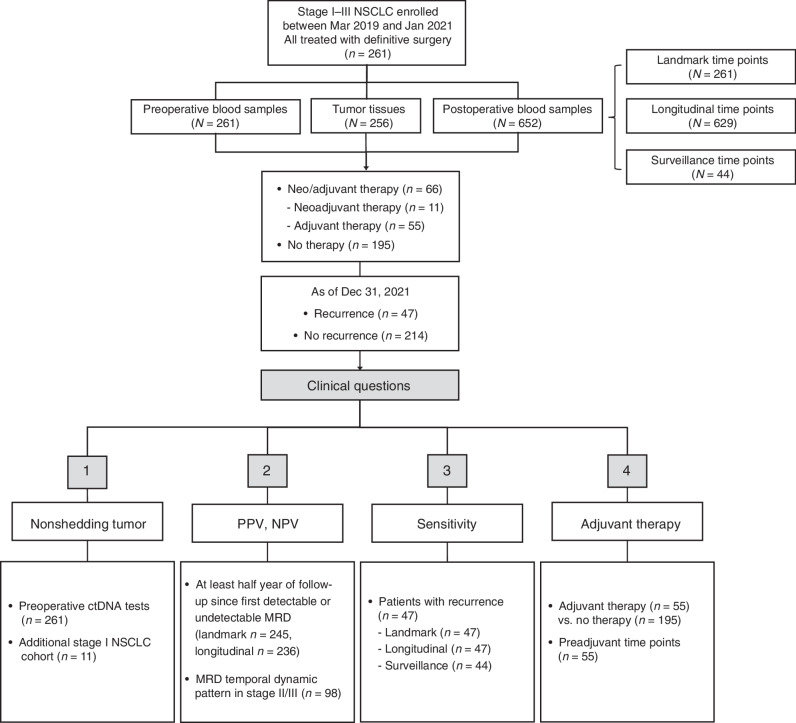
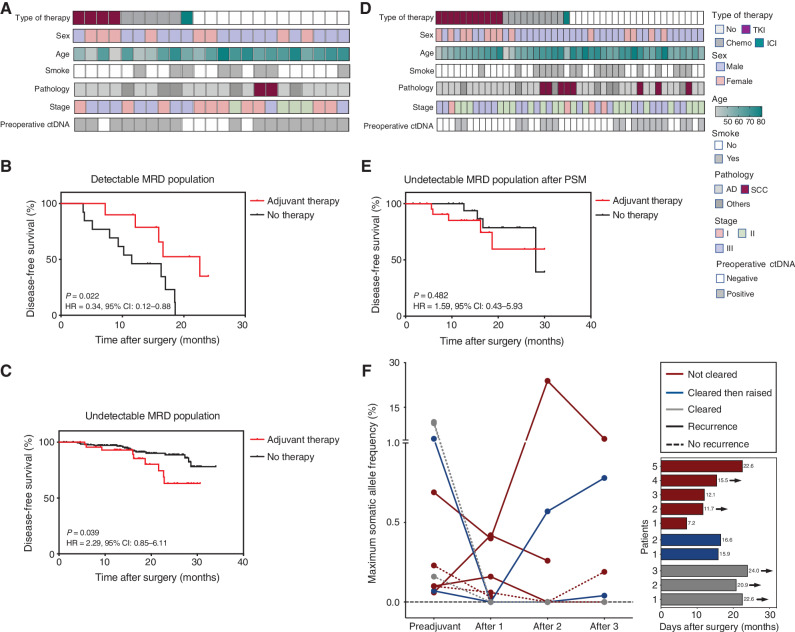
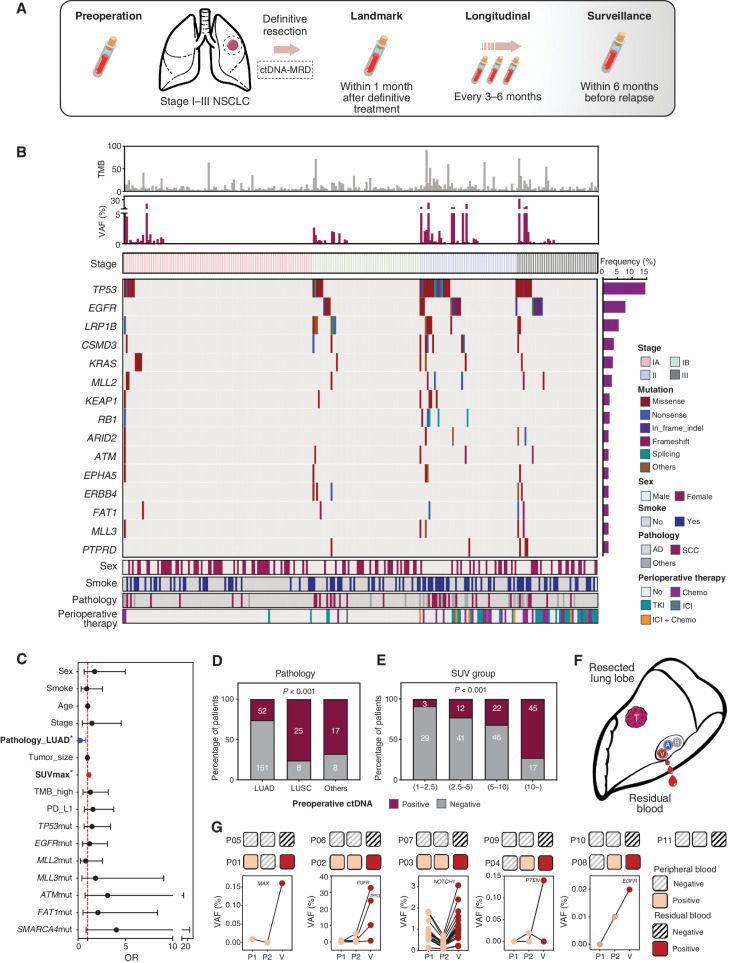
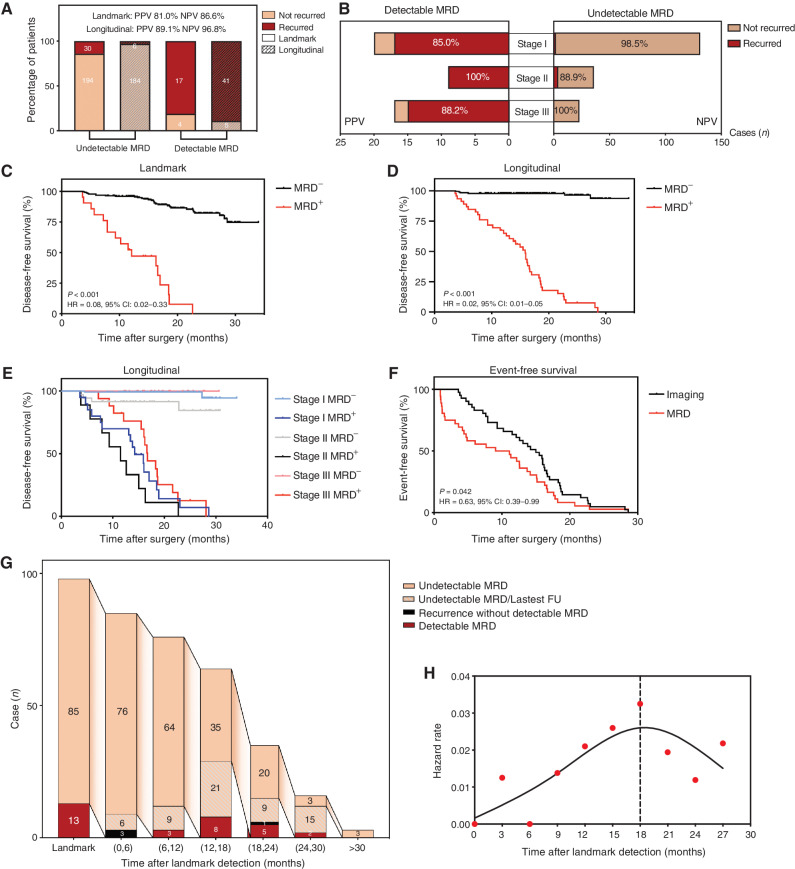
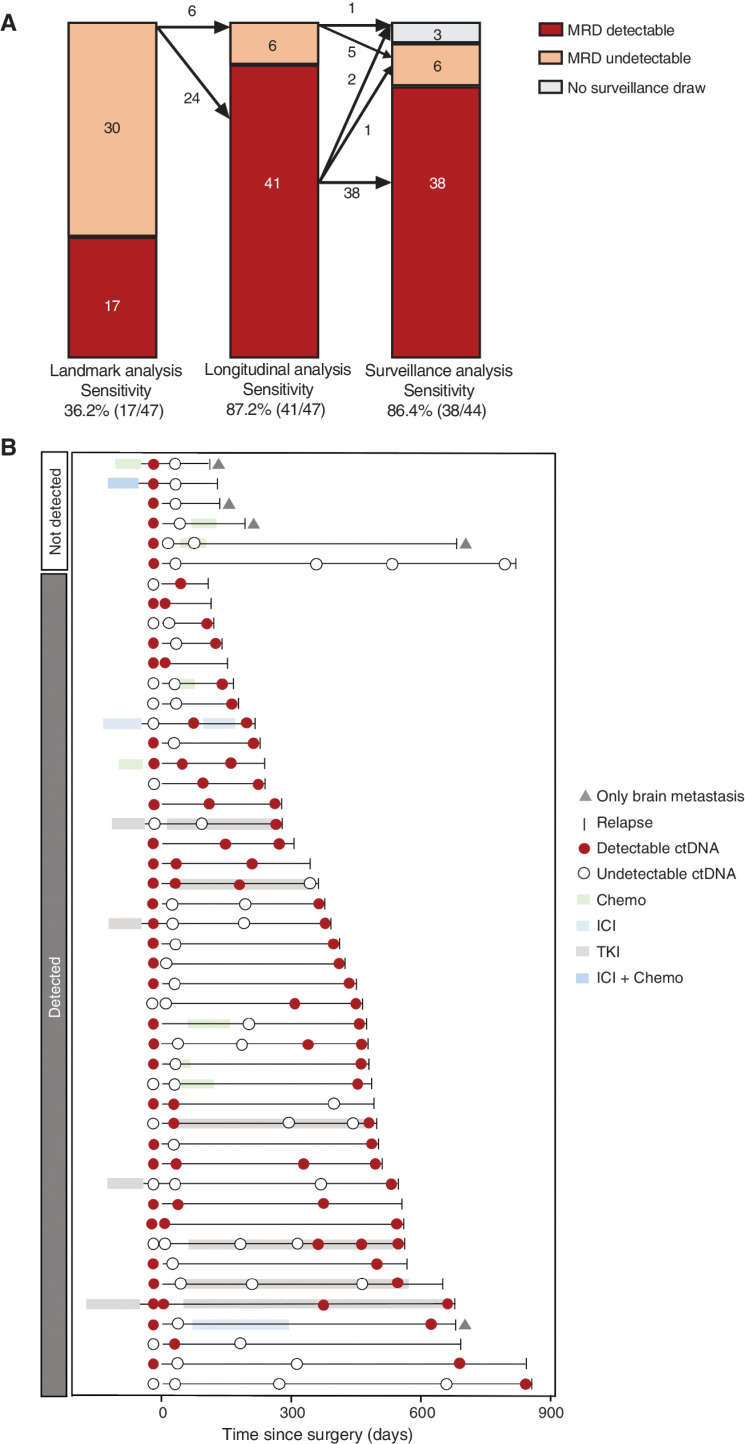
The efficacy and potential limitations of molecular residual disease (MRD) detection urgently need to be fully elucidated in a larger population of non-small cell lung cancer (NSCLC). We enrolled 261 patients with stages I to III NSCLC who underwent definitive surgery, and 913 peripheral blood samples were successfully detected by MRD assay. Within the population, only six patients (3.2%) with longitudinal undetectable MRD recurred, resulting in a negative predictive value of 96.8%. Longitudinal undetectable MRD may define the patients who were cured. The peak risk of developing detectable MRD was approximately 18 months after landmark detection. Correspondingly, the positive predictive value of longitudinal detectable MRD was 89.1%, with a median lead time of 3.4 months. However, brain-only recurrence was less commonly detected by MRD (n = 1/5, 20%). Further subgroup analyses revealed that patients with undetectable MRD might not benefit from adjuvant therapy. Together, these results expound the value of MRD in NSCLC.
This study confirms the prognostic value of MRD detection in patients with NSCLC after definitive surgery, especially in those with longitudinal undetectable MRD, which might represent the potentially cured population regardless of stage and adjuvant therapy. Moreover, the risk of developing detectable MRD decreased stepwise after 18 months since landmark detection. This article is highlighted in the In This Issue feature, p. 1599.
迫切需要在更大的非小细胞肺癌(NSCLC)人群中充分阐明分子残留疾病(MRD)检测的疗效和潜在局限性。我们纳入了 261 名接受根治性手术的 I 期至 III 期 NSCLC 患者,并通过 MRD 检测成功检测到 913 个外周血样本。在该人群中,只有 6 名(3.2%)纵向不可检测 MRD 的患者复发,阴性预测值为 96.8%。纵向不可检测的 MRD 可能定义为已治愈的患者。检测到可检测的 MRD 的风险高峰出现在 landmark 检测后约 18 个月。相应地,纵向可检测 MRD 的阳性预测值为 89.1%,中位领先时间为 3.4 个月。然而,MRD 较少检测到脑转移复发(n = 1/5,20%)。进一步的亚组分析表明,不可检测 MRD 的患者可能无法从辅助治疗中获益。综上所述,这些结果阐述了 MRD 在 NSCLC 中的价值。
本研究证实了 MRD 检测在根治性手术后 NSCLC 患者中的预后价值,尤其是在纵向不可检测 MRD 的患者中,这可能代表了潜在治愈的人群,无论分期和辅助治疗如何。此外,在 landmark 检测后 18 个月,检测到可检测 MRD 的风险呈逐步下降趋势。本文在本期特色栏目(p. 1599)中重点介绍。