Department of Physics, University of California San Diego, La Jolla, CA 92093.
Division of Biological Sciences, University of California San Diego, La Jolla, CA 92093.
Proc Natl Acad Sci U S A. 2022 May 17;119(20):e2201585119. doi: 10.1073/pnas.2201585119. Epub 2022 May 11.
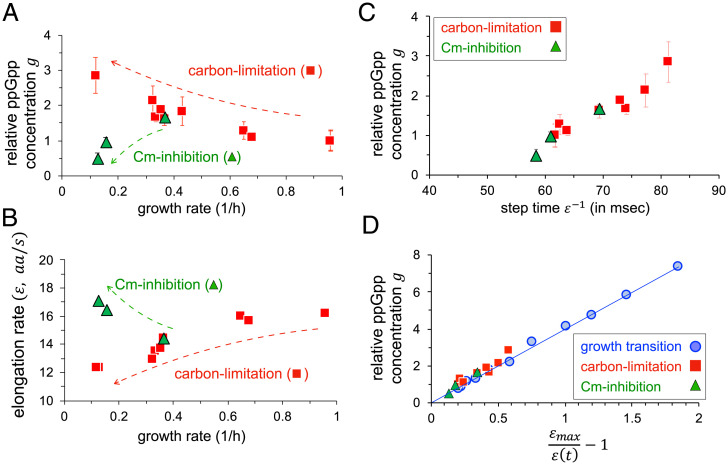
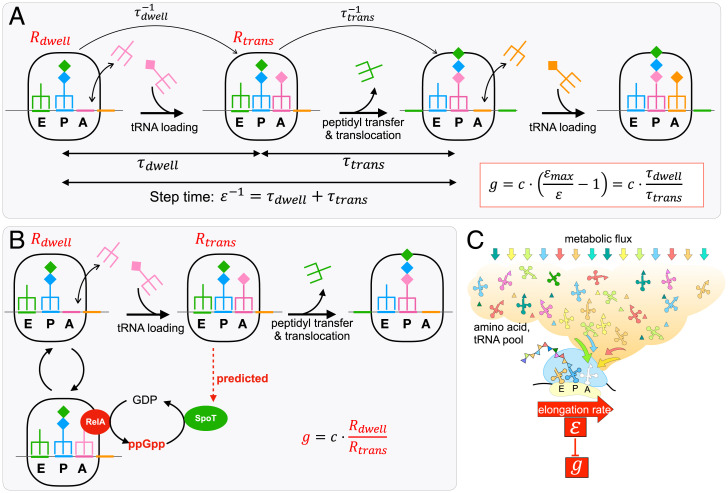
Many cellular activities in bacteria are organized according to their growth rate. The notion that ppGpp measures the cell’s growth rate is well accepted in the field of bacterial physiology. However, despite decades of interrogation and the identification of multiple molecular interactions that connects ppGpp to some aspects of cell growth, we lack a system-level, quantitative picture of how this alleged “measurement” is performed. Through quantitative experiments, we show that the ppGpp pool responds inversely to the rate of translational elongation in Escherichia coli. Together with its roles in inhibiting ribosome biogenesis and activity, ppGpp closes a key regulatory circuit that enables the cell to perceive and control the rate of its growth across conditions. The celebrated linear growth law relating the ribosome content and growth rate emerges as a consequence of keeping a supply of ribosome reserves while maintaining elongation rate in slow growth conditions. Further analysis suggests the elongation rate itself is detected by sensing the ratio of dwelling and translocating ribosomes, a strategy employed to collapse the complex, high-dimensional dynamics of the molecular processes underlying cell growth to perceive the physiological state of the whole.
许多细菌的细胞活动是根据其生长速度组织的。ppGpp 衡量细胞生长速度的概念在细菌生理学领域已被广泛接受。然而,尽管经过了几十年的研究和鉴定,确定了 ppGpp 与细胞生长某些方面相关的多种分子相互作用,但我们仍然缺乏一个系统的、定量的图像,说明这种所谓的“测量”是如何进行的。通过定量实验,我们表明 ppGpp 池与大肠杆菌中翻译延伸的速度呈负相关。ppGpp 与其在抑制核糖体生物发生和活性方面的作用一起,构成了一个关键的调节回路,使细胞能够感知和控制其在不同条件下的生长速度。著名的核糖体含量与生长速度之间的线性生长规律是通过在缓慢生长条件下保持核糖体储备供应和延长率来实现的。进一步的分析表明,延伸率本身是通过检测驻留核糖体和移位核糖体的比例来检测的,这是一种用来简化细胞生长所基于的分子过程的复杂、高维动力学的策略,以感知整个细胞的生理状态。