Honda Kazuho, Takaki Takashi, Kang Dedong
Department of Anatomy, Showa University School of Medicine, Tokyo, Japan.
Division of Electron Microscopy, Showa University, Tokyo, Japan.
Kidney Res Clin Pract. 2023 Mar;42(2):155-165. doi: 10.23876/j.krcp.21.270. Epub 2022 May 4.
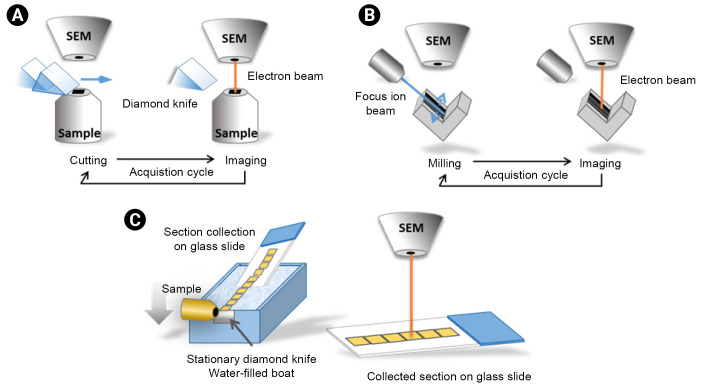
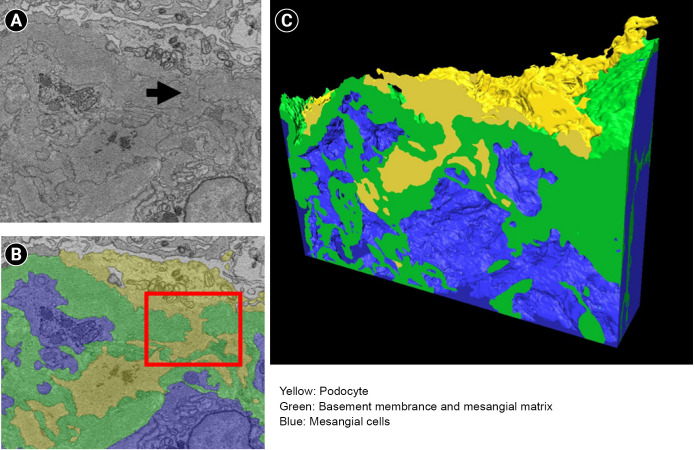
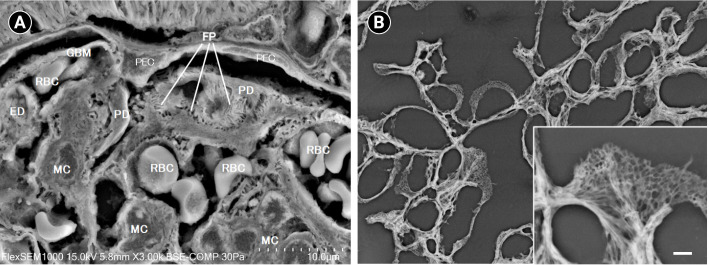
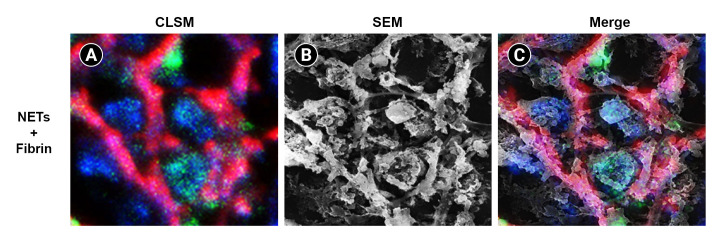
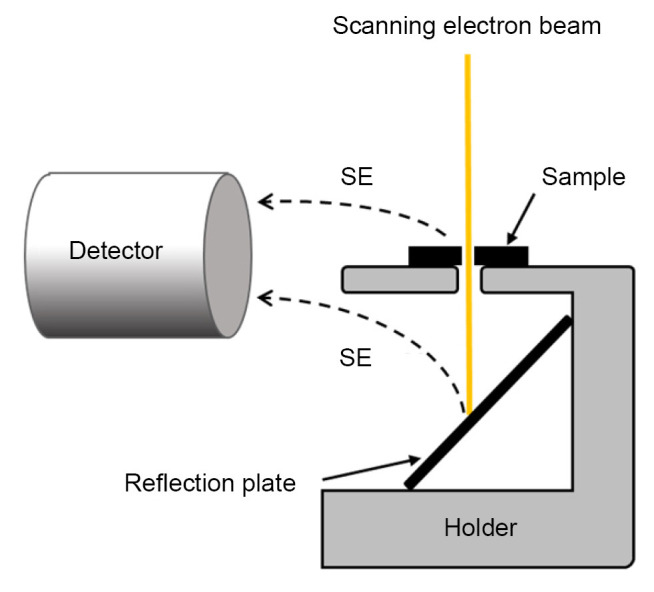
Recent technical advances in the detection of backscattered electrons during scanning electron microscopy (SEM) have improved resolution and have provided several new technologies for research and clinical practice in kidney disease. The advances include three-dimensional (3D) electron microscopy (3D-EM), correlative light and electron microscopy (CLEM), low-vacuum SEM (LVSEM), and scanning transmission electron microscopy (STEM). 3D-EM analysis used to be laborious, but recently three different technologies, serial block-face SEM, focused ion beam SEM, and array tomography, have made 3D-EM easier by automating sectioning and the subsequent image acquisition in an SEM. CLEM is a method to correlate light microscopic images, especially immunofluorescent and electron microscopy images, providing detailed ultrastructure of the area of interest where the immunofluorescent marker is located. LVSEM enables the use of SEM on materials with poor electron conductivity. For example, LVSEM makes it possible for high resolution, 3D observation of paraffin sections. Finally, STEM is a method to observe ultrathin sections with improved resolution by using the focused electron beam scanning used in SEM and not the broad electron beam used in transmission electron microscopy. These technical advances in electron microscopy are promising to provide plenty of novel insights for understanding the pathogenesis and diagnosis of various glomerular diseases.
扫描电子显微镜(SEM)中背散射电子检测技术的最新进展提高了分辨率,并为肾脏疾病的研究和临床实践提供了多种新技术。这些进展包括三维(3D)电子显微镜(3D-EM)、 correlative light and electron microscopy(CLEM)、低真空SEM(LVSEM)和扫描透射电子显微镜(STEM)。3D-EM分析过去很费力,但最近三种不同的技术,即连续块面SEM、聚焦离子束SEM和阵列断层扫描,通过在SEM中自动切片和随后的图像采集,使3D-EM变得更容易。CLEM是一种将光学显微镜图像,特别是免疫荧光和电子显微镜图像相关联的方法,可提供免疫荧光标记所在感兴趣区域的详细超微结构。LVSEM能够对电子导电性差的材料进行SEM分析。例如,LVSEM使对石蜡切片进行高分辨率、三维观察成为可能。最后,STEM是一种通过使用SEM中使用的聚焦电子束扫描而不是透射电子显微镜中使用的宽电子束来观察超薄切片的方法,具有更高的分辨率。电子显微镜的这些技术进展有望为理解各种肾小球疾病的发病机制和诊断提供大量新见解。