Department of Clinical Psychology and Psychotherapy, Philipps-Universität Marburg, Marburg, Germany
Department of Internal Medicine, Division of Haematology and Oncology, Philipps-Universität Marburg Fachbereich Medizin, Marburg, Germany.
BMJ Open. 2022 May 11;12(5):e058531. doi: 10.1136/bmjopen-2021-058531.
During serious illness, open communication with caregivers can ensure high-quality care. Without end-of-life communication, caregivers may become surrogates and decision-makers without knowing the patient's preferences. However, expectations and fears may influence the initiation of communication. The present study investigates differences between palliative patients with cancer and caregivers regarding expectations of end-of-life communication, end-of-life fears and experiences with end-of-life communication.
A cross-sectional study using a semi-structured interview and a paper-based questionnaire SETTING: University Hospital in Germany.
151 participants: 85 palliative cancer patients (mean age: 62.8 years, 65.9% male) and 66 caregivers (mean age: 56.3 years, 28.8% male).
Expectations, end-of-life fears and experiences of end-of-life discussions.
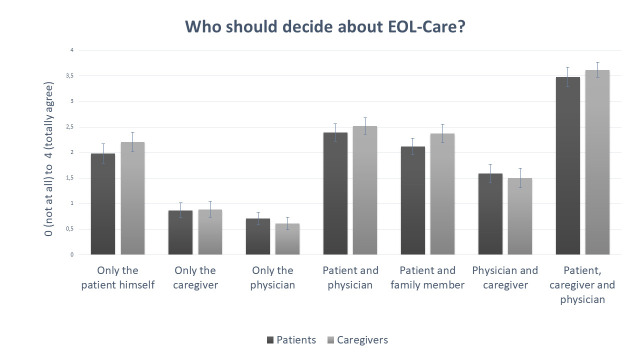
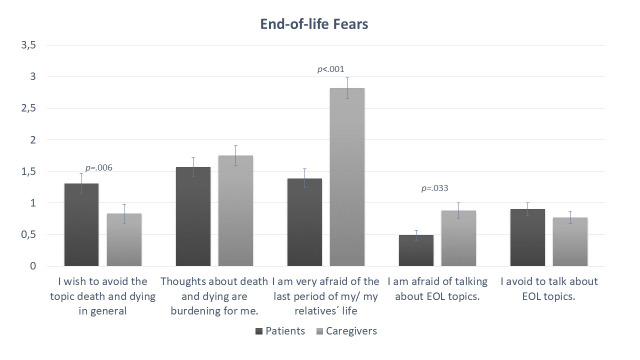
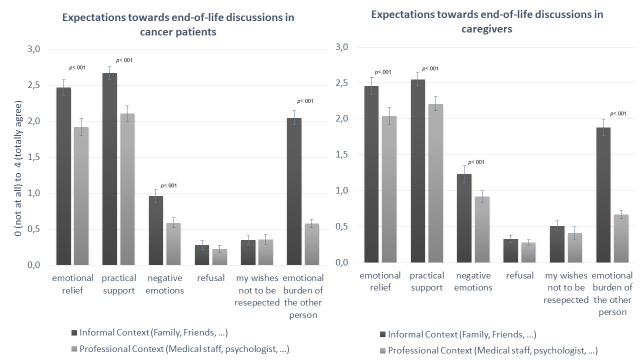
Patients and caregivers wish for the patient to be self-determined. In general, participants reported more positive than negative expectations of end-of-life discussions. Importantly, concerns about emotionally burdening other person was rated much higher in an informal context than a professional context (F(1,149)=316 958, p<0.001, η²=0.680), even though the emotional relief was expected to be higher (F(1,149)=46.115, p<0.001, η²=0.236). Caregivers reported more fears about the last period of life and more fears about end-of-life discussions than palliative patients, whereas palliative patients tended to avoid the topics of death and dying to a greater extent.
There seems to exist a 'self-other' asymmetry: palliative patients and their caregivers expect substantial personal relief when openly talking about end-of-life issues, but also expect the other person to be burdened by such communication. Professionals repeatedly need to initiate end-of-life communication.
在重病期间,与护理人员进行坦诚沟通有助于提供高质量的护理。如果没有临终沟通,护理人员可能会在不知道患者偏好的情况下成为代理人和决策者。然而,期望和恐惧可能会影响沟通的开始。本研究调查了癌症晚期患者和护理人员在临终沟通期望、临终恐惧和临终沟通体验方面的差异。
一项使用半结构式访谈和纸质问卷的横断面研究。
德国大学医院。
151 名参与者:85 名癌症晚期患者(平均年龄:62.8 岁,65.9%为男性)和 66 名护理人员(平均年龄:56.3 岁,28.8%为男性)。
期望、临终恐惧和临终讨论体验。
患者和护理人员希望患者能够自主决定。总的来说,参与者对临终讨论的期望多为积极,而非消极。重要的是,与非正式环境相比,人们在专业环境中对情感负担的担忧要高得多(F(1,149)=316 958,p<0.001,η²=0.680),尽管人们期望情感上得到更多的缓解(F(1,149)=46.115,p<0.001,η²=0.236)。护理人员报告称,他们对生命的最后阶段和临终讨论的恐惧比晚期癌症患者更多,而晚期癌症患者则更倾向于回避死亡和死亡的话题。
似乎存在一种“自我-他人”的不对称性:晚期癌症患者及其护理人员期望在坦诚谈论临终问题时能获得实质性的个人解脱,但也期望对方会因这种沟通而感到负担。专业人员需要反复主动发起临终沟通。