Youth Preventive Services, Health Promotion Board, Singapore.
Singapore Med J. 2023 May;64(5):294-301. doi: 10.11622/smedj.2022053.
Cervical cancer has a high disease burden in Singapore, and it is strongly associated with human papillomavirus (HPV) infections. Despite constant efforts to encourage vaccination, local HPV vaccine uptake remains low. Universal mass vaccination is a proven cost-effective method to reduce the cervical cancer disease burden. This paper reviews the newly implemented school-based HPV vaccination programme in Singapore and the factors that led to its success.
Fully subsidised HPV vaccinations were offered to all Secondary 1 female students on an opt-in basis, starting as a rollout dose in 2019. One-time catchup vaccination was also offered to female students in Secondary 2-5. Eligible recipients were identified using enrolment data provided by Ministry of Education schools. A total of 19,144 students across 139 schools were offered the rollout dose, and 20,854 students across 140 schools were offered the catchup doses.
High vaccine uptake rates of 80.6%-87.3% were noted with the introduction of the school-based programme, translating to high vaccine coverage of 90.3%-93.4%. Only a small proportion of students (1.5%-1.9% per cohort) opted out. The rate of reported side effects, which were commonly known effects, was low at one in 1000. Among the students who reported side effects, those who received the second vaccine dose did so uneventfully.
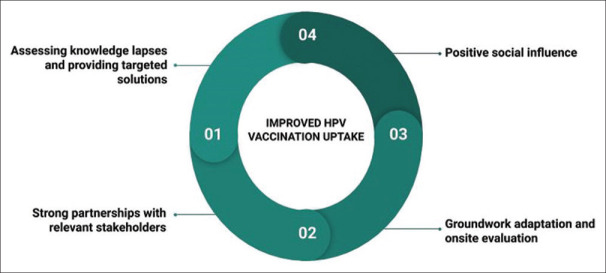
High HPV vaccine coverage was achieved after implementation of the school-based immunisation programme. Timely assessment of knowledge lapses and targeted intervention, strong partnerships with stakeholders, constant on-site adaptation and positive social influence contributed to its success. This model can be applied to future school health programmes.
宫颈癌在新加坡的疾病负担很高,与人类乳头瘤病毒(HPV)感染密切相关。尽管一直在努力鼓励接种疫苗,但当地 HPV 疫苗接种率仍然很低。普遍的大规模疫苗接种是降低宫颈癌疾病负担的一种经过验证的具有成本效益的方法。本文回顾了新加坡新实施的基于学校的 HPV 疫苗接种计划,以及导致该计划成功的因素。
所有中二女学生以选择加入的方式免费接种 HPV 疫苗,从 2019 年开始进行首轮接种。还为中二至五女学生提供一次性补种疫苗。使用教育部学校提供的注册数据来确定符合条件的接种者。共有 139 所学校的 19144 名学生接种了首轮疫苗,140 所学校的 20854 名学生接种了补种疫苗。
随着学校计划的引入,疫苗接种率高达 80.6%-87.3%,这意味着疫苗接种覆盖率高达 90.3%-93.4%。只有一小部分学生(每批 1.5%-1.9%)选择退出。报告副作用的比例很低,每 1000 人中只有一例。在报告副作用的学生中,那些接受第二剂疫苗的学生接种过程很顺利。
在实施基于学校的免疫接种计划后,HPV 疫苗的高覆盖率得以实现。及时评估知识差距并进行针对性干预、与利益相关者建立强有力的伙伴关系、不断进行现场调整以及积极的社会影响促成了该计划的成功。这种模式可以应用于未来的学校卫生计划。