School of Nursing, Nanjing Medical University, Nanjing, Jiangsu, China.
University of Utah College of Nursing, Salt Lake City, UT, USA.
BMC Geriatr. 2022 May 11;22(1):415. doi: 10.1186/s12877-022-03060-0.
Although there is a general trend of functional decline with age, there lacks an understanding of how cancer diagnosis and other factors may contribute to this trend. This study aimed to examine functional limitation trajectories among adults with and without cancer, and before versus after the cancer diagnosis, and to explore potential contributing factors associated with functional trajectories among cancer survivors.
The sample were middle-aged and older Chinese adults who participated in all 3 waves of the China Health and Retirement Longitudinal Study (CHARLS, 2011-2015). Ordinary and multiphase growth curve analyses were conducted to examine (1) differences in functional trajectories between participants with (n = 139) and without cancer (n = 7,313), (2) pre-and post-cancer diagnosis changes in functional limitations among those who reported a cancer diagnosis over the 4-year timeframe, and (3) contributing factors associated with functional trajectories among cancer survivors, guided by the Disablement Process Models, including psychological (depressive symptoms), physical (pain and falls), cognitive (self-reported memory problems), and environmental (social contact and available support) factors.
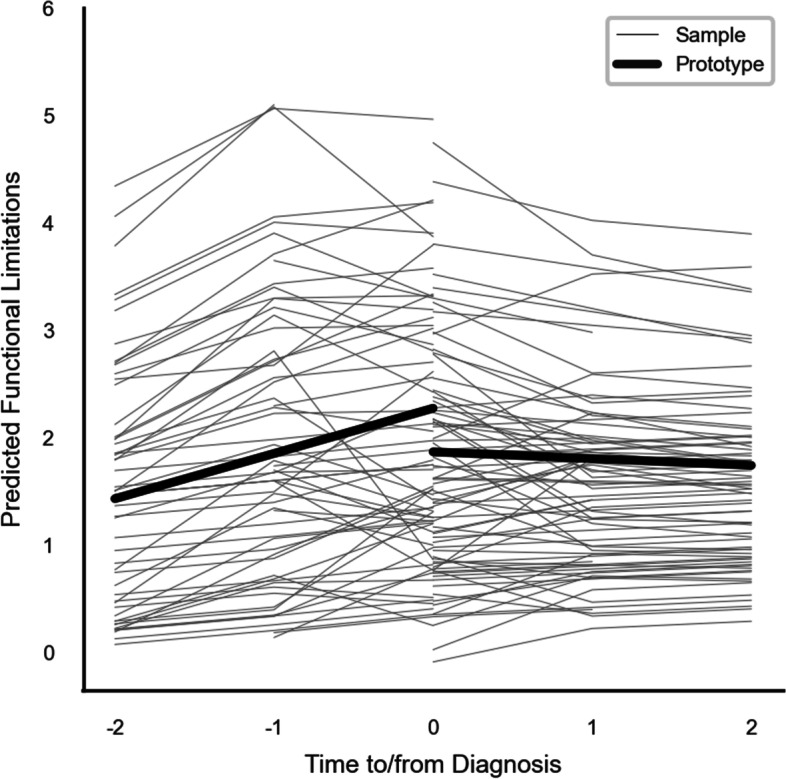
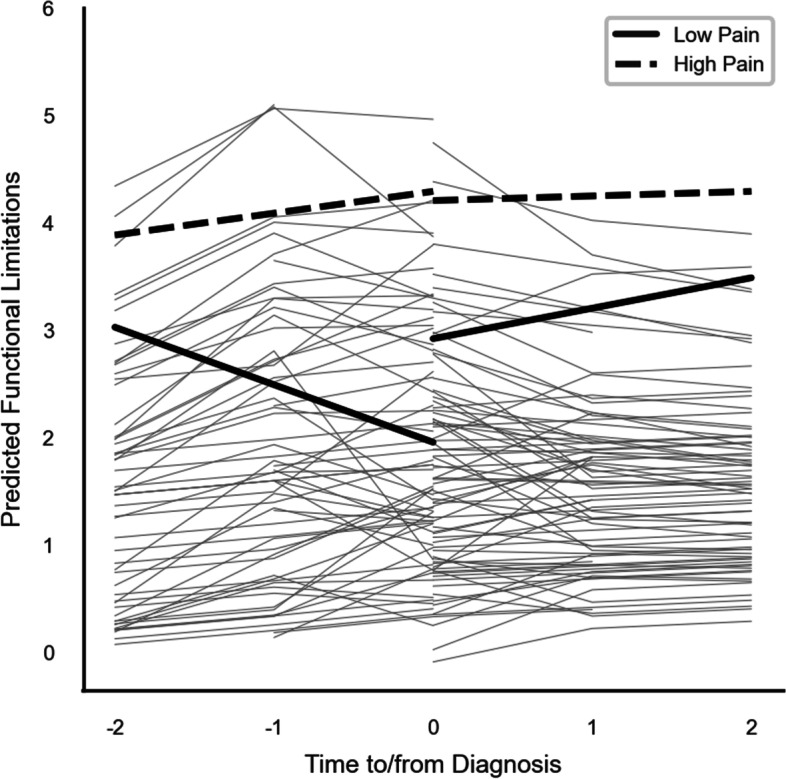
There was a trend of increased functional limitations among all participants over time (unstandardized β = 0.17, p < .0001). However, participants with cancer did not differ from non-cancer participants in neither the level (unstandardized β = 0.77, p = .08) nor the rate of functional decline (unstandardized β = -0.43, p = .07). Functional limitation trajectories were different pre- versus post-cancer diagnosis, although not in expected directions (unstandardized β = -0.48, p < .05). Cancer survivors with greater pain had higher levels of functional limitations which were sustained over time compared to those with less pain (unstandardized β = 0.93, p < .001).
The study confirmed that Chinese middle-aged and older adults had overall decreased functional decline over time. A novel finding that cancer survivors experienced less rapidly functional decline after the cancer diagnosis suggested that cancer diagnosis might serve as an inflection point at which early intervention is promising to slow the functional decline. In addition, findings that within-person contributing factors, such as pain, can be influential in functional limitation trajectories suggested that more attention is needed to pay to patients with cancer-pain. These findings demonstrated the heterogeneity of functional limitation trajectories and needs for person-centered interventions among Chinese cancer survivors.
尽管随着年龄的增长,功能衰退是一种普遍趋势,但人们对癌症诊断和其他因素如何导致这种趋势知之甚少。本研究旨在检验有癌症和无癌症的成年人的功能障碍轨迹,以及癌症诊断前后的功能障碍轨迹,并探讨与癌症幸存者功能轨迹相关的潜在影响因素。
本研究样本为参加了中国健康与养老追踪调查(CHARLS,2011-2015 年)的中老年中国成年人。采用普通和多相增长曲线分析,考察了(1)有癌症和无癌症参与者(癌症组:n=139;无癌症组:n=7313)的功能轨迹差异,(2)在 4 年时间内报告癌症诊断的参与者的癌症诊断前后功能障碍的变化,以及(3)基于残疾过程模型(包括心理因素[抑郁症状]、身体因素[疼痛和跌倒]、认知因素[自我报告的记忆问题]和环境因素[社会联系和可用支持]),探讨与癌症幸存者功能轨迹相关的影响因素。
所有参与者的功能障碍随时间呈上升趋势(未标准化β=0.17,p<0.0001)。然而,癌症组和非癌症组在功能障碍水平(未标准化β=0.77,p=0.08)和功能下降速度(未标准化β=-0.43,p=0.07)上均无差异。尽管方向不符合预期,但癌症诊断前后的功能障碍轨迹仍存在差异(未标准化β=-0.48,p<0.05)。与疼痛程度较低的癌症幸存者相比,疼痛程度较高的癌症幸存者的功能障碍水平更高,且随着时间的推移持续存在(未标准化β=0.93,p<0.001)。
本研究证实,中国中老年成年人的整体功能随时间呈下降趋势。一个新的发现是,癌症幸存者在癌症诊断后功能下降速度较慢,这表明癌症诊断可能是一个拐点,早期干预有望减缓功能下降。此外,个体内的影响因素(如疼痛)在功能障碍轨迹中的影响表明,需要更加关注患有癌症-疼痛的患者。这些发现表明了中国癌症幸存者功能障碍轨迹的异质性和以人为中心的干预需求。