Department of Obstetrics and Gynecology, University of Helsinki and Helsinki University Central Hospital, Helsinki, Finland.
Department of Obstetrics and Gynecology, Medical University Varna, Varna, Bulgaria.
Acta Obstet Gynecol Scand. 2022 Jul;101(7):779-786. doi: 10.1111/aogs.14375. Epub 2022 May 11.
The incidence of ectopic pregnancy is up to four times higher after in vitro fertilization/intracytoplasmic sperm injection (IVF/ICSI) than in spontaneous pregnancies, and the risk of ectopic pregnancy is increased by tubal factor infertility and the transfer of multiple embryos. However, the effect of embryo quality on the probability of ectopic pregnancy has not been investigated until now and it is not clear whether ovarian stimulation parameters affect the incidence of ectopic pregnancy.
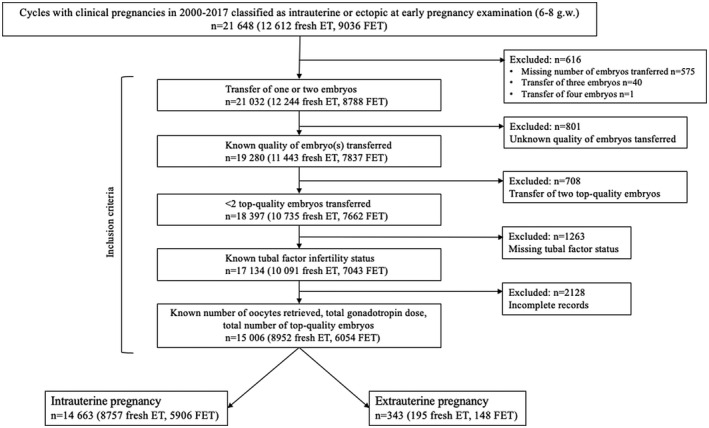
An historical cohort study of 15 006 clinical pregnancies (diagnosed by ultrasound at 6-8 gestational weeks) after non-donor IVF/ICSI with fresh embryo transfer (n = 8952) or frozen-thawed embryo transfer (n = 6054). Treatments were performed during 2000-2017 in Finland. A total of 9207 (61.4%) single and 5799 (38.6%) double embryo transfers of no more than one top-quality embryo were evaluated. We analyzed the effects of multiple factors on ectopic pregnancy by logistic regression, including type of cycle (fresh vs frozen embryo transfer), female age, number and quality of embryos transferred, tubal factor infertility and factors of ovarian response to gonadotropin stimulation.
Ectopic pregnancy was observed in 2.3% of cycles. There was no significant difference in ectopic pregnancy rate after fresh embryo transfer and frozen embryo transfer (2.2% vs 2.4%, p = 0.3). The ectopic pregnancy rate was lower in cycles with top-quality embryo transfer (1.9%) than of those where only non-top quality embryos were transferred (2.7%, p < 0.0001). Tubal factor infertility was diagnosed more often in ectopic pregnancy than in intrauterine pregnancies (21.2% vs 11.0%, p < 0.0001). Logistic regression revealed lower odds for ectopic pregnancy after a top-quality embryo transfer than after transfer of a non-top quality embryo (odds ratio [OR] 0.72, 95% confidence interval [CI] 0.56-0.92, p = 0.007). Transfer of two vs one embryo (OR 1.35, 95% CI 1.05-1.70, p = 0.02) and tubal factor infertility (OR 2.21, 95% CI 1.68-2.91, p < 0.0001) significantly increased the risk of ectopic pregnancy.
Transfer of non-top quality embryos is associated with a higher rate of ectopic pregnancy. This is particularly important to keep in mind in treatments with only non-top embryos available even in the absence of tubal factor infertility. To minimize the risk of ectopic pregnancy, the number of embryos transferred should be as low as possible.
体外受精/胞浆内单精子注射(IVF/ICSI)后异位妊娠的发生率比自然妊娠高 4 倍,而输卵管因素不孕和胚胎移植数量的增加会增加异位妊娠的风险。然而,胚胎质量对异位妊娠概率的影响直到现在还没有被研究过,也不清楚卵巢刺激参数是否会影响异位妊娠的发生率。
这是一项对 15006 例经非供体 IVF/ICSI 后行新鲜胚胎移植(n=8952)或冷冻胚胎移植(n=6054)的临床妊娠(妊娠 6-8 周时经超声诊断)的回顾性队列研究。治疗于 2000-2017 年在芬兰进行。共评估了 9207 例(61.4%)单胚胎和 5799 例(38.6%)不超过一个优质胚胎的双胚胎移植。我们通过逻辑回归分析了多种因素对异位妊娠的影响,包括周期类型(新鲜胚胎移植与冷冻胚胎移植)、女性年龄、移植胚胎的数量和质量、输卵管因素不孕以及促性腺激素刺激反应的因素。
异位妊娠发生率为 2.3%。新鲜胚胎移植和冷冻胚胎移植后异位妊娠发生率无显著差异(2.2% vs 2.4%,p=0.3)。优质胚胎移植后异位妊娠发生率(1.9%)低于仅移植非优质胚胎(2.7%,p<0.0001)。与宫内妊娠相比,异位妊娠中更常诊断出输卵管因素不孕(21.2% vs 11.0%,p<0.0001)。逻辑回归显示,优质胚胎移植后异位妊娠的可能性低于非优质胚胎移植(优势比[OR]0.72,95%置信区间[CI]0.56-0.92,p=0.007)。与移植一个胚胎相比,移植两个胚胎(OR 1.35,95%CI 1.05-1.70,p=0.02)和输卵管因素不孕(OR 2.21,95%CI 1.68-2.91,p<0.0001)显著增加了异位妊娠的风险。
移植非优质胚胎与异位妊娠发生率较高相关。这一点在仅存在非优质胚胎且不存在输卵管因素不孕的治疗中尤为重要。为了最大限度地降低异位妊娠的风险,应尽可能减少胚胎移植的数量。