Yu Geng-Nan, Huang Jun-Chao, Li Li, Liu Ruo-Tong, Cao Jie-Qiong, Wu Qiong, Zhang Shuang-Yan, Wang Cheng-Xi, Mei Wen-Jie, Zheng Wen-Jie
School of Pharmacy, Guangdong Pharmaceutical University Guangzhou 510006 China
Traditional Chinese Medicine College, Guangdong Pharmaceutical University Guangzhou 510006 China.
RSC Adv. 2018 Aug 30;8(53):30573-30581. doi: 10.1039/c8ra05454a. eCollection 2018 Aug 24.
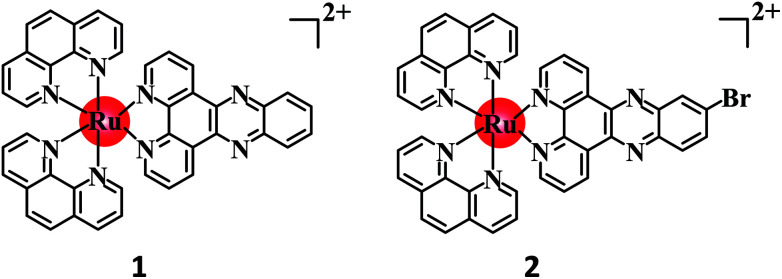
The development of Ru(ii) complexes as luminescent probes has attracted increasing attention in recent decades. In this study, the nanosized polymers of two Ru(ii) complexes Ru(phen)(dppz) (1, phen = 1,10-phenanthrolin; dppz = dipyrido[3,2-:2',3'-]phenazine) and Ru(phen)(Br-dppz) (2, Br-dppz = 11-bromodipyrido[3,2-:2',3'-]phenazine) with oligonucleotides were prepared and investigated as potential tumor-imaging probes. The formation of the nanosized polymers, which had an average width of 125-438 nm and an average height of 3-6 nm, for 1 and 2@oligonucleotides were observed through atomic force microscopy. The emission spectra indicated that the luminescence of 1 and 2 markedly increased after binding to oligonucleotides and double-strand DNA (calf thymus DNA), respectively. Moreover, further studies indicated that 1@oligonucleotides and 2@oligonucleotides can easily enter into tumor cells and selectively highlight the tumor area in the zebrafish bear xenograft tumor (MDA-MB-231). In summary, this study demonstrated that 1@oligonucleotides and 2@oligonucleotides could be developed as potential tumor-imaging luminescent probes for clinical diagnosis and therapy.
近几十年来,钌(II)配合物作为发光探针的发展引起了越来越多的关注。在本研究中,制备了两种钌(II)配合物Ru(phen)(dppz)(1,phen = 1,10 - 菲咯啉;dppz = 二吡啶并[3,2 - a:2',3'- c]吩嗪)和Ru(phen)(Br - dppz)(2,Br - dppz = 11 - 溴二吡啶并[3,2 - a:2',3'- c]吩嗪)与寡核苷酸的纳米聚合物,并将其作为潜在的肿瘤成像探针进行研究。通过原子力显微镜观察到1和2@寡核苷酸形成了纳米聚合物,其平均宽度为125 - 438 nm,平均高度为3 - 6 nm。发射光谱表明,1和2与寡核苷酸和双链DNA(小牛胸腺DNA)结合后,发光明显增强。此外,进一步研究表明,1@寡核苷酸和2@寡核苷酸能够轻松进入肿瘤细胞,并在携带异种移植肿瘤(MDA-MB-231)的斑马鱼中选择性地突出肿瘤区域。总之,本研究表明1@寡核苷酸和2@寡核苷酸可开发成为用于临床诊断和治疗的潜在肿瘤成像发光探针。