Graf A, Lemke J, Schulze M, Soeldner R, Rebner K, Hoehse M, Matuszczyk J
Product Development, Sartorius Stedim Biotech GmbH, Göttingen, Germany.
Corporate Research, Sartorius Stedim Biotech GmbH, Göttingen, Germany.
Front Bioeng Biotechnol. 2022 Apr 25;10:719614. doi: 10.3389/fbioe.2022.719614. eCollection 2022.
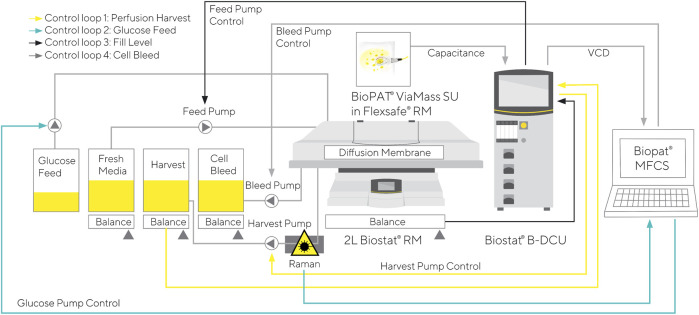
Continuous manufacturing is becoming more important in the biopharmaceutical industry. This processing strategy is favorable, as it is more efficient, flexible, and has the potential to produce higher and more consistent product quality. At the same time, it faces some challenges, especially in cell culture. As a steady state has to be maintained over a prolonged time, it is unavoidable to implement advanced process analytical technologies to control the relevant process parameters in a fast and precise manner. One such analytical technology is Raman spectroscopy, which has proven its advantages for process monitoring and control mostly in (fed-) batch cultivations. In this study, an in-line flow cell for Raman spectroscopy is included in the cell-free harvest stream of a perfusion process. Quantitative models for glucose and lactate were generated based on five cultivations originating from varying bioreactor scales. After successfully validating the glucose model (Root Mean Square Error of Prediction (RMSEP) of ∼0.2 g/L), it was employed for control of an external glucose feed in cultivation with a glucose-free perfusion medium. The generated model was successfully applied to perform process control at 4 g/L and 1.5 g/L glucose over several days, respectively, with variability of ±0.4 g/L. The results demonstrate the high potential of Raman spectroscopy for advanced process monitoring and control of a perfusion process with a bioreactor and scale-independent measurement method.
连续制造在生物制药行业中变得越来越重要。这种加工策略具有优势,因为它更高效、灵活,并且有可能生产出更高且更稳定的产品质量。与此同时,它也面临一些挑战,尤其是在细胞培养方面。由于必须在较长时间内维持稳定状态,因此不可避免地要采用先进的过程分析技术来快速、精确地控制相关过程参数。拉曼光谱法就是这样一种分析技术,它已在(补料)分批培养中充分证明了其在过程监测和控制方面的优势。在本研究中,用于拉曼光谱的在线流通池被纳入灌注过程的无细胞收获流中。基于来自不同生物反应器规模的五次培养生成了葡萄糖和乳酸的定量模型。在成功验证葡萄糖模型(预测均方根误差(RMSEP)约为0.2 g/L)后,将其用于在使用无葡萄糖灌注培养基的培养中控制外部葡萄糖进料。所生成的模型分别成功应用于在4 g/L和1.5 g/L葡萄糖水平下进行为期数天的过程控制,波动范围为±0.4 g/L。结果表明,拉曼光谱法对于采用生物反应器且测量方法与规模无关的灌注过程的先进过程监测和控制具有很高的潜力。