Kakni Panagiota, López-Iglesias Carmen, Truckenmüller Roman, Habibović Pamela, Giselbrecht Stefan
Department of Instructive Biomaterials Engineering, MERLN Institute for Technology-Inspired Regenerative Medicine, Maastricht University, Maastricht, Netherlands.
Microscopy CORE Lab, Maastricht Multimodal Molecular Imaging Institute (M4I), Maastricht University, Maastricht, Netherlands.
Front Bioeng Biotechnol. 2022 Apr 25;10:879024. doi: 10.3389/fbioe.2022.879024. eCollection 2022.
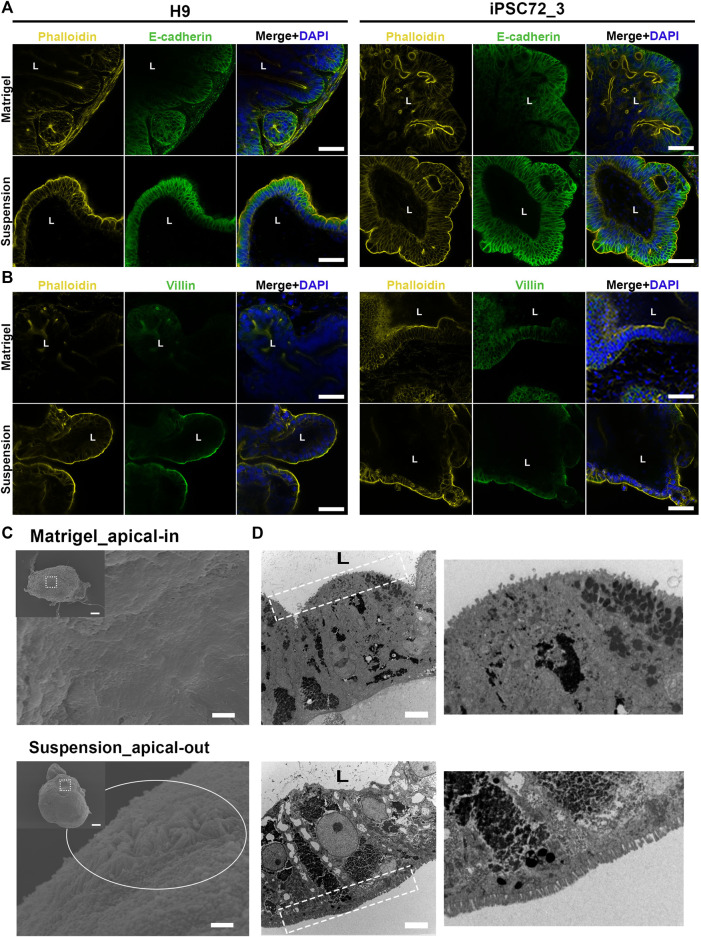
The inner surface of the intestine is a dynamic system, composed of a single layer of polarized epithelial cells. The development of intestinal organoids was a major breakthrough since they robustly recapitulate intestinal architecture, regional specification and cell composition . However, the cyst-like organization hinders direct access to the apical side of the epithelium, thus limiting their use in functional assays. For the first time, we show an intestinal organoid model from pluripotent stem cells with reversed polarity where the apical side faces the surrounding culture media and the basal side faces the lumen. These inside-out organoids preserve a distinct apico-basolateral orientation for a long period and differentiate into the major intestinal cell types. This novel model lays the foundation for developing new functional assays particularly targeting the apical surface of the epithelium and thus offers a new research tool to study nutrient/drug uptake, metabolism and host-microbiome/pathogen interactions.
肠道内表面是一个动态系统,由单层极化上皮细胞组成。肠道类器官的发展是一项重大突破,因为它们能有力地重现肠道结构、区域特化和细胞组成。然而,囊状结构阻碍了直接接触上皮细胞的顶端,从而限制了它们在功能测定中的应用。我们首次展示了一种来自多能干细胞的极性反转的肠道类器官模型,其中顶端面向周围的培养基,基底面向管腔。这些由内向外的类器官长期保持独特的顶-基底方向,并分化为主要的肠道细胞类型。这种新型模型为开发特别针对上皮细胞顶端表面的新功能测定奠定了基础,从而提供了一种新的研究工具来研究营养物质/药物摄取、代谢以及宿主-微生物群/病原体相互作用。