Prillinger Karin, Radev Stefan T, Doganay Kamer, Poustka Luise, Konicar Lilian
Department of Child and Adolescent Psychiatry, Medical University of Vienna, Vienna, Austria.
Department of Quantitative Research Methods, Institute of Psychology, Heidelberg University, Heidelberg, Germany.
Front Hum Neurosci. 2022 Apr 25;16:838080. doi: 10.3389/fnhum.2022.838080. eCollection 2022.
The contingent negative variation (CNV) is a well-studied indicator of attention- and expectancy-related processes in the human brain. An abnormal CNV amplitude has been found in diverse neurodevelopmental psychiatric disorders. However, its role as a potential biomarker of successful clinical interventions in autism spectrum disorder (ASD) remains unclear.
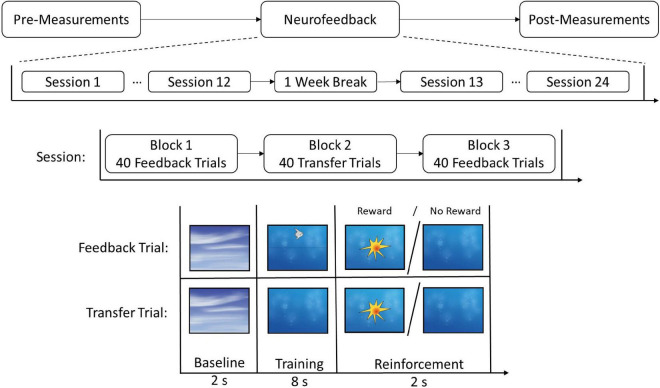
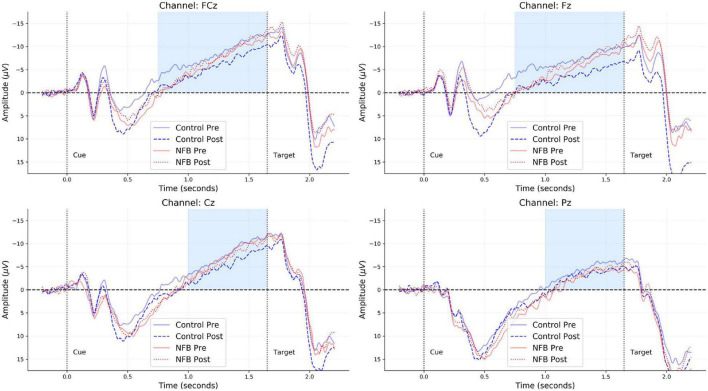
In this randomized controlled trial, we investigated how the CNV changes following an intensive neurofeedback training. Therefore, twenty-one adolescents with ASD underwent 24 sessions of slow cortical potential (SCP) neurofeedback training. Twenty additional adolescents with ASD formed a control group and received treatment as usual. CNV waveforms were obtained from a continuous performance test (CPT), which all adolescents performed before and after the corresponding 3-month long training period. In order to utilize all available neural time series, trial-based area under the curve values for all four electroencephalogram (EEG) channels were analyzed with a hierarchical Bayesian model. In addition, the model included impulsivity, inattention, and hyperactivity as potential moderators of change in CNV.
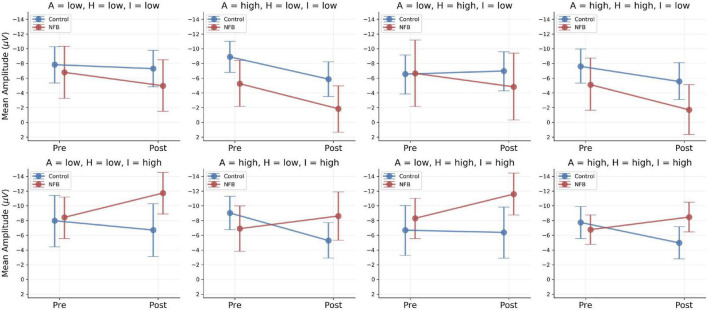
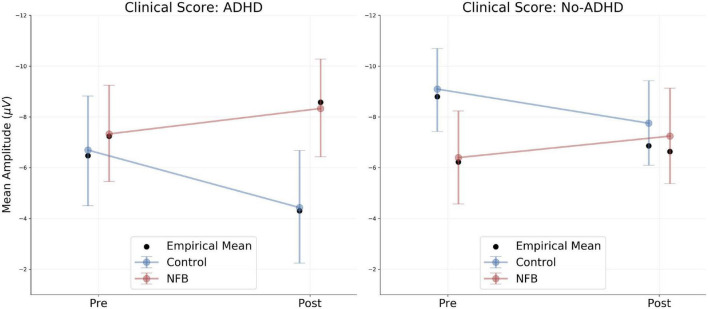
Our model implies that impulsivity moderates the effects of neurofeedback training on CNV depending on group. In the control group, the average CNV amplitude decreased or did not change after treatment as usual. In the experimental group, the CNV changed depending on the severity of comorbid impulsivity symptoms. The average CNV amplitude of participants with low impulsivity scores decreased markedly, whereas the average CNV amplitude of participants with high impulsivity increased.
The degree of impulsivity seems to play a crucial role in the changeability of the CNV following an intensive neurofeedback training. Therefore, comorbid symptomatology should be recorded and analyzed in future EEG-based brain training interventions.
https://www.drks.de, identifier DRKS00012339.
关联性负变(CNV)是人类大脑中与注意力和预期相关过程的一个经过充分研究的指标。在多种神经发育性精神疾病中都发现了异常的CNV振幅。然而,其作为自闭症谱系障碍(ASD)成功临床干预潜在生物标志物的作用仍不明确。
在这项随机对照试验中,我们研究了强化神经反馈训练后CNV如何变化。因此,21名患有ASD的青少年接受了24节慢皮层电位(SCP)神经反馈训练。另外20名患有ASD的青少年组成对照组,接受常规治疗。CNV波形通过连续性能测试(CPT)获得,所有青少年在为期3个月的相应训练期前后都进行了该测试。为了利用所有可用的神经时间序列,使用分层贝叶斯模型分析了所有四个脑电图(EEG)通道基于试验的曲线下面积值。此外,该模型将冲动性、注意力不集中和多动作为CNV变化的潜在调节因素。
我们的模型表明,冲动性根据组别调节神经反馈训练对CNV的影响。在对照组中,常规治疗后平均CNV振幅降低或未改变。在实验组中,CNV的变化取决于共病冲动症状的严重程度。冲动性得分低的参与者的平均CNV振幅显著降低,而冲动性得分高的参与者的平均CNV振幅增加。
冲动程度似乎在强化神经反馈训练后CNV的可变性中起关键作用。因此,在未来基于脑电图的脑训练干预中应记录和分析共病症状。