Department of Child and Adolescence Psychiatry, Medical University of Vienna, Vienna, Austria.
Department of Child and Adolescence Psychiatry, Medical University of Vienna, Vienna, Austria; Institute of Psychology, University of Heidelberg, Germany.
Neuroimage Clin. 2021;29:102557. doi: 10.1016/j.nicl.2021.102557. Epub 2021 Jan 9.
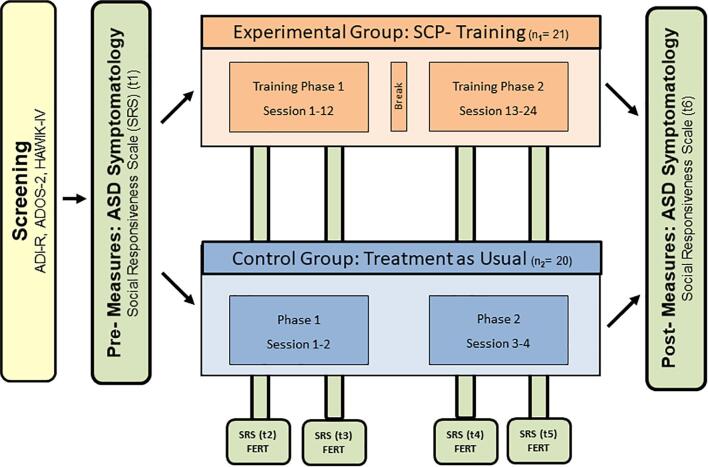
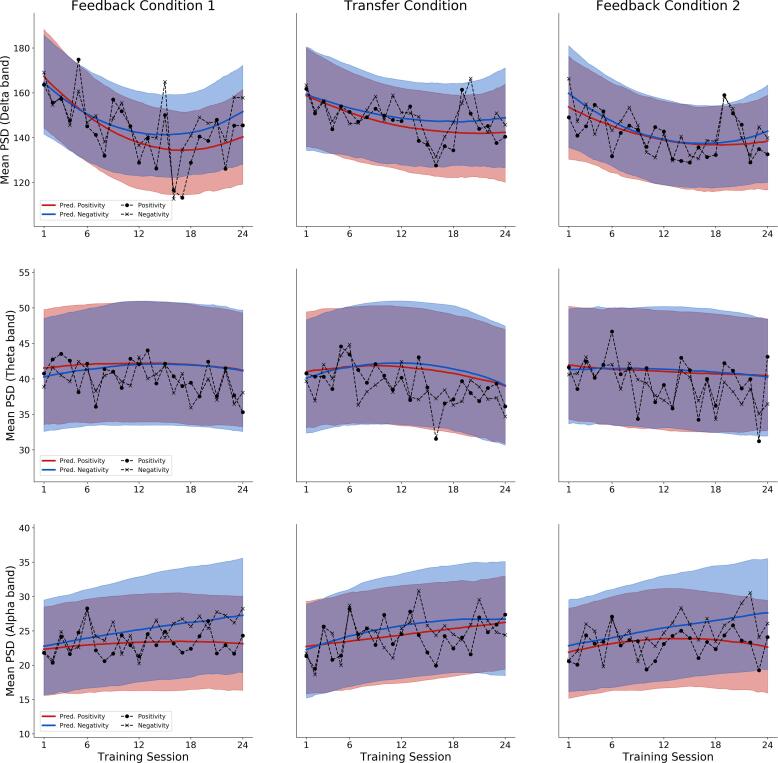
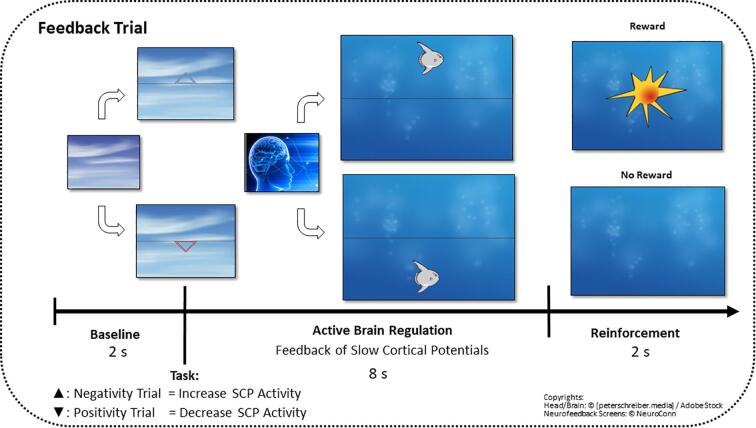
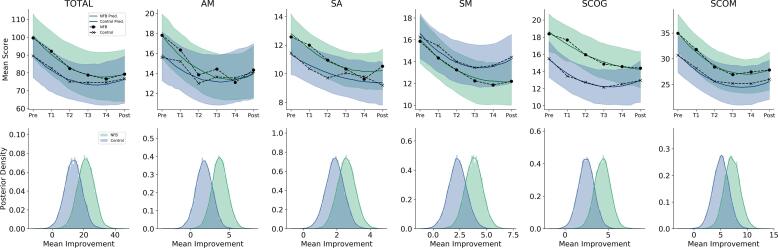
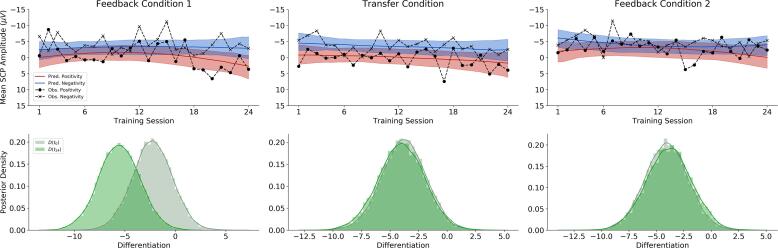
Autism spectrum disorder is (ASD) characterized by a persisting triad of impairments of social interaction, language as well as inflexible, stereotyped and ritualistic behaviors. Increasingly, scientific evidence suggests a neurobiological basis of these emotional, social and cognitive deficits in individuals with ASD. The aim of this randomized controlled brain self-regulation intervention study was to investigate whether the core symptomatology of ASD could be reduced via an electroencephalography (EEG) based brain self-regulation training of Slow Cortical Potentials (SCP). 41 male adolescents with ASD were recruited and allocated to a) an experimental group undergoing 24 sessions of EEG-based brain training (n = 21), or to b) an active control group undergoing conventional treatment (n = 20), that is, clinical counseling during a 3-months intervention period. We employed real-time neurofeedback training recorded from a fronto-central electrode intended to enable participants to volitionally regulate their brain activity. Core autistic symptomatology was measured at six time points during the intervention and analyzed with Bayesian multilevel approach to characterize changes in core symptomatology. Additional Bayesian models were formulated to describe the neural dynamics of the training process as indexed by SCP (time-domain) and power density (PSD, frequency-domain) measures. The analysis revealed a substantial improvement in the core symptomatology of ASD in the experimental group (reduction of 21.38 points on the Social Responsiveness Scale, SD = 5.29), which was slightly superior to that observed in the control group (evidence Ratio = 5.79). Changes in SCP manifested themselves as different trajectories depending on the different feedback conditions and tasks. Further, the model of PSD revealed a continuous decrease in delta power, parallel to an increase in alpha power. Most notably, a non-linear (quadratic) model turned out to be better at predicting the data than a linear model across all analyses. Taken together, our analyses suggest that behavioral and neural processes of change related to neurofeedback training are complex and non-linear. Moreover, they have implications for the design of future trials and training protocols.
自闭症谱系障碍(ASD)的特征是社交互动、语言以及僵化、刻板和仪式性行为方面持续存在的三重障碍。越来越多的科学证据表明,自闭症个体的这些情绪、社交和认知缺陷存在神经生物学基础。本随机对照脑自我调节干预研究的目的是调查基于脑电图(EEG)的慢皮层电位(SCP)自我调节训练是否可以减少 ASD 的核心症状。招募了 41 名男性 ASD 青少年,并将他们分配到 a) 实验组,进行 24 次基于 EEG 的大脑训练(n=21),或 b) 主动对照组,进行常规治疗(n=20),即在 3 个月的干预期间进行临床咨询。我们采用实时神经反馈训练,记录来自额中央电极的信号,旨在使参与者能够自主调节大脑活动。在干预期间的六个时间点测量核心自闭症症状,并采用贝叶斯多层方法进行分析,以描述核心症状的变化。还制定了额外的贝叶斯模型来描述 SCP(时域)和功率密度(PSD,频域)测量指标所反映的训练过程中的神经动力学。分析结果表明,实验组 ASD 的核心症状有了显著改善(社会反应量表减少 21.38 分,SD=5.29),略优于对照组(证据比=5.79)。SCP 的变化表现为不同的轨迹,这取决于不同的反馈条件和任务。此外,PSD 的模型揭示了 delta 功率的连续下降,与 alpha 功率的增加平行。值得注意的是,与线性模型相比,所有分析中,非线性(二次)模型在预测数据方面表现更好。总的来说,我们的分析表明,与神经反馈训练相关的行为和神经过程的变化是复杂的、非线性的。此外,它们对未来试验和训练方案的设计具有启示意义。