Stephens Georgina C, Sarkar Mahbub, Lazarus Michelle D
Centre for Human Anatomy Education, Department of Anatomy and Developmental Biology, Monash University, Melbourne, VIC, Australia.
Monash Centre for Scholarship in Health Education, Faculty of Medicine, Nursing and Health Sciences, Monash University, Melbourne, VIC, Australia.
Front Med (Lausanne). 2022 Apr 25;9:864141. doi: 10.3389/fmed.2022.864141. eCollection 2022.
Uncertainty tolerance (UT), a construct explicating individuals' response to perceived uncertainty, is increasingly considered a competency for effective medical practice. Lower UT among physicians is linked with negative outcomes, including less favorable attitudes toward patient-centered care, and increased burnout risk. Despite decades of research, as yet few have engaged methodological approaches aiming to understand the factors that may influence medical students' UT (so-called moderators). Such knowledge, though, could inform teaching practices for fostering learners' skills for managing uncertainties. Accordingly, we asked "
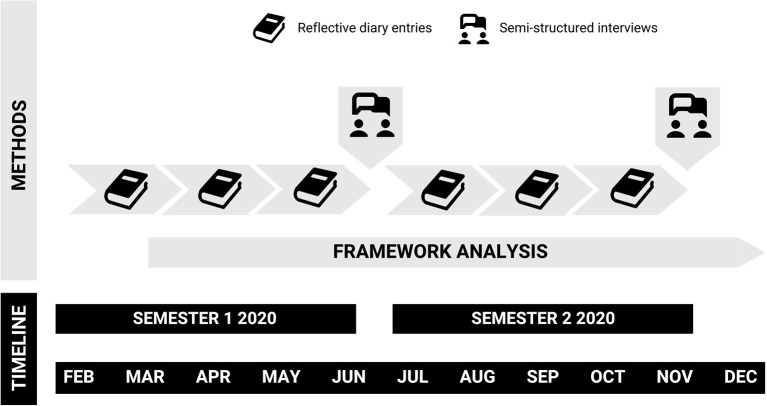
We conducted a qualitative study with forty-one medical students in clinical years at an Australian medical school, with data collected throughout 2020. Participants described their experiences of uncertainty through both in-semester reflective diary entries ( = 230) and end of semester group or individual semi-structured interviews ( = 40). Data were analyzed using a team-based framework analysis approach.
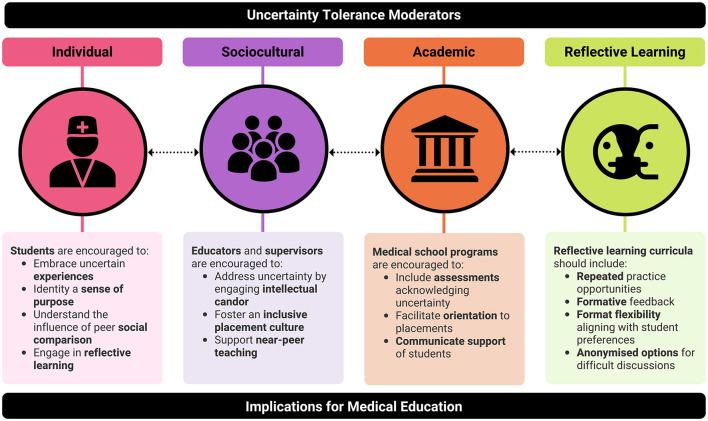
Four major themes of UT moderators were identified: (1) Individual factors, (2) Sociocultural factors, (3) Academic factors and (4) Reflective learning. Aspects of individual, sociocultural and academic factors were perceived as having either positive or negative influences on students' perceptions of uncertainty. By contrast, reflective learning was described as having a predominantly positive influence on students' perceptions of uncertainty, with students noting learning opportunities and personal growth afforded through uncertain experiences.
As healthcare becomes increasingly complex, a future challenge is equipping our medical students with strategies and skills to manage uncertainties. Our study identified multiple moderators of medical students' UT, key among them being reflective learning. We also identified UT moderators that contemporary and future medical educators may be able to harness in order to develop learner UT as a healthcare graduate attribute, especially through teaching practices such as intellectual candor. Further research is now required to evaluate the impact of proposed educational interventions, and to develop effective assessments of students' skills for managing clinical uncertainties.
不确定性容忍度(UT)是一种解释个体对感知到的不确定性的反应的结构,越来越被认为是有效医疗实践的一项能力。医生较低的不确定性容忍度与负面结果相关,包括对以患者为中心的护理态度不那么积极,以及倦怠风险增加。尽管经过了数十年的研究,但迄今为止,很少有人采用旨在了解可能影响医学生不确定性容忍度的因素(所谓的调节因素)的方法。然而,这些知识可以为培养学习者应对不确定性的技能的教学实践提供参考。因此,我们提出了“
我们对澳大利亚一所医学院临床年级的41名医学生进行了一项定性研究,数据收集于2020年全年。参与者通过学期内的反思日记条目(n = 230)和学期末的小组或个人半结构化访谈(n = 40)描述了他们的不确定性经历。数据采用基于团队的框架分析方法进行分析。
确定了不确定性容忍度调节因素的四个主要主题:(1)个人因素,(2)社会文化因素,(3)学术因素和(4)反思性学习。个人、社会文化和学术因素的各个方面被认为对学生对不确定性的认知有积极或消极影响。相比之下,反思性学习被描述为对学生对不确定性的认知主要有积极影响,学生指出通过不确定的经历获得了学习机会和个人成长。
随着医疗保健变得越来越复杂,未来的一项挑战是让我们的医学生具备应对不确定性的策略和技能。我们的研究确定了医学生不确定性容忍度的多个调节因素,其中关键的是反思性学习。我们还确定了当代和未来的医学教育工作者可以利用的不确定性容忍度调节因素,以便将学习者的不确定性容忍度培养成为医疗保健毕业生的一项特质,特别是通过诸如学术坦诚等教学实践。现在需要进一步的研究来评估所提议的教育干预措施的影响,并开发对学生应对临床不确定性技能的有效评估。