Wicks Eric D, Stack Jason, Rezaie Nima, Zeini Ibrahim Mamdouh, Osbahr Daryl C
Orlando Health Orthopedics and Sports Medicine, Orlando, Florida, USA.
Orthop J Sports Med. 2022 May 5;10(5):23259671221091252. doi: 10.1177/23259671221091252. eCollection 2022 May.
Internal bracing of anterior cruciate ligament (ACL) surgery is a newer concept gaining popularity.
PURPOSE/HYPOTHESIS: To assess the biomechanical performance of soft tissue ACL reconstruction allografts reinforced with suture tape. It was hypothesized that load to failure would increase and cyclic displacement would decrease at time zero in the constructs reinforced with internal brace suture tape compared with those without suture tape augmentation.
Controlled laboratory study.
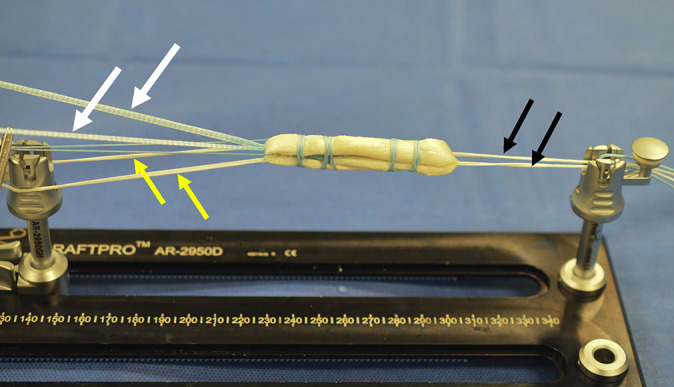
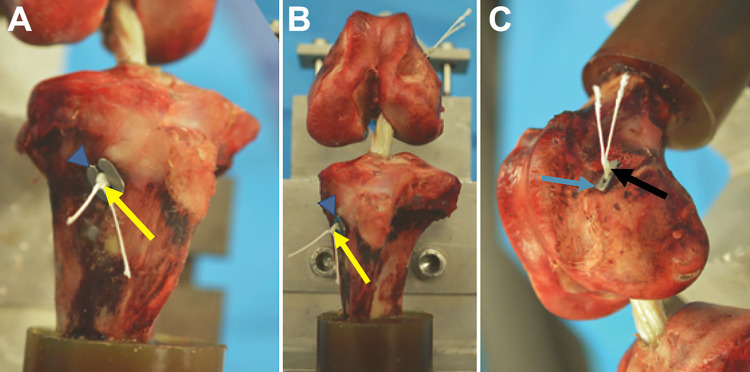
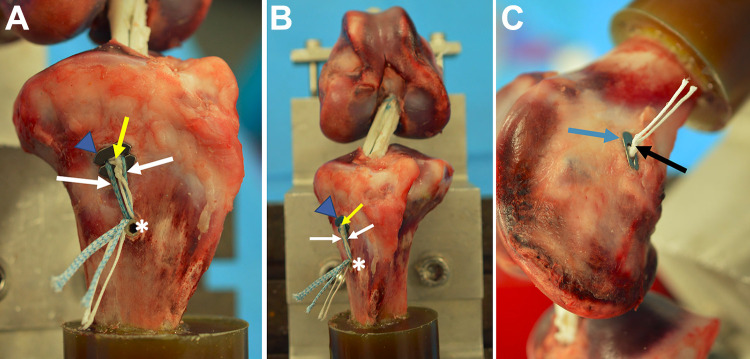
We performed ACL reconstruction on porcine knees using bovine extensor tendon soft tissue allografts: 10 knees without (control) and 10 knees with (reinforced) suture tape reinforcement. An all-inside reconstruction technique was utilized with retrograde tunnel creation. An adjustable-loop device was used for femoral and tibial fixation of all grafts. The suture tape was placed through the tension loop in the femoral fixation construct and independently fixed in the tibia with an interference screw anchor. For each specimen, the authors recorded ultimate load, yield load, stiffness, cyclic displacement, and mode of failure. Outcomes between groups were compared using the Student test.
There was a 33% decrease in mean cyclic displacement in the specimens with reinforced grafts (reinforced vs control: 3.9 ± 0.7 vs 5.8 ± 1.5 mm; = .001). The reinforced grafts also had a 22% higher mean ultimate load (921 ± 180 vs 717 ± 122 N; = .008) and a 25% higher mean yield load (808 ± 201 vs 602 ± 155 N; = .020). There was no significant difference in stiffness between the reinforced versus nonreinforced grafts (136 ± 16 vs 132 ± 18 N/mm; = .617). Three of the 10 control specimens failed at the graft, compared with 1 of 10 reinforced grafts. All other constructs in both groups failed at the tibial fixation site.
Suture tape reinforcement of soft tissue grafts significantly decreased cyclic displacement while significantly increasing ultimate and yield loads without increasing graft construct stiffness during biomechanical testing at time zero in a porcine animal model.
The improved biomechanical performance of suture tape-reinforced graft constructs could allow patients to participate in earlier advancement of aggressive rehabilitation and potentially reduce failure rates as graft remodeling progresses.
前交叉韧带(ACL)手术中的内部支撑是一个越来越流行的新概念。
目的/假设:评估用缝线带增强的软组织ACL重建同种异体移植物的生物力学性能。假设与未用缝线带增强的结构相比,在零时用内部支撑缝线带增强的结构中,失效负荷会增加,循环位移会减少。
对照实验室研究。
我们使用牛伸肌腱软组织同种异体移植物对猪膝关节进行ACL重建:10个膝关节未用(对照组),10个膝关节用(增强组)缝线带增强。采用全关节镜重建技术并逆行创建隧道。所有移植物均使用可调环装置进行股骨和胫骨固定。缝线带穿过股骨固定结构中的张力环,并通过干涉螺钉锚独立固定在胫骨中。对于每个标本,作者记录了极限负荷、屈服负荷、刚度、循环位移和失效模式。使用学生t检验比较两组之间的结果。
增强移植物的标本平均循环位移降低了33%(增强组与对照组:3.9±0.7 vs 5.8±1.5 mm;P = 0.001)。增强移植物的平均极限负荷也高出22%(921±180 vs 717±122 N;P = 0.008),平均屈服负荷高出25%(808±201 vs 602±155 N;P = 0.020)。增强移植物与未增强移植物之间的刚度无显著差异(136±16 vs 132±18 N/mm;P = 0.617)。10个对照标本中有3个在移植物处失效,而10个增强移植物中有1个失效。两组中的所有其他结构均在胫骨固定部位失效。
在猪动物模型中零时的生物力学测试期间,软组织移植物的缝线带增强显著降低了循环位移,同时显著增加了极限负荷和屈服负荷,而未增加移植物结构的刚度。
缝线带增强移植物结构的生物力学性能改善可能使患者能够更早地积极推进康复,并随着移植物重塑的进展潜在地降低失败率。