Ahmadikhatir Shonaz, Ostadrahimi Alireza, Safaiyan Abdolrasoul, Ahmadikhatir Shoyar, Farrin Nazila
Nutrition Research Center, Faculty of Nutrition and Food Science, Tabriz University of Medical Sciences, Tabriz, Iran.
Department of Vital Statistics and Epidemiology, Faculty of Health, Tabriz University of Medical Sciences, Tabriz, Iran.
J Res Med Sci. 2022 Apr 15;27:30. doi: 10.4103/jrms.JRMS_1253_20. eCollection 2022.
Atherosclerosis is the most common cause of the cardiovascular disease. Saffron is a traditional food that affects many diseases and disorders. Therefore, the aim of this study was to identify the effects of Saffron ( L.) on quality of life (QOL) and appetite in patients with atherosclerosis.
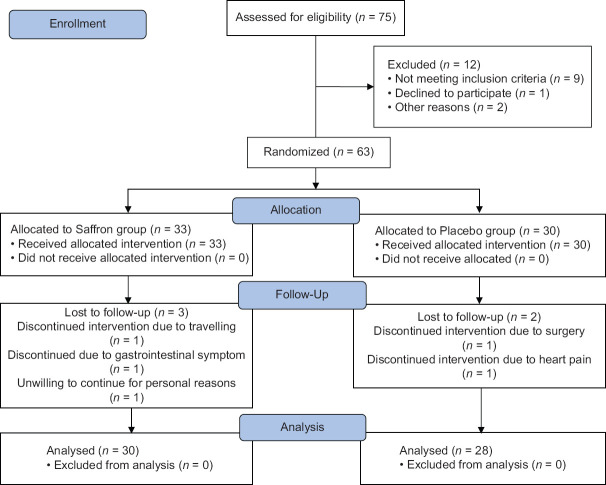
This was a randomized, double-blind, placebo-controlled clinical trial. A total of 63 participants with atherosclerosis were recruited from Emam Sajjad Hospital, Valiasr Hospital, and Zafaranieyh Clinic in Tehran, Iran. The participants were divided randomly into two groups. Participants received 100 mg/d saffron or placebo capsule for 6 weeks. QOL and appetite levels were measured by the McNew QOL questionnaire, and visual analog scale questionnaire, respectively. Furthermore, anthropometric indices of participants were measured before and after the intervention.
Statistical analysis showed that there was a statistically significant difference between atherosclerosis patients who received placebo and those who consumed saffron in terms of the physical domain ( = 0.008) and social domain ( = 0.012) of QOL. In the saffron group increased score in Total score Macnew ( < 0.001), physical domain ( = 0.025), and social domain ( < 0.001) was significant after the intervention. Moreover, the consumption of saffron did not significantly affect emotional domains of QOL, and appetite levels.
Saffron may be considered as a novel agent in patients with atherosclerosis to improve the QOL. A great deal of further research will be needed to critically validate the efficacy of saffron and its mechanisms in atherosclerosis.
动脉粥样硬化是心血管疾病最常见的病因。藏红花是一种影响多种疾病和紊乱状况的传统食物。因此,本研究的目的是确定藏红花对动脉粥样硬化患者生活质量(QOL)和食欲的影响。
这是一项随机、双盲、安慰剂对照的临床试验。总共从伊朗德黑兰的伊玛目萨贾德医院、瓦利亚斯尔医院和扎法拉尼耶诊所招募了63名动脉粥样硬化患者。参与者被随机分为两组。参与者接受100毫克/天的藏红花或安慰剂胶囊,持续6周。生活质量和食欲水平分别通过麦克纽生活质量问卷和视觉模拟量表问卷进行测量。此外,在干预前后测量参与者的人体测量指标。
统计分析表明,在生活质量的身体领域(P = 0.008)和社会领域(P = 0.012)方面,接受安慰剂的动脉粥样硬化患者与食用藏红花的患者之间存在统计学上的显著差异。在藏红花组中,干预后麦克纽总分(P < 0.001)、身体领域(P = 0.025)和社会领域(P < 0.001)的得分显著增加。此外,藏红花的食用对生活质量的情感领域和食欲水平没有显著影响。
藏红花可被视为改善动脉粥样硬化患者生活质量的一种新型药物。需要大量进一步的研究来严格验证藏红花在动脉粥样硬化中的疗效及其机制。