Abedimanesh Nasim, Bathaie S Zahra, Abedimanesh Saeed, Motlagh Behrooz, Separham Ahmad, Ostadrahimi Alireza
Nutrition Research Center, Tabriz University of Medical Sciences, Tabriz, Iran.
Department of Clinical Biochemistry, Tarbiat Modares University, Tehran, Iran.
J Cardiovasc Thorac Res. 2017;9(4):200-208. doi: 10.15171/jcvtr.2017.35. Epub 2017 Dec 30.
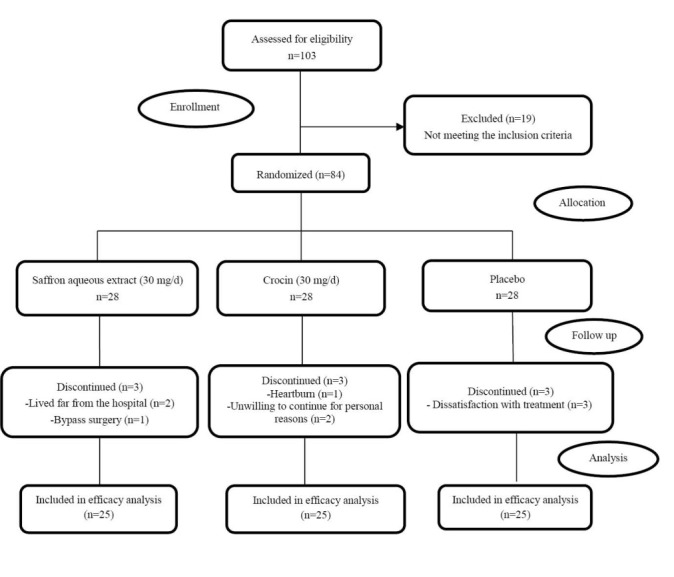
Central obesity is an independent risk factor for coronary artery disease (CAD). It can increase cardio-metabolic risks through hypertension, hyperlipidemia and insulin resistance. Saffron and its bioactive compounds (crocin and crocetin) can modify some of metabolic disorders through multiple mechanisms. The aim of this study was to assess the efficacy of saffron and crocin on lipid profile, appetite, dietary intakes, anthropometric indices and body composition in patients with CAD. This 8 weeks randomized, double-blind, and placebo-controlled trial was conducted on 84 patients with CAD between the ages of 40 and 65 years old. Participants were randomly divided into groups to receive a daily supplement of 30 mg saffron aqueous extract (SAE) or 30 mg crocin or placebo. Appetite, dietary intake, anthropometry, body composition, biochemical analysis were assessed before and after the study. In SAE and crocin group, anthropometric and some body composition variables revealed a pattern of improvement after intervention. Decrease in body mass index (BMI), waist circumference and fat mass values in SAE group was significantly more than crocin group (< 0.001). There was no significant difference at the end of study in lipid profile parameters. Both SAE and crocin yielded significant decrease in energy and dietary intake mean values (< 0.001 and = 0.046), while it remained unchanged in the placebo group, also the appetite decreased significantly in SAE and crocin group (< 0.001 and = 0.029, respectively). The results of present study regarding anti-obesity feature of SAE and crocin in patients with CAD was promising. However the SAE was better in appetite suppressing, dietary intake and central obesity reduction.
中心性肥胖是冠状动脉疾病(CAD)的独立危险因素。它可通过高血压、高脂血症和胰岛素抵抗增加心脏代谢风险。藏红花及其生物活性化合物(藏红花素和西红花酸)可通过多种机制改善某些代谢紊乱。本研究旨在评估藏红花和藏红花素对CAD患者血脂谱、食欲、饮食摄入量、人体测量指标和身体成分的影响。这项为期8周的随机、双盲、安慰剂对照试验对84名年龄在40至65岁之间的CAD患者进行。参与者被随机分组,每天补充30毫克藏红花水提取物(SAE)或30毫克藏红花素或安慰剂。在研究前后评估食欲、饮食摄入量、人体测量、身体成分、生化分析。在SAE组和藏红花素组中,人体测量和一些身体成分变量在干预后呈现改善模式。SAE组体重指数(BMI)、腰围和脂肪量值的下降明显多于藏红花素组(<0.001)。研究结束时血脂谱参数无显著差异。SAE和藏红花素均使能量和饮食摄入量平均值显著下降(<0.001和=0.046),而安慰剂组保持不变,SAE组和藏红花素组的食欲也显著下降(分别为<0.001和=0.029)。本研究关于SAE和藏红花素对CAD患者的抗肥胖特性的结果很有前景。然而,SAE在抑制食欲、减少饮食摄入和减轻中心性肥胖方面效果更好。