Liu Rui, Zhang Rongxue, Yang Yi, Liu Xuejun, Gong Qingqiu
State Key Laboratory of Microbial Metabolism, Joint International Research Laboratory of Metabolic and Developmental Sciences, School of Life Sciences and Biotechnology, Shanghai Jiao Tong University, Shanghai, China.
Tianjin Key Laboratory of Crop Genetics and Breeding, Tianjin Agricultural University, Tianjin, China.
Front Plant Sci. 2022 Apr 25;13:866367. doi: 10.3389/fpls.2022.866367. eCollection 2022.
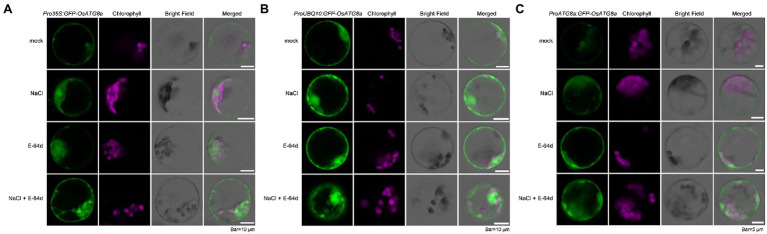
Autophagy is a conserved intracellular trafficking pathway for bulk degradation and recycling of cellular components in eukaryotes. The hallmark of autophagy is the formation of double-membraned vesicles termed autophagosomes, which selectively or non-selectively pack up various macromolecules and organelles and deliver these cargoes into the vacuole/lysosome. Like all other membrane trafficking pathways, the observation of autophagy is largely dependent on marker lines. ATG8/LC3 is the only autophagy-related (ATG) protein that, through a covalent bond to phosphatidylethanolamine (PE), associates tightly with the isolation membrane/pre-autophagosomal structure (PAS), the growing phagophore, the mature autophagosome, and the autophagic bodies. Therefore, fluorescent protein (FP)-tagged ATG8 had been widely used for monitoring autophagosome formation and autophagic flux. In rice (), FP-OsATG8 driven by Cauliflower mosaic virus (CaMV) 35S promoter had been used for imaging autophagosome and autophagic bodies. Here, we constructed three vectors carrying , driven by , , and the endogenous promoter, individually. Then, we compared them for their suitability in monitoring autophagy, by observing GFP-ATG8a puncta formation in transiently transformed rice protoplasts, and by tracking the autophagic flux with GFP-ATG8 cleavage assay in rice stable transgenic lines. GFP-Trap immunoprecipitation and mass spectrometry were also performed with the three marker lines to show that they can be used reliably for proteomic studies. We found out that the ubiquitin promoter is the best for protoplast imaging. Transgenic rice seedlings of the three marker lines showed comparable performance in autophagic flux measurement using the GFP-ATG8 cleavage assay. Surprisingly, the levels of GFP-ATG8a transcripts and protein contents were similar in all marker lines, indicating post-transcriptional regulation of the transgene expression by a yet unknown mechanism. These marker lines can serve as useful tools for autophagy studies in rice.
自噬是真核生物中一种保守的细胞内运输途径,用于大量降解和循环利用细胞成分。自噬的标志是形成称为自噬体的双膜囊泡,其选择性或非选择性地包裹各种大分子和细胞器,并将这些货物输送到液泡/溶酶体中。与所有其他膜运输途径一样,自噬的观察在很大程度上依赖于标记系。ATG8/LC3是唯一一种与自噬相关(ATG)的蛋白质,它通过与磷脂酰乙醇胺(PE)形成共价键,与隔离膜/自噬前体结构(PAS)、正在生长的吞噬泡、成熟的自噬体和自噬小体紧密结合。因此,荧光蛋白(FP)标记的ATG8已被广泛用于监测自噬体形成和自噬通量。在水稻中,由花椰菜花叶病毒(CaMV)35S启动子驱动的FP-OsATG8已被用于对自噬体和自噬小体进行成像。在这里,我们分别构建了三个携带由、和内源性启动子驱动的载体。然后,我们通过观察瞬时转化的水稻原生质体中GFP-ATG8a斑点的形成,以及通过在水稻稳定转基因系中用GFP-ATG8切割试验追踪自噬通量,比较了它们在监测自噬方面的适用性。还对这三个标记系进行了GFP-Trap免疫沉淀和质谱分析,以表明它们可可靠地用于蛋白质组学研究。我们发现泛素启动子最适合原生质体成像。这三个标记系的转基因水稻幼苗在使用GFP-ATG8切割试验测量自噬通量方面表现出相当的性能。令人惊讶的是,所有标记系中GFP-ATG8a转录本水平和蛋白质含量相似,表明转基因表达通过一种未知机制受到转录后调控。这些标记系可作为水稻自噬研究的有用工具。