Song Jun Ho, Lee Sun-Mi, Yoo Kyung-Hwa
Department of Physics, Yonsei University Seoul 03722 Republic of Korea
Graduate Program for Nanomedical Science and Technology, Yonsei University Seoul 03722 Republic of Korea.
RSC Adv. 2018 Sep 4;8(54):31246-31254. doi: 10.1039/c8ra05273e. eCollection 2018 Aug 30.
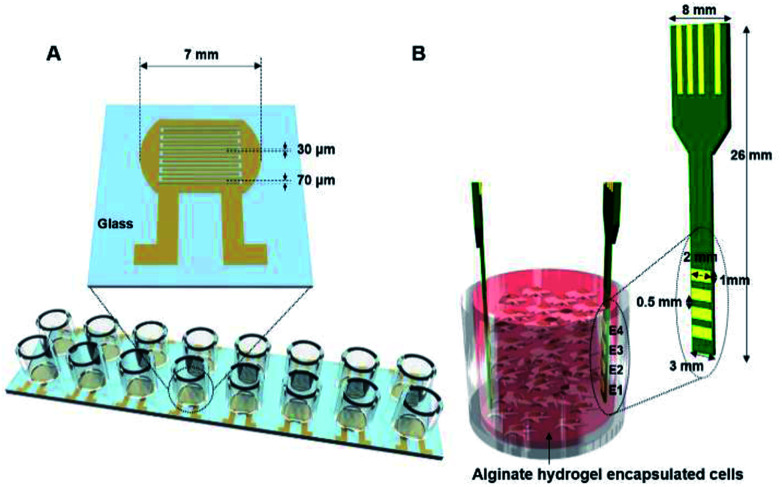
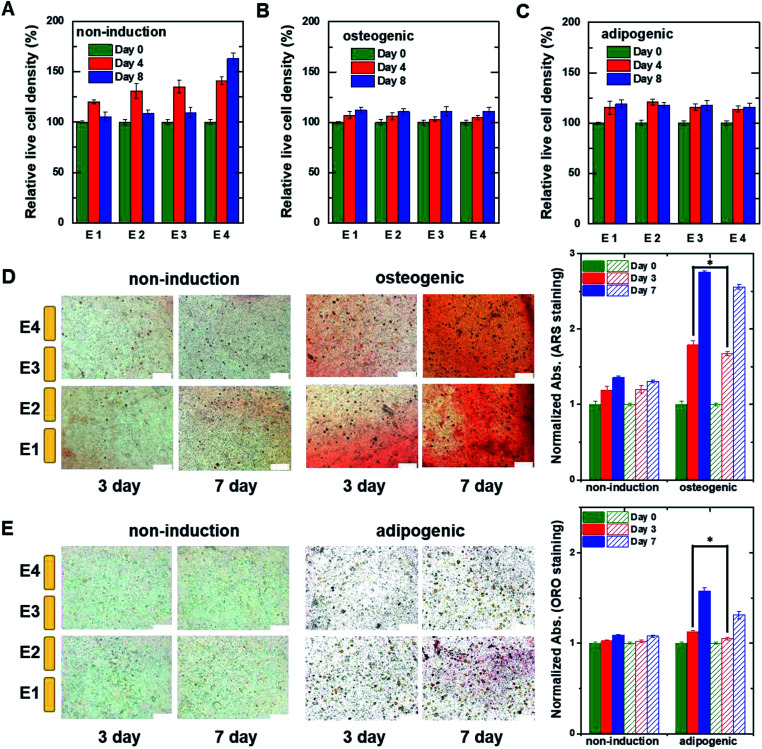
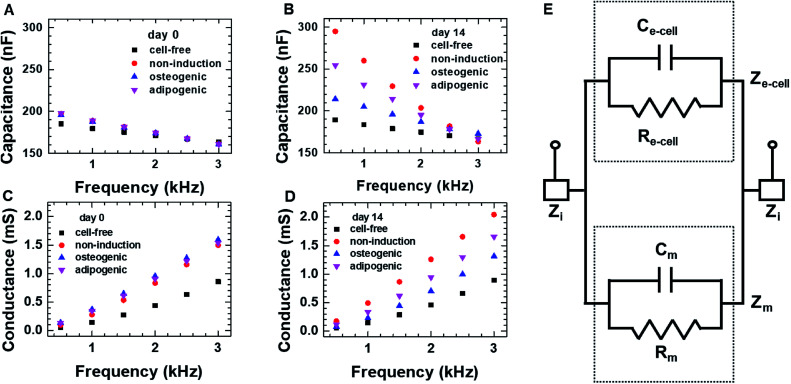
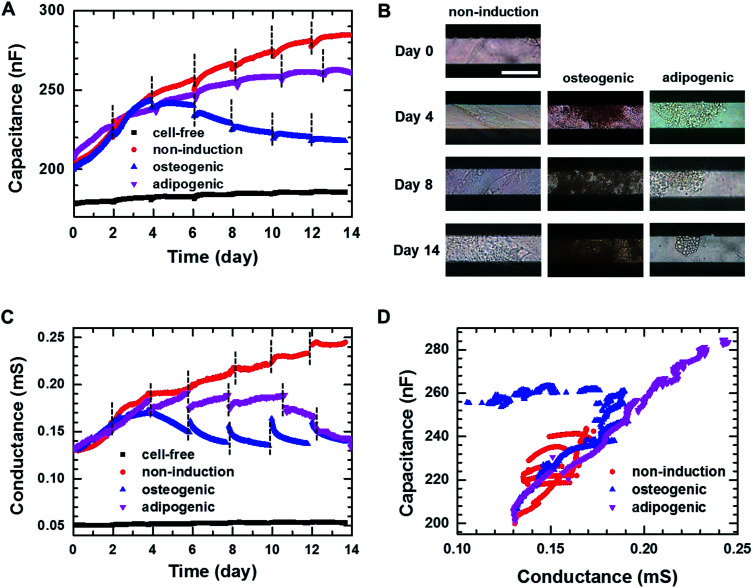
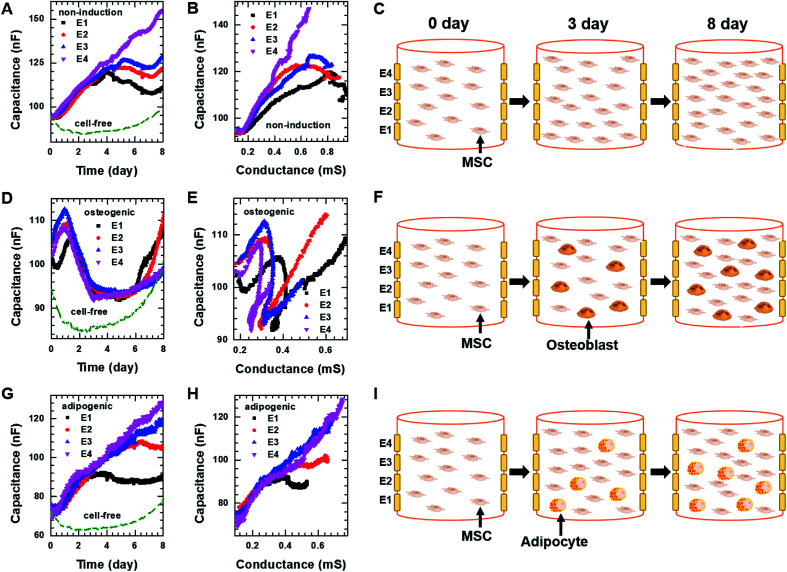
Three dimensional (3D) stem cell culture has recently received considerable attention because it may enable the development of 3D tissue models. In particular, label-free and real-time monitoring of stem cell differentiation is of importance for tissue engineering applications; however, only a few non-invasive monitoring methods are available, especially for 3D cell culture. Here, we describe impedance cell sensors that allowed the monitoring of cellular behaviors in 2D and 3D cell cultures in real-time. Specifically, apparent capacitance peaks appeared in both 2D and 3D cell culture systems when human mesenchymal stem cells (hMSCs) were cultured in osteogenic induction medium. In contrast, when hMSCs were cultured in adipogenic induction medium, the capacitance increased monotonically. In addition, distinct characteristics were noted in the plots of capacitance conductance for the cells cultured in osteogenic and adipocyte induction media. These results demonstrated that the differentiation of hMSCs toward osteoblasts and adipocytes in 2D and 3D cell culture systems could be discriminated non-invasively by measuring the real-time capacitance and conductance. Furthermore, the vertical distribution of cellular activities in 3D cell cultures could be monitored in real-time using the 3D impedance cell sensors. Thus, these sensors may be suitable for monitoring the differentiation of various stem cells into different types of cells with distinct dielectric properties for tissue engineering applications.
三维(3D)干细胞培养近来备受关注,因为它可能推动3D组织模型的发展。特别是,对干细胞分化进行无标记实时监测对于组织工程应用至关重要;然而,可用的非侵入性监测方法很少,尤其是对于3D细胞培养。在此,我们描述了阻抗细胞传感器,它能够实时监测二维和三维细胞培养中的细胞行为。具体而言,当人间充质干细胞(hMSCs)在成骨诱导培养基中培养时,二维和三维细胞培养系统中均出现明显的电容峰值。相比之下,当hMSCs在脂肪生成诱导培养基中培养时,电容单调增加。此外,在成骨和脂肪细胞诱导培养基中培养的细胞的电容 - 电导图中观察到明显特征。这些结果表明,通过测量实时电容和电导,可以非侵入性地区分二维和三维细胞培养系统中hMSCs向成骨细胞和脂肪细胞的分化。此外,使用三维阻抗细胞传感器可以实时监测三维细胞培养中细胞活动的垂直分布。因此,这些传感器可能适用于监测各种干细胞向具有不同介电特性的不同类型细胞的分化,以用于组织工程应用。