Leong Justin W Y, Singhal Rohit, Whitehouse Michael R, Howell Jonathan R, Hamer Andrew, Khanduja Vikas, Board Tim N
Department of Trauma and Orthopaedic Surgery, Countess of Chester Hospital NHS Foundation Trust, Chester, UK.
Department of Trauma and Orthopaedic Surgery, Wrightington Hospital, Wigan, UK.
Bone Jt Open. 2022 May;3(5):423-431. doi: 10.1302/2633-1462.35.BJO-2022-0022.R1.
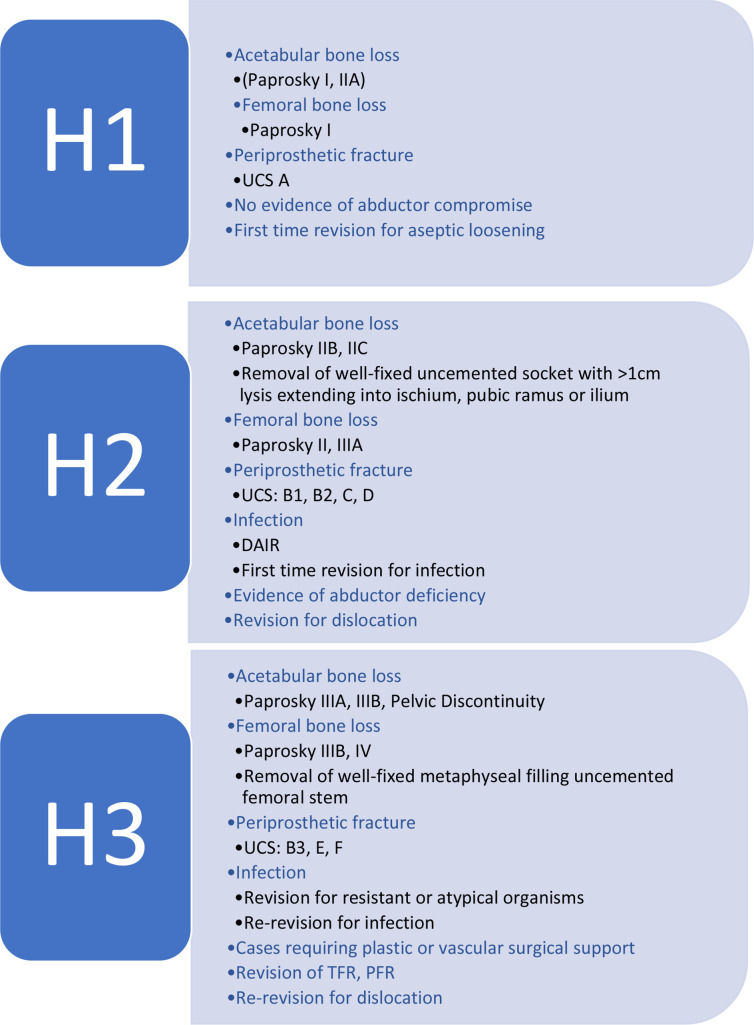
The aim of this modified Delphi process was to create a structured Revision Hip Complexity Classification (RHCC) which can be used as a tool to help direct multidisciplinary team (MDT) discussions of complex cases in local or regional revision networks.
The RHCC was developed with the help of a steering group and an invitation through the British Hip Society (BHS) to members to apply, forming an expert panel of 35. We ran a mixed-method modified Delphi process (three rounds of questionnaires and one virtual meeting). Round 1 consisted of identifying the factors that govern the decision-making and complexities, with weighting given to factors considered most important by experts. Participants were asked to identify classification systems where relevant. Rounds 2 and 3 focused on grouping each factor into H1, H2, or H3, creating a hierarchy of complexity. This was followed by a virtual meeting in an attempt to achieve consensus on the factors which had not achieved consensus in preceding rounds.
The expert group achieved strong consensus in 32 out of 36 factors following the Delphi process. The RHCC used the existing Paprosky (acetabulum and femur), Unified Classification System, and American Society of Anesthesiologists (ASA) classification systems. Patients with ASA grade III/IV are recognized with a qualifier of an asterisk added to the final classification. The classification has good intraobserver and interobserver reliability with Kappa values of 0.88 to 0.92 and 0.77 to 0.85, respectively.
The RHCC has been developed through a modified Delphi technique. RHCC will provide a framework to allow discussion of complex cases as part of a local or regional hip revision MDT. We believe that adoption of the RHCC will provide a comprehensive and reproducible method to describe each patient's case with regard to surgical complexity, in addition to medical comorbidities that may influence their management. Cite this article: 2022;3(5):423-431.
本改良德尔菲法的目的是创建一种结构化的髋关节翻修复杂性分类法(RHCC),该分类法可作为一种工具,用于指导多学科团队(MDT)在本地或区域翻修网络中对复杂病例进行讨论。
在一个指导小组的帮助下制定了RHCC,并通过英国髋关节协会(BHS)邀请成员申请,组建了一个由35名成员组成的专家小组。我们开展了一个混合方法的改良德尔菲法(三轮问卷调查和一次虚拟会议)。第一轮包括确定影响决策和复杂性的因素,并对专家认为最重要的因素进行加权。要求参与者确定相关的分类系统。第二轮和第三轮重点是将每个因素分为H1、H2或H3,创建一个复杂性层次结构。随后召开了一次虚拟会议,试图就前几轮未达成共识的因素达成共识。
经过德尔菲法,专家组在36个因素中的32个上达成了强烈共识。RHCC采用了现有的帕普罗斯基分类法(髋臼和股骨)、统一分类系统以及美国麻醉医师协会(ASA)分类系统。ASA III/IV级患者在最终分类中用星号作为限定词标识。该分类法具有良好的观察者内和观察者间可靠性,Kappa值分别为0.88至0.92和0.77至0.85。
RHCC是通过改良德尔菲技术开发的。RHCC将提供一个框架,以便作为本地或区域髋关节翻修MDT的一部分对复杂病例进行讨论。我们认为,采用RHCC将提供一种全面且可重复的方法,用于描述每个患者在手术复杂性以及可能影响其治疗的医疗合并症方面的情况。引用本文:2022;3(5):423 - 431。