He Chao-Peng, Chen Cheng, Jiang Xin-Chen, Li Hui, Zhu Li-Xin, Wang Ping-Xiao, Xiao Tao
Department of Orthopedics, The Second Xiangya Hospital of Central South University, Changsha, China.
Department of Orthopedics, Second Affiliated Hospital of Hunan Normal University, Changsha, China.
Bone Joint Res. 2022 May;11(5):292-300. doi: 10.1302/2046-3758.115.BJR-2021-0334.R1.
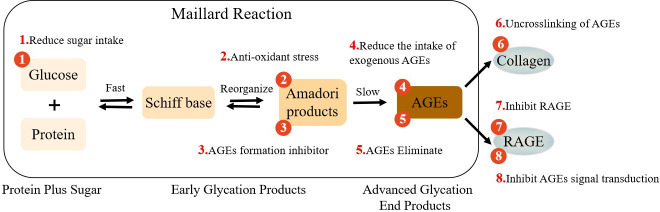
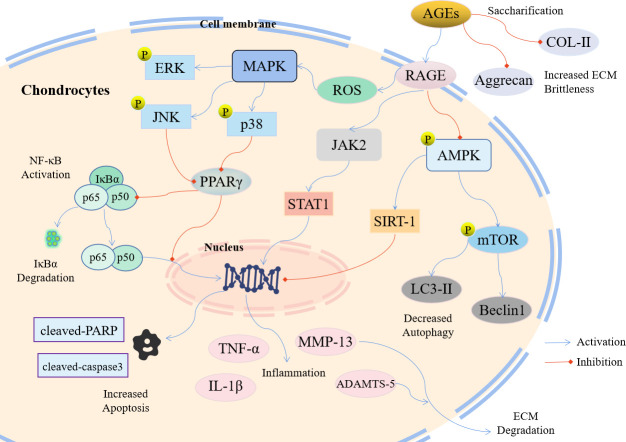
Osteoarthritis (OA) is a degenerative disease resulting from progressive joint destruction caused by many factors. Its pathogenesis is complex and has not been elucidated to date. Advanced glycation end products (AGEs) are a series of irreversible and stable macromolecular complexes formed by reducing sugar with protein, lipid, and nucleic acid through a non-enzymatic glycosylation reaction (Maillard reaction). They are an important indicator of the degree of ageing. Currently, it is considered that AGEs accumulation in vivo is a molecular basis of age-induced OA, and AGEs production and accumulation in vivo is one of the important reasons for the induction and acceleration of the pathological changes of OA. In recent years, it has been found that AGEs are involved in a variety of pathological processes of OA, including extracellular matrix degradation, chondrocyte apoptosis, and autophagy. Clearly, AGEs play an important role in regulating the expression of OA-related genes and maintaining the chondrocyte phenotype and the stability of the intra-articular environment. This article reviews the latest research results of AGEs in a variety of pathological processes of OA, to provide a new direction for the study of OA pathogenesis and a new target for prevention and treatment. Cite this article: 2022;11(5):292-300.
骨关节炎(OA)是一种由多种因素导致关节进行性破坏引起的退行性疾病。其发病机制复杂,至今尚未阐明。晚期糖基化终末产物(AGEs)是还原糖与蛋白质、脂质和核酸通过非酶糖基化反应(美拉德反应)形成的一系列不可逆且稳定的大分子复合物。它们是衰老程度的重要指标。目前认为,体内AGEs的积累是年龄相关性骨关节炎的分子基础,且体内AGEs的产生和积累是诱导和加速骨关节炎病理变化的重要原因之一。近年来发现,AGEs参与了骨关节炎的多种病理过程,包括细胞外基质降解、软骨细胞凋亡和自噬。显然,AGEs在调节骨关节炎相关基因的表达、维持软骨细胞表型和关节内环境的稳定性方面发挥着重要作用。本文综述了AGEs在骨关节炎多种病理过程中的最新研究成果,为骨关节炎发病机制的研究提供新方向,为预防和治疗提供新靶点。引用本文:2022;11(5):292 - 300。