Faculty of Rehabilitation and Allied Health Sciences, Riphah International University, Islamabad, Lahore Campus, Pakistan.
BMC Musculoskelet Disord. 2022 May 12;23(1):443. doi: 10.1186/s12891-022-05408-4.
The Cumberland Ankle Instability Tool (CAIT) is a self-assessment tool for people with chronic ankle instability (CAI). This tool had been translated and validated in many languages but there is no Urdu version of CAIT available.
The aim was to translate the CAIT into the Urdu Language and determine its validity and reliability.
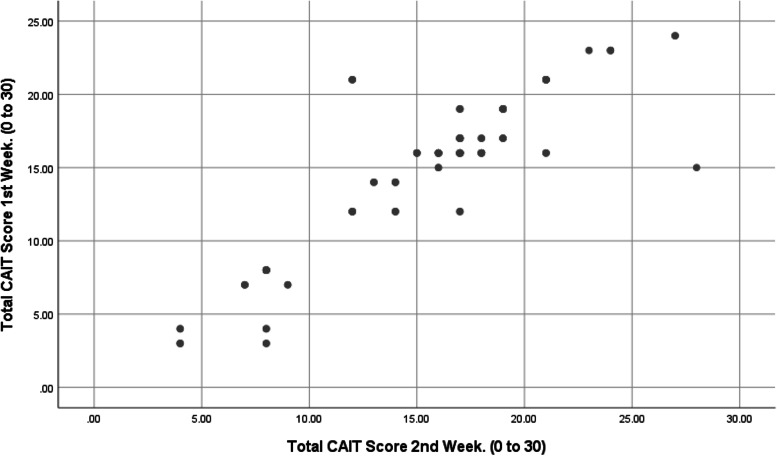
A standardized step-wise forward and backward translation process was followed. Content, construct, convergent validity, internal consistency, and test-retest reliability were determined. A pilot study was done on 10 patients with CAI. The final version was investigated in 120 patients (mean age 26.6 ± 4.8 yrs) with CAI for validity and test-retest reliability in which 105 participants filled the questionnaire in the second week. Internal consistency was calculated by Cronbach's alpha. Intraclass correlation (ICC) was calculated to assess test-retest reliability between two weeks. Standard error of measurement (SEM) and smallest detectable change (SDC) were calculated. Convergent validity was determined by correlating Urdu CAIT with the Foot and Ankle Outcome Score (FAOS) using Spearman's correlation co-efficient. Factor analysis describes the structure of underlying factors.
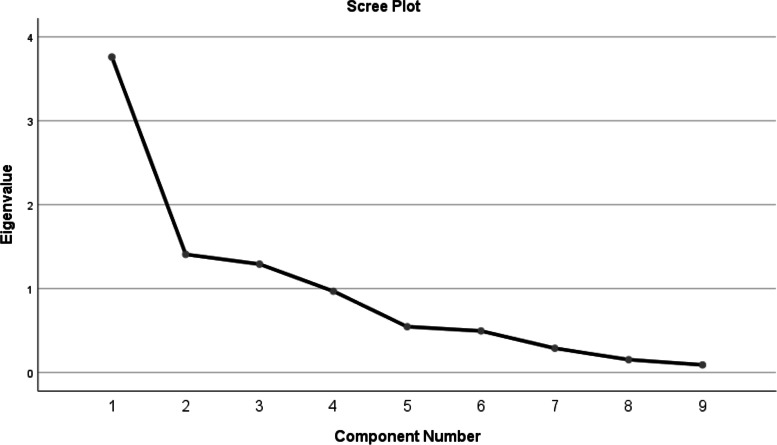
Content validity index was > 0.80 of each question. Internal consistency was acceptable (Cronbach's alpha > 0.75). Convergent validity with FAOS total score showed a moderate negative correlation (r = -0.68) with U-CAIT and negatively correlated with subscales of FAOS. Test-retest reliability was excellent ICC > 0.80. Scree plot showed 3 factors > 1eigen value.
The Urdu version of CAIT is a valid and reliable assessment tool for patients with chronic ankle instability. It has good content validity, construct validity and reliability.
坎伯兰踝关节不稳定工具(CAIT)是一种用于慢性踝关节不稳定(CAI)患者的自我评估工具。该工具已经被翻译成多种语言并经过验证,但目前尚无 CAIT 的乌尔都语版本。
将 CAIT 翻译成乌尔都语,并确定其有效性和可靠性。
采用标准的逐步正向和反向翻译过程。确定了内容、结构、收敛有效性、内部一致性和重测信度。对 10 例 CAI 患者进行了预试验研究。在 120 例 CAI 患者(平均年龄 26.6±4.8 岁)中进行了最终版本的有效性和重测信度研究,其中 105 例参与者在第二周填写了问卷。内部一致性用 Cronbach's alpha 进行计算。计算组内相关系数(ICC)以评估两周之间的重测信度。测量标准误差(SEM)和最小可检测变化(SDC)也进行了计算。通过 Spearman 相关系数分析乌尔都语 CAIT 与足踝结局评分(FAOS)的相关性来确定收敛有效性。因子分析描述了潜在因素的结构。
每个问题的内容效度指数均>0.80。内部一致性可接受(Cronbach's alpha>0.75)。与 FAOS 总分的收敛有效性显示,U-CAIT 与 FAOS 呈中度负相关(r=-0.68),且与 FAOS 的子量表呈负相关。重测信度极好 ICC>0.80。碎石图显示有 3 个因素>1 个特征值。
乌尔都语版 CAIT 是一种用于慢性踝关节不稳定患者的有效且可靠的评估工具。它具有良好的内容有效性、结构有效性和可靠性。