Department of Clinical Science and Education, Karolinska Institute, Södersjukhuset, SE-118 83, Stockholm, Sweden.
Department of Orthopedics, Södersjukhuset Hospital, Stockholm, Sweden.
BMC Musculoskelet Disord. 2022 May 12;23(1):447. doi: 10.1186/s12891-022-05394-7.
Surgical treatment of displaced distal radius fractures (DRF) in older patients has increased, despite lacking evidence of its superiority over non-operative treatment. How treatment choice affects these patients after the initial 12-month period remains unknown. This study presents a clinical and radiographic follow up at an average of 3 years after treatment in the context of a randomized clinical trial comparing outcomes in patients aged ≥70 years, with a dorsally displaced distal radius fracture treated either surgically with volar locking plate or non-operatively.
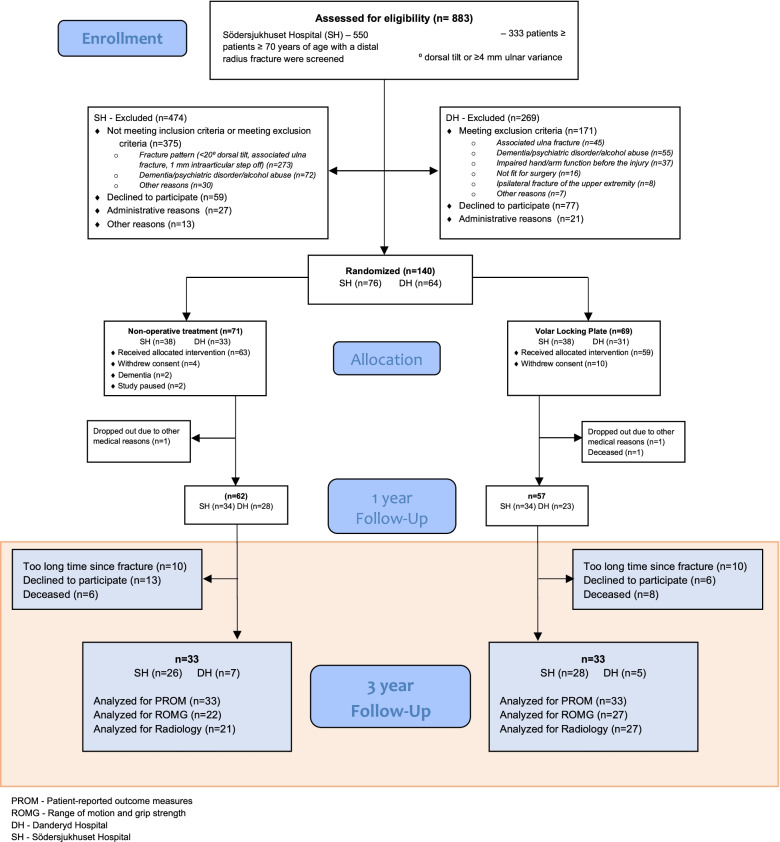
Between 2009 and 2017, 140 patients aged ≥70 years with dorsally displaced DRF were randomized to surgery with volar locking plate (VLP) or non-operative treatment. At an average of 3 years after inclusion the participants were invited to an additional follow-up. The primary outcome was Patient Rated Wrist Evaluation (PRWE). Secondary outcomes included additional Patient Reported Outcome Measures (PROM), grip strength, range of motion, complications and radiological results.
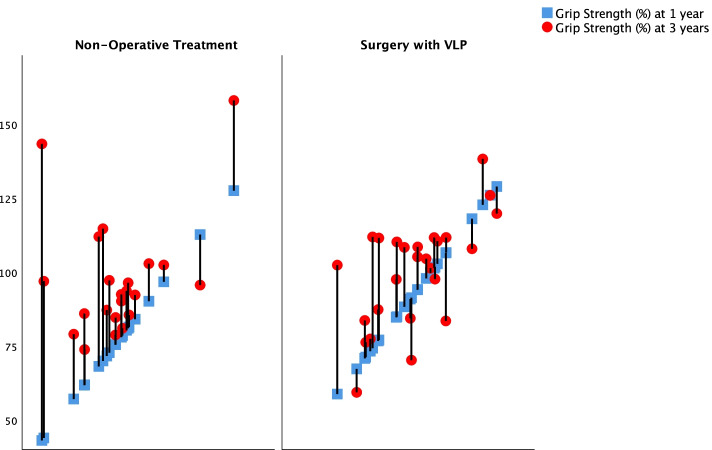
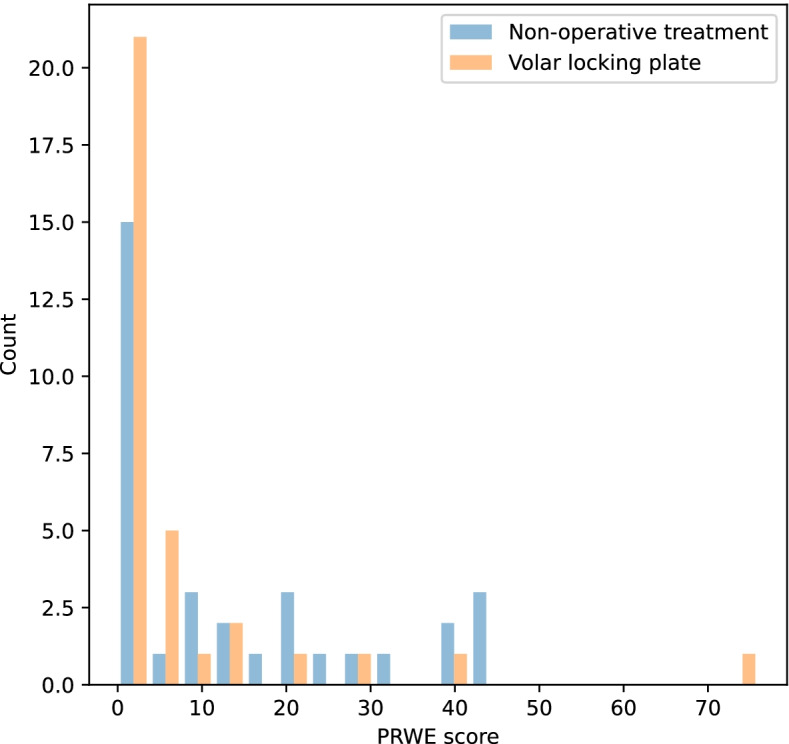
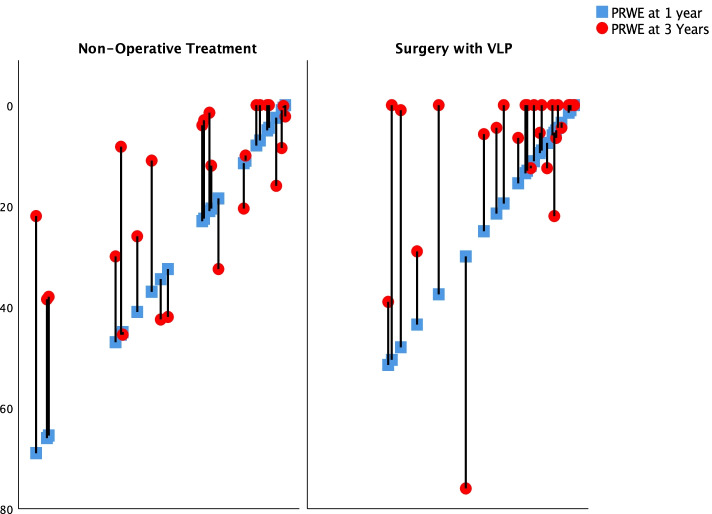
Sixty six patients were available for a 3 year follow-up, 33 in the non-operatively treated group and 33 in the VLP-group. The mean age at injury was 77 years. At 3 years the median PRWE was better (0 points) in the VLP-group than in the non-operative treatment group (9 points) p-value: 0.027. No statistically significant difference was found in Disabilities of the Arm, Hand, and Shoulder (DASH), EuroQol 5 Dimensions (EQ-5D) or grip strength. Total arc of range of motion was larger in the operatively treated group. No significant difference in osteoarthritis was found. Both groups had regained grip strength. The complication rate was similar. Outcomes improved from the 1 year to the 3 year follow-up.
Surgery with volar locking plate gave less long-term disability compared to non-operative treatment for severely displaced distal radius fractures in patients aged ≥70 years. Our findings were statistically significant but in the lower range of clinical importance.
The study was registered at : NCT02154620 03/06/2014 and NCT01268397 30/12/2010. Ethical approval was obtained from Ethical Committee in Stockholm, Sweden (2009/37-31/3, 2013/105-31/2, 2014/1041-32, 2017/611-32).
尽管手术治疗桡骨远端骨折(DRF)的疗效并不优于非手术治疗,但在老年患者中的应用却有所增加。治疗选择如何影响这些患者在最初 12 个月后的情况尚不清楚。本研究在一项比较 70 岁以上患者接受手术(掌侧锁定板)或非手术治疗的桡骨远端背侧移位骨折的随机临床试验背景下,报告了平均 3 年的临床和影像学随访结果。
2009 年至 2017 年间,共纳入 140 例 70 岁以上、桡骨远端背侧移位 DRF 患者,随机分为手术(掌侧锁定板)和非手术治疗组。纳入后平均 3 年时,邀请患者参加额外的随访。主要结局指标为患者腕关节评分(PRWE)。次要结局指标包括其他患者报告的结果测量(PROM)、握力、活动范围、并发症和影像学结果。
66 例患者完成了 3 年随访,其中非手术治疗组 33 例,掌侧锁定板治疗组 33 例。受伤时的平均年龄为 77 岁。3 年时,掌侧锁定板组的 PRWE 中位数(0 分)优于非手术治疗组(9 分),p 值:0.027。在手臂残疾、手和肩(DASH)、欧洲五维健康量表(EQ-5D)或握力方面,两组间无统计学差异。活动范围的总弧较大的是手术治疗组。未发现骨关节炎有显著差异。两组患者的握力均有恢复。并发症发生率相似。结局从 1 年随访到 3 年随访有所改善。
对于 70 岁以上严重桡骨远端骨折患者,与非手术治疗相比,掌侧锁定板手术治疗可减少长期残疾。我们的发现具有统计学意义,但在临床重要性方面处于较低水平。
该研究在 ClinicalTrials.gov 注册,编号为 NCT02154620(2014 年 6 月 3 日)和 NCT01268397(2010 年 12 月 30 日)。瑞典斯德哥尔摩伦理委员会批准了该研究(2009/37-31/3、2013/105-31/2、2014/1041-32、2017/611-32)。