Faculty of Psychology, Universitas Gadjah Mada, Yogyakarta, Indonesia.
BMC Public Health. 2022 May 12;22(1):949. doi: 10.1186/s12889-022-13380-w.
Mental health problems are associated with decreasing the quality of various aspects of life. Cases of mental health problems (e.g., depressive symptoms) have increased continuously. Researchers predicted depression to be the first cause of world burden diseases in 2030. One of the determinant factors of mental health is parents' education levels, but there have been contradictory research findings. The current research investigates the effect parental education attainment has on children's mental health.
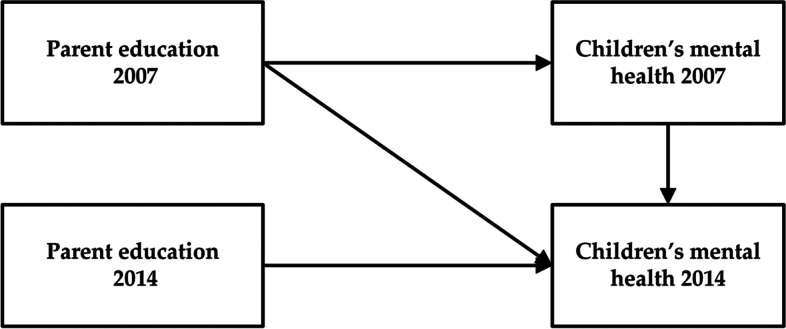
We used public data from two waves of the Indonesia Family Life Survey (IFLS) conducted in 2007 and 2014. There were 767 participants aged 15-19 years old (M = 16.80, SD = 1.37) in 2007. All participants were re-interviewed in 2014. We examined the highest level of the parents' formal education in 2007 and the children's mental health in 2014 to find the longitudinal effects. We used depressive symptoms and happiness as representative variables of mental health. The structural equation model (SEM) was used to examine the hypothesis, and we prioritized predictive testing over the models' goodness of fit. We have built 12 models of combinations of children's and parents' sexes and different independent variables.
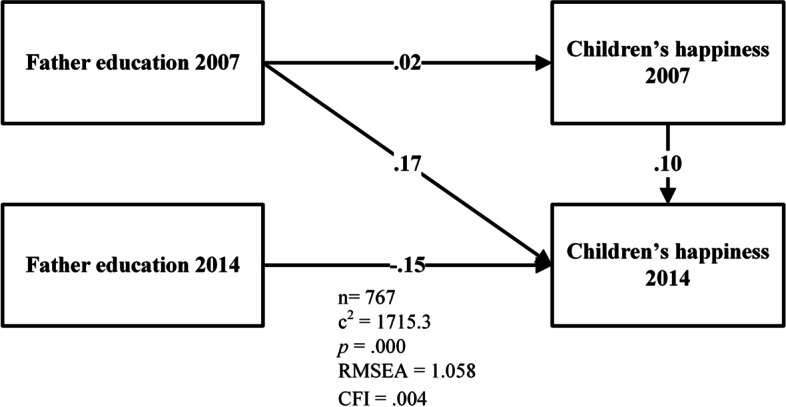
The hypothesis testing showed the longitudinal effects that fathers' education in 2007 has on daughters' depressive symptoms in 2014 (β = -.203, p < 0.01), while there were longitudinal effects from mothers' education in 2007 on their daughters' depressive symptoms (β = -.163, p < 0.01) and sons' depressive symptoms (β = .096, p ≤ 0.05) in 2014. Testing the happiness models showed that fathers' education in 2007 influenced the happiness of all of participants (β = .167, p < 0.01), including both sons (β = .206, p < 0.01) and daughters (β = 149, p < 0.01). On the contrary, no significant correlation was found between mothers' education and children's happiness across all three categories of participants.
The general results of this study showed that parents' education levels were associated with their children's mental health, but there are different associations found through the different combinations of children's and parents' sexes.
心理健康问题会降低生活各个方面的质量。心理健康问题(如抑郁症状)的案例不断增加。研究人员预测,到 2030 年,抑郁将成为全球负担疾病的首要原因。心理健康的决定因素之一是父母的受教育程度,但研究结果却存在矛盾。目前的研究旨在探讨父母受教育程度对子女心理健康的影响。
我们使用了 2007 年和 2014 年两次印度尼西亚家庭生活调查(IFLS)的公开数据。2007 年有 767 名 15-19 岁的参与者(M=16.80,SD=1.37)。所有参与者都在 2014 年进行了重新采访。我们在 2007 年检查了父母受教育程度的最高水平,在 2014 年检查了子女的心理健康状况,以发现纵向影响。我们使用抑郁症状和幸福感作为心理健康的代表性变量。结构方程模型(SEM)用于检验假设,我们优先进行预测测试,而不是对模型的拟合程度进行测试。我们建立了 12 个模型,其中包含了儿童和父母性别以及不同自变量的组合。
假设检验显示,2007 年父亲的教育水平对 2014 年女儿的抑郁症状存在纵向影响(β=-.203,p<0.01),而 2007 年母亲的教育水平对女儿(β=-.163,p<0.01)和儿子(β=0.096,p≤0.05)的抑郁症状在 2014 年也存在纵向影响。检验幸福感模型表明,2007 年父亲的教育水平影响了所有参与者的幸福感(β=167,p<0.01),包括儿子(β=206,p<0.01)和女儿(β=149,p<0.01)。相反,在所有三个类别参与者中,母亲的教育水平与孩子的幸福感之间没有发现显著的相关性。
本研究的总体结果表明,父母的教育水平与子女的心理健康有关,但通过子女和父母性别不同的组合,发现了不同的关联。