• 文献检索
  • 文档翻译
  • 深度研究
  • 学术资讯
  • Suppr Zotero 插件Zotero 插件
  • 邀请有礼
  • 套餐&价格
  • 历史记录
应用&插件
Suppr Zotero 插件Zotero 插件浏览器插件Mac 客户端Windows 客户端微信小程序
定价
高级版会员购买积分包购买API积分包
服务
文献检索文档翻译深度研究API 文档MCP 服务
关于我们
关于 Suppr公司介绍联系我们用户协议隐私条款
关注我们

Suppr 超能文献

核心技术专利:CN118964589B侵权必究
粤ICP备2023148730 号-1Suppr @ 2026

文献检索

告别复杂PubMed语法,用中文像聊天一样搜索,搜遍4000万医学文献。AI智能推荐,让科研检索更轻松。

立即免费搜索

文件翻译

保留排版,准确专业,支持PDF/Word/PPT等文件格式,支持 12+语言互译。

免费翻译文档

深度研究

AI帮你快速写综述,25分钟生成高质量综述,智能提取关键信息,辅助科研写作。

立即免费体验

通过可解释的机器学习对吸入性急性呼吸窘迫综合征的中重度病情进行早期预测。

Early prediction of moderate-to-severe condition of inhalation-induced acute respiratory distress syndrome via interpretable machine learning.

机构信息

Library of Graduate School, Chinese People's Liberation Army General Hospital, Beijing, 100853, China.

Ping An Healthcare Technology, Beijing, China.

出版信息

BMC Pulm Med. 2022 May 12;22(1):193. doi: 10.1186/s12890-022-01963-7.

DOI:10.1186/s12890-022-01963-7
PMID:35550064
原文链接:https://pmc.ncbi.nlm.nih.gov/articles/PMC9098141/
Abstract

BACKGROUND

Several studies have investigated the correlation between physiological parameters and the risk of acute respiratory distress syndrome (ARDS), in addition, etiology-associated heterogeneity in ARDS has become an emerging topic quite recently; however, the intersection between the two, which is early prediction of target conditions in etiology-specific ARDS, has not been well-studied. We aimed to develop and validate a machine-learning model for the early prediction of moderate-to-severe condition of inhalation-induced ARDS.

METHODS

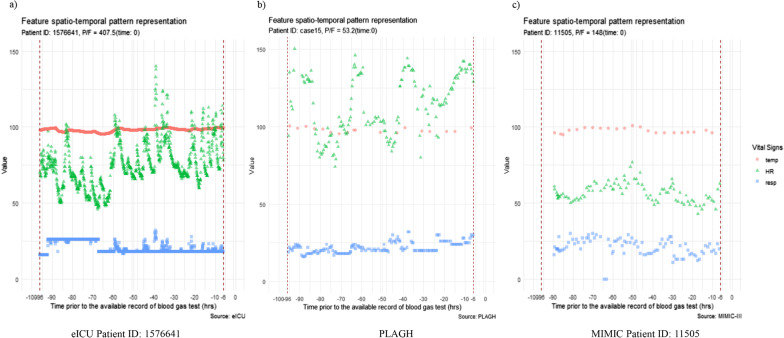
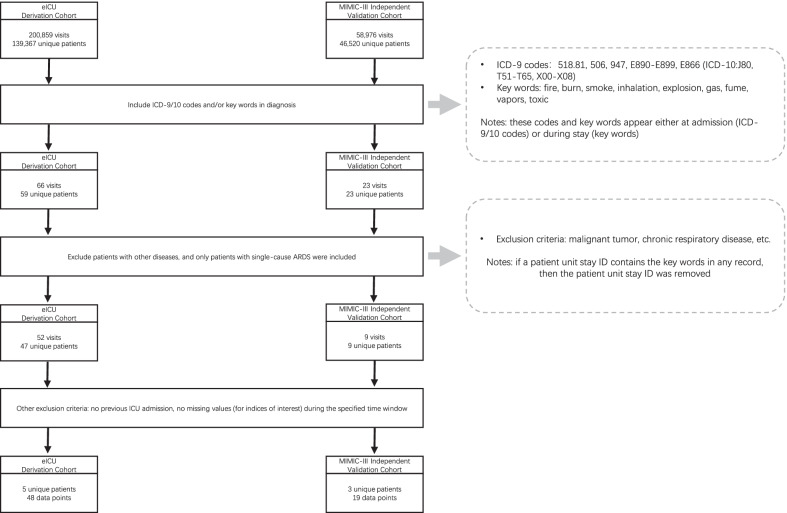
Clinical expertise was applied with data-driven analysis. Using data from electronic intensive care units (retrospective derivation cohort) and the three most accessible vital signs (i.e. heart rate, temperature, and respiratory rate) together with feature engineering, we applied a random forest approach during the time window of 90 h that ended 6 h prior to the onset of moderate-to-severe respiratory failure (the ratio of partial pressure of arterial oxygen to fraction of inspired oxygen ≤ 200 mmHg).

RESULTS

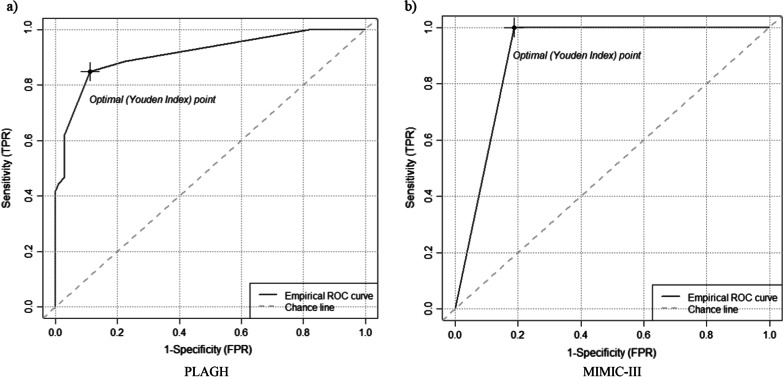
The trained random forest classifier was validated using two independent validation cohorts, with an area under the curve of 0.9127 (95% confidence interval 0.8713-0.9542) and 0.9026 (95% confidence interval 0.8075-1), respectively. A Stable and Interpretable RUle Set (SIRUS) was used to extract rules from the RF to provide guidelines for clinicians. We identified several predictive factors, including resp_96h_6h_min < 9, resp_96h_6h_mean ≥ 16.1, HR_96h_6h_mean ≥ 102, and temp_96h_6h_max > 100, that could be used for predicting inhalation-induced ARDS (moderate-to-severe condition) 6 h prior to onset in critical care units. ('xxx_96h_6h_min/mean/max': the minimum/mean/maximum values of the xxx vital sign collected during a 90 h time window beginning 96 h prior to the onset of ARDS and ending 6 h prior to the onset from every recorded blood gas test).

CONCLUSIONS

This newly established random forest‑based interpretable model shows good predictive ability for moderate-to-severe inhalation-induced ARDS and may assist clinicians in decision-making, as well as facilitate the enrolment of patients in prevention programmes to improve their outcomes.

摘要

背景

多项研究调查了生理参数与急性呼吸窘迫综合征(ARDS)风险之间的相关性,此外,ARDS 的病因相关性异质性最近也成为一个新兴话题;然而,这两者之间的交集,即病因特异性 ARDS 中目标病症的早期预测,尚未得到很好的研究。我们旨在开发和验证一种用于预测吸入性 ARDS 中中重度疾病的机器学习模型。

方法

采用临床专业知识和数据驱动分析。使用电子重症监护病房的数据(回顾性推导队列)和三个最易获得的生命体征(即心率、体温和呼吸率),以及特征工程,我们在 90 小时的时间窗口内应用随机森林方法,该时间窗口在中重度呼吸衰竭(动脉血氧分压与吸入氧分数之比≤200mmHg)发作前 6 小时结束。

结果

使用两个独立的验证队列验证了训练好的随机森林分类器,其曲线下面积分别为 0.9127(95%置信区间 0.8713-0.9542)和 0.9026(95%置信区间 0.8075-1)。使用稳定且可解释的规则集(SIRUS)从 RF 中提取规则,为临床医生提供指导。我们确定了几个预测因素,包括 resp_96h_6h_min<9、resp_96h_6h_mean≥16.1、HR_96h_6h_mean≥102 和 temp_96h_6h_max>100,这些因素可用于预测重症监护病房中吸入性 ARDS(中重度疾病)在发病前 6 小时。('xxx_96h_6h_min/mean/max':ARDS 发作前 96 小时开始的 90 小时时间窗口内收集的 xxx 生命体征的最小值/平均值/最大值,在每个记录的血气检查中结束前 6 小时)。

结论

这个新建立的基于随机森林的可解释模型对中重度吸入性 ARDS 具有良好的预测能力,可能有助于临床医生做出决策,并有助于将患者纳入预防计划以改善其结局。
https://cdn.ncbi.nlm.nih.gov/pmc/blobs/5573/9102355/09d34d4429ba/12890_2022_1963_Fig3_HTML.jpg
https://cdn.ncbi.nlm.nih.gov/pmc/blobs/5573/9102355/39f39155f0cd/12890_2022_1963_Fig1_HTML.jpg
https://cdn.ncbi.nlm.nih.gov/pmc/blobs/5573/9102355/432536b6c269/12890_2022_1963_Fig2_HTML.jpg
https://cdn.ncbi.nlm.nih.gov/pmc/blobs/5573/9102355/09d34d4429ba/12890_2022_1963_Fig3_HTML.jpg
https://cdn.ncbi.nlm.nih.gov/pmc/blobs/5573/9102355/39f39155f0cd/12890_2022_1963_Fig1_HTML.jpg
https://cdn.ncbi.nlm.nih.gov/pmc/blobs/5573/9102355/432536b6c269/12890_2022_1963_Fig2_HTML.jpg
https://cdn.ncbi.nlm.nih.gov/pmc/blobs/5573/9102355/09d34d4429ba/12890_2022_1963_Fig3_HTML.jpg

相似文献

1
Early prediction of moderate-to-severe condition of inhalation-induced acute respiratory distress syndrome via interpretable machine learning.通过可解释的机器学习对吸入性急性呼吸窘迫综合征的中重度病情进行早期预测。
BMC Pulm Med. 2022 May 12;22(1):193. doi: 10.1186/s12890-022-01963-7.
2
eARDS: A multi-center validation of an interpretable machine learning algorithm of early onset Acute Respiratory Distress Syndrome (ARDS) among critically ill adults with COVID-19.eARDS:一种可解释的机器学习算法对 COVID-19 危重症成人早期急性呼吸窘迫综合征(ARDS)的多中心验证。
PLoS One. 2021 Sep 24;16(9):e0257056. doi: 10.1371/journal.pone.0257056. eCollection 2021.
3
[Comparison of pulse oxygen saturation/fraction of inhaled oxygen and arterial partial pressure of oxygen/fraction of inhaled oxygen in the assessment of oxygenation in acute respiratory distress syndrome patients at different high altitudes in Yunnan Province].[云南省不同高海拔地区急性呼吸窘迫综合征患者氧合评估中脉搏血氧饱和度/吸入氧分数与动脉血氧分压/吸入氧分数的比较]
Zhonghua Wei Zhong Bing Ji Jiu Yi Xue. 2021 Jul;33(7):826-831. doi: 10.3760/cma.j.cn121430-20210301-00303.
4
Supervised machine learning for the early prediction of acute respiratory distress syndrome (ARDS).基于监督学习的急性呼吸窘迫综合征(ARDS)早期预测。
J Crit Care. 2020 Dec;60:96-102. doi: 10.1016/j.jcrc.2020.07.019. Epub 2020 Jul 24.
5
Prediction of Acute Respiratory Distress Syndrome in Traumatic Brain Injury Patients Based on Machine Learning Algorithms.基于机器学习算法预测创伤性脑损伤患者的急性呼吸窘迫综合征。
Medicina (Kaunas). 2023 Jan 15;59(1):171. doi: 10.3390/medicina59010171.
6
Assessment of PaO₂/FiO₂ for stratification of patients with moderate and severe acute respiratory distress syndrome.评估氧合指数(PaO₂/FiO₂)用于中重度急性呼吸窘迫综合征患者的分层。
BMJ Open. 2015 Mar 27;5(3):e006812. doi: 10.1136/bmjopen-2014-006812.
7
[Feasibility of pulse oxygen saturation for the condition evaluation of acute respiratory distress syndrome patients in the Lijiang region].[脉搏血氧饱和度用于丽江地区急性呼吸窘迫综合征患者病情评估的可行性]
Zhonghua Wei Zhong Bing Ji Jiu Yi Xue. 2021 Dec;33(12):1447-1452. doi: 10.3760/cma.j.cn121430-20210518-00737.
8
Tree-based ensemble machine learning models in the prediction of acute respiratory distress syndrome following cardiac surgery: a multicenter cohort study.基于树的集成机器学习模型在心脏手术后急性呼吸窘迫综合征预测中的应用:一项多中心队列研究。
J Transl Med. 2024 Aug 15;22(1):772. doi: 10.1186/s12967-024-05395-1.
9
[Diagnostic value of mechanical power in patients with moderate to severe acute respiratory distress syndrome: an analysis using the data from MIMIC-III].[机械功率在中重度急性呼吸窘迫综合征患者中的诊断价值:一项基于MIMIC-III数据的分析]
Zhonghua Wei Zhong Bing Ji Jiu Yi Xue. 2022 Jan;34(1):35-40. doi: 10.3760/cma.j.cn121430-20210630-00978.
10
Machine Learning Classifier Models Can Identify Acute Respiratory Distress Syndrome Phenotypes Using Readily Available Clinical Data.机器学习分类器模型可以使用现成的临床数据识别急性呼吸窘迫综合征表型。
Am J Respir Crit Care Med. 2020 Oct 1;202(7):996-1004. doi: 10.1164/rccm.202002-0347OC.

引用本文的文献

1
Novel machine learning models for the prediction of acute respiratory distress syndrome after liver transplantation.用于预测肝移植术后急性呼吸窘迫综合征的新型机器学习模型
Front Artif Intell. 2025 May 27;8:1548131. doi: 10.3389/frai.2025.1548131. eCollection 2025.
2
The application of explainable artificial intelligence (XAI) in electronic health record research: A scoping review.可解释人工智能(XAI)在电子健康记录研究中的应用:一项范围综述。
Digit Health. 2024 Oct 30;10:20552076241272657. doi: 10.1177/20552076241272657. eCollection 2024 Jan-Dec.
3
A systematic review of machine learning models for management, prediction and classification of ARDS.

本文引用的文献

1
Etiology-associated heterogeneity in acute respiratory distress syndrome: a retrospective cohort study.病因相关异质性在急性呼吸窘迫综合征中的表现:一项回顾性队列研究。
BMC Pulm Med. 2021 May 31;21(1):183. doi: 10.1186/s12890-021-01557-9.
2
Risk factors analysis of COVID-19 patients with ARDS and prediction based on machine learning.基于机器学习的 COVID-19 合并 ARDS 患者风险因素分析及预测
Sci Rep. 2021 Feb 3;11(1):2933. doi: 10.1038/s41598-021-82492-x.
3
Novel risk scoring system for predicting acute respiratory distress syndrome among hospitalized patients with coronavirus disease 2019 in Wuhan, China.
机器学习模型在 ARDS 管理、预测和分类中的系统评价。
Respir Res. 2024 Jun 4;25(1):232. doi: 10.1186/s12931-024-02834-x.
4
An explainable machine learning approach for Alzheimer's disease classification.基于可解释机器学习的阿尔茨海默病分类方法。
Sci Rep. 2024 Feb 1;14(1):2637. doi: 10.1038/s41598-024-51985-w.
中国武汉住院的 2019 年冠状病毒病患者中预测急性呼吸窘迫综合征的新型风险评分系统。
BMC Infect Dis. 2020 Dec 17;20(1):960. doi: 10.1186/s12879-020-05561-y.
4
A Time-Phased Machine Learning Model for Real-Time Prediction of Sepsis in Critical Care.基于时相的机器学习模型对重症监护中脓毒症的实时预测
Crit Care Med. 2020 Oct;48(10):e884-e888. doi: 10.1097/CCM.0000000000004494.
5
Supervised machine learning for the early prediction of acute respiratory distress syndrome (ARDS).基于监督学习的急性呼吸窘迫综合征(ARDS)早期预测。
J Crit Care. 2020 Dec;60:96-102. doi: 10.1016/j.jcrc.2020.07.019. Epub 2020 Jul 24.
6
Neutrophil-to-lymphocyte ratio as a predictive biomarker for moderate-severe ARDS in severe COVID-19 patients.中性粒细胞与淋巴细胞比值可作为重症 COVID-19 患者中中重度 ARDS 的预测生物标志物。
Crit Care. 2020 Jun 5;24(1):288. doi: 10.1186/s13054-020-03007-0.
7
Comparison of Early Warning Scoring Systems for Hospitalized Patients With and Without Infection at Risk for In-Hospital Mortality and Transfer to the Intensive Care Unit.比较有感染风险的住院患者和无感染风险的住院患者的预警评分系统,以预测住院死亡率和转入重症监护病房的情况。
JAMA Netw Open. 2020 May 1;3(5):e205191. doi: 10.1001/jamanetworkopen.2020.5191.
8
Vital Signs Directed Therapy for the Critically Ill: Improved Adherence to the Treatment Protocol Two Years after Implementation in an Intensive Care Unit in Tanzania.危重症患者的生命体征导向治疗:在坦桑尼亚一家重症监护病房实施两年后,治疗方案的依从性得到改善。
Emerg Med Int. 2020 Jan 7;2020:4819805. doi: 10.1155/2020/4819805. eCollection 2020.
9
Early prediction of circulatory failure in the intensive care unit using machine learning.使用机器学习对重症监护病房循环衰竭进行早期预测。
Nat Med. 2020 Mar;26(3):364-373. doi: 10.1038/s41591-020-0789-4. Epub 2020 Mar 9.
10
A new method for identifying the acute respiratory distress syndrome disease based on noninvasive physiological parameters.一种基于无创生理参数的急性呼吸窘迫综合征疾病识别新方法。
PLoS One. 2020 Feb 5;15(2):e0226962. doi: 10.1371/journal.pone.0226962. eCollection 2020.