Department of Applied Health Research, UCL, 1-19 Torrington Place, London, WC1E 6BT, UK.
Department of Global Health and Development, London School of Hygiene and Tropical Medicine, London, England.
BMC Med Educ. 2022 May 13;22(1):365. doi: 10.1186/s12909-022-03410-x.
Use of virtual patient educational tools could fill the current gap in the teaching of clinical reasoning skills. However, there is a limited understanding of their effectiveness. The aim of this study was to synthesise the evidence to understand the effectiveness of virtual patient tools aimed at improving undergraduate medical students' clinical reasoning skills.
We searched MEDLINE, EMBASE, CINAHL, ERIC, Scopus, Web of Science and PsycINFO from 1990 to January 2022, to identify all experimental articles testing the effectiveness of virtual patient educational tools on medical students' clinical reasoning skills. Quality of the articles was assessed using an adapted form of the MERSQI and the Newcastle-Ottawa Scale. A narrative synthesis summarised intervention features, how virtual patient tools were evaluated and reported effectiveness.
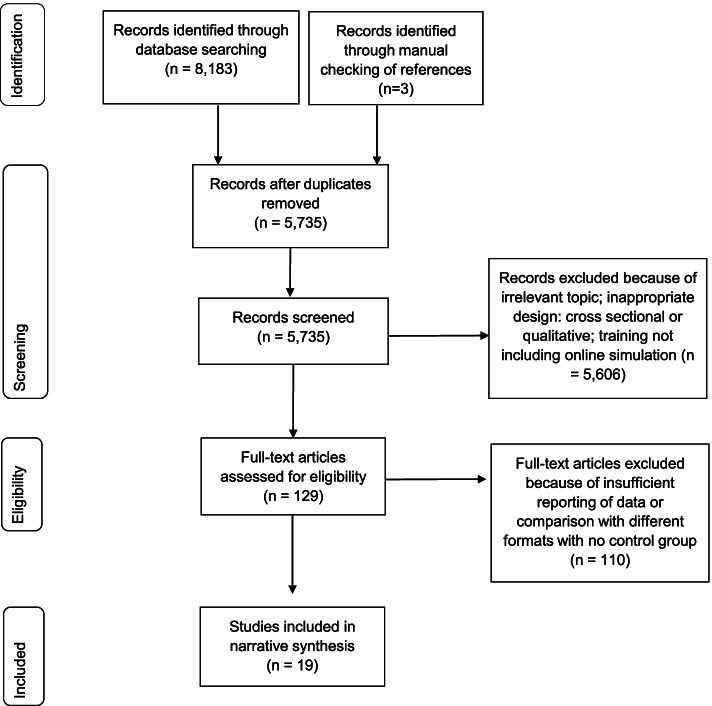
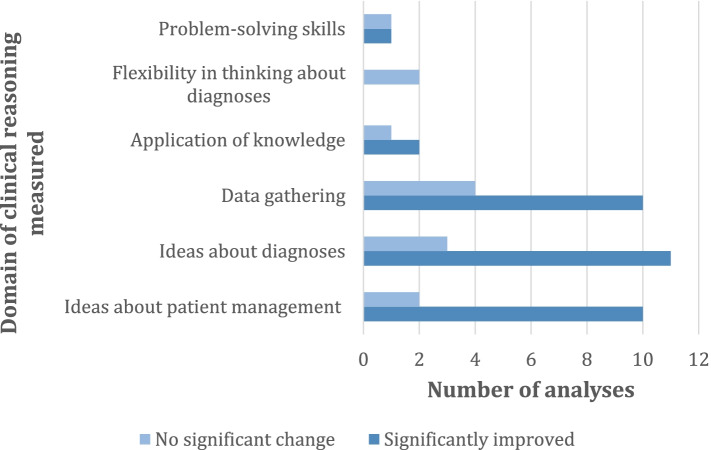
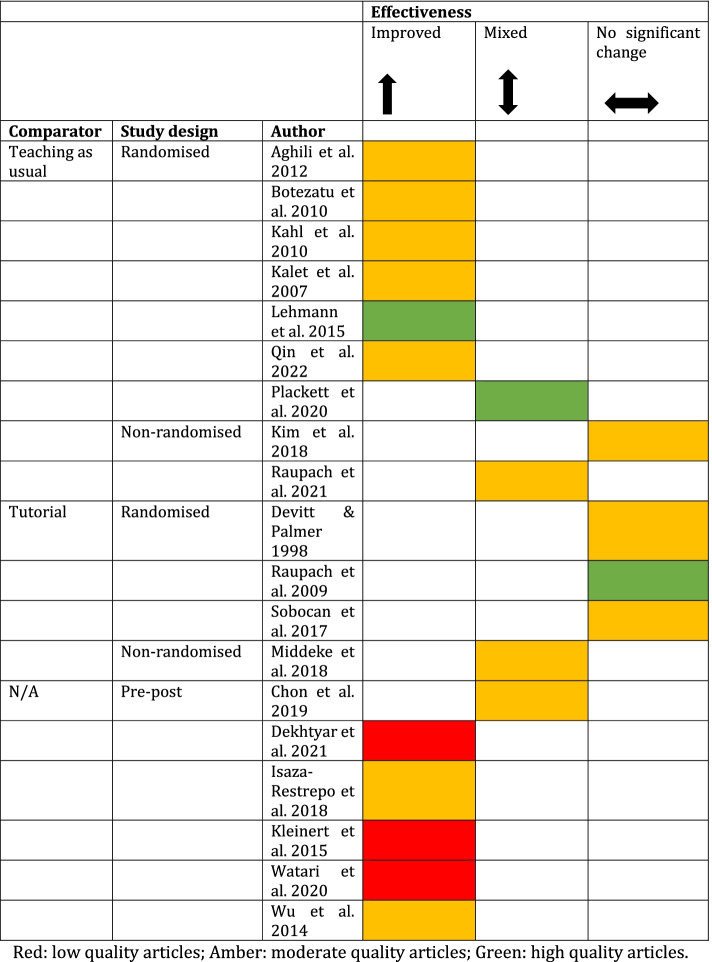
The search revealed 8,186 articles, with 19 articles meeting the inclusion criteria. Average study quality was moderate (M = 6.5, SD = 2.7), with nearly half not reporting any measurement of validity or reliability for their clinical reasoning outcome measure (8/19, 42%). Eleven articles found a positive effect of virtual patient tools on reasoning (11/19, 58%). Four reported no significant effect and four reported mixed effects (4/19, 21%). Several domains of clinical reasoning were evaluated. Data gathering, ideas about diagnosis and patient management were more often found to improve after virtual patient use (34/47 analyses, 72%) than application of knowledge, flexibility in thinking and problem-solving (3/7 analyses, 43%).
Using virtual patient tools could effectively complement current teaching especially if opportunities for face-to-face teaching or other methods are limited, as there was some evidence that virtual patient educational tools can improve undergraduate medical students' clinical reasoning skills. Evaluations that measured more case specific clinical reasoning domains, such as data gathering, showed more consistent improvement than general measures like problem-solving. Case specific measures might be more sensitive to change given the context dependent nature of clinical reasoning. Consistent use of validated clinical reasoning measures is needed to enable a meta-analysis to estimate effectiveness.
使用虚拟患者教育工具可以填补目前临床医学推理技能教学的空白。然而,人们对其效果的理解有限。本研究旨在综合证据,了解旨在提高本科医学学生临床推理技能的虚拟患者工具的效果。
我们从 1990 年到 2022 年 1 月,在 MEDLINE、EMBASE、CINAHL、ERIC、Scopus、Web of Science 和 PsycINFO 中搜索了所有测试虚拟患者教育工具对医学生临床推理技能影响的实验性文章。使用改良的 MERSQI 和纽卡斯尔-渥太华量表评估文章的质量。叙述性综述总结了干预措施的特点、如何评估虚拟患者工具以及报告效果。
搜索共显示 8186 篇文章,其中 19 篇符合纳入标准。平均研究质量为中等(M=6.5,SD=2.7),近一半的研究没有报告其临床推理结果测量的任何有效性或可靠性(8/19,42%)。11 篇文章发现虚拟患者工具对推理有积极影响(11/19,58%)。4 篇报告没有显著效果,4 篇报告混合效果(4/19,21%)。评估了几个临床推理领域。在使用虚拟患者后,数据收集、诊断思路和患者管理等方面的改善更为常见(34/47 次分析,72%),而知识应用、思维灵活性和解决问题的能力(3/7 次分析,43%)则不然。
使用虚拟患者工具可以有效补充当前的教学,特别是在面对面教学或其他方法有限的情况下,因为有一些证据表明虚拟患者教育工具可以提高本科医学学生的临床推理技能。评估更具体的临床推理领域,如数据收集,可以更一致地提高,而不是像解决问题这样的一般措施。鉴于临床推理的上下文依赖性,特定于案例的措施可能对变化更敏感。需要一致使用经过验证的临床推理措施,以便能够进行荟萃分析来估计效果。