Center for Neurocognitive Research (MEG Center), Moscow State University of Psychology and Education, Moscow, Russian Federation.
Department of Psychology, National Research University Higher School of Economics, Moscow, Russian Federation.
Mol Autism. 2022 May 12;13(1):20. doi: 10.1186/s13229-022-00498-2.
Altered neuronal excitation-inhibition (E-I) balance is strongly implicated in ASD. However, it is not known whether the direction and degree of changes in the E-I ratio in individuals with ASD correlates with intellectual disability often associated with this developmental disorder. The spectral slope of the aperiodic 1/f activity reflects the E-I balance at the scale of large neuronal populations and may uncover its putative alternations in individuals with ASD with and without intellectual disability.
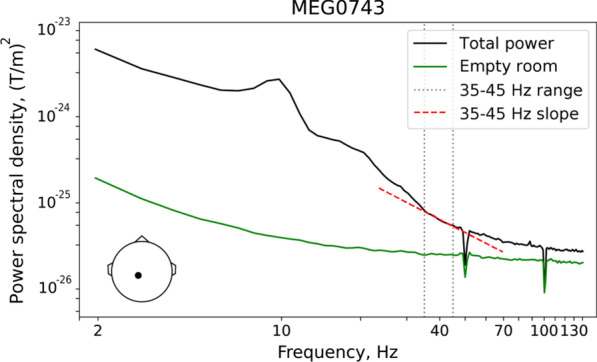
Herein, we used magnetoencephalography (MEG) to test whether the 1/f slope would differentiate ASD children with average and below-average (< 85) IQ. MEG was recorded at rest with eyes open/closed in 49 boys with ASD aged 6-15 years with IQ ranging from 54 to 128, and in 49 age-matched typically developing (TD) boys. The cortical source activity was estimated using the beamformer approach and individual brain models. We then extracted the 1/f slope by fitting a linear function to the log-log-scale power spectra in the high-frequency range.
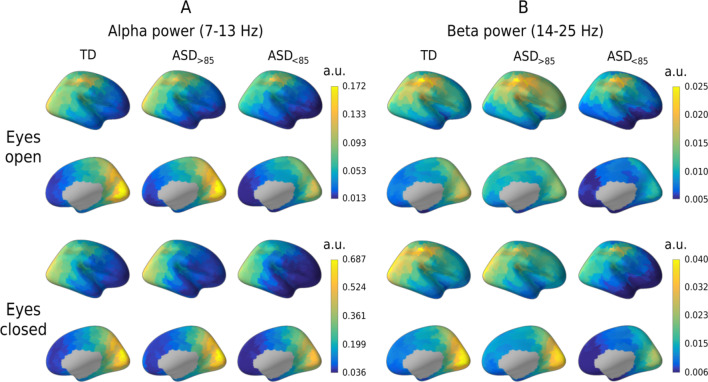
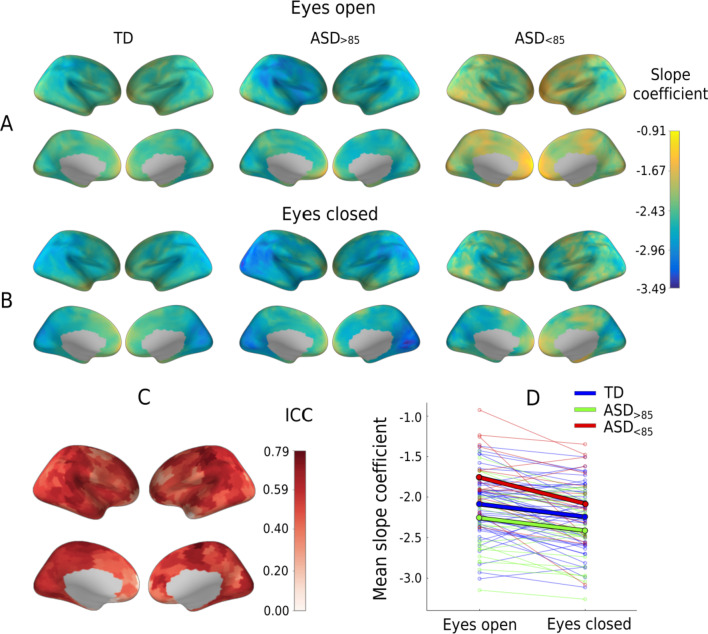
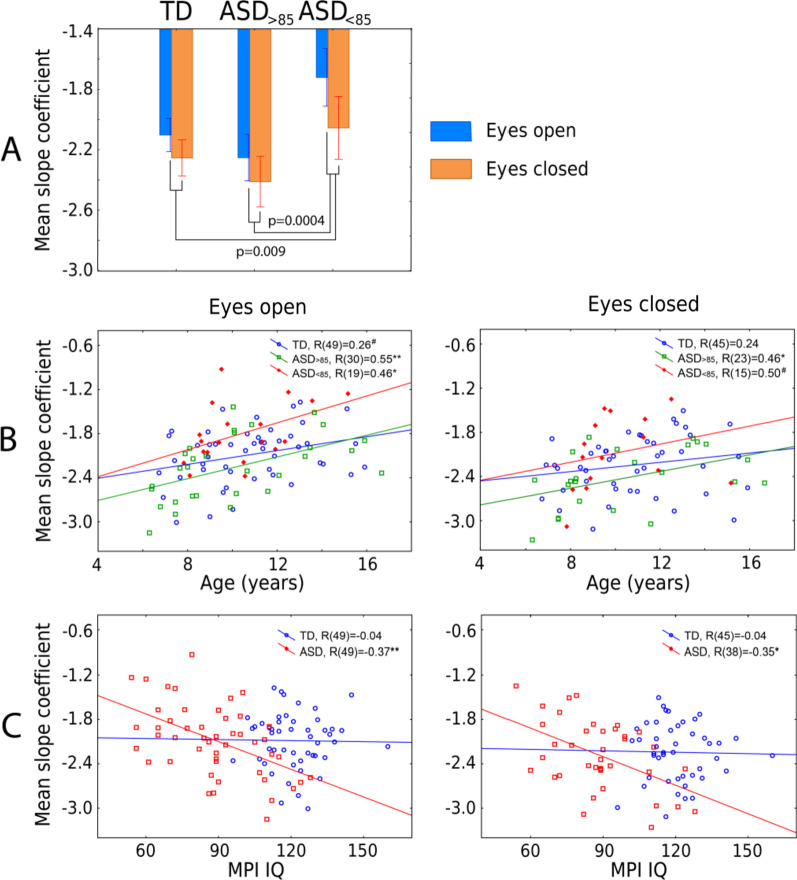
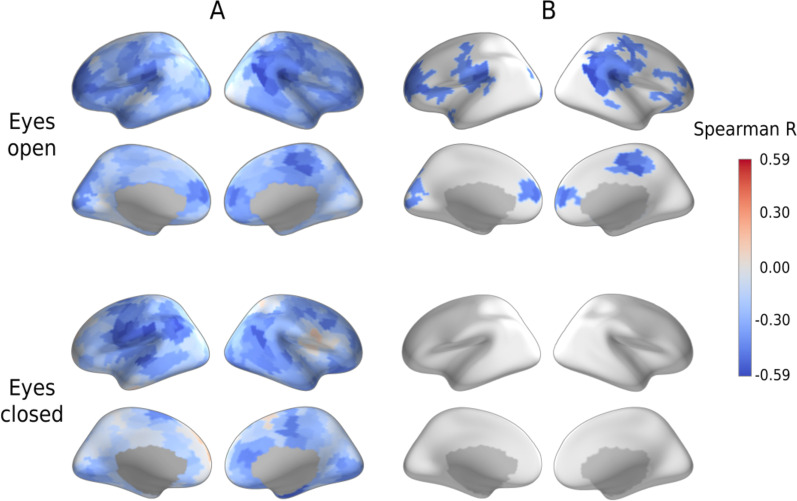
The global 1/f slope averaged over all cortical sources demonstrated high rank-order stability between the two conditions. Consistent with previous research, it was steeper in the eyes-closed than in the eyes-open condition and flattened with age. Regardless of condition, children with ASD and below-average IQ had flatter slopes than either TD or ASD children with average or above-average IQ. These group differences could not be explained by differences in signal-to-noise ratio or periodic (alpha and beta) activity.
Further research is needed to find out whether the observed changes in E-I ratios are characteristic of children with below-average IQ of other diagnostic groups.
The atypically flattened spectral slope of aperiodic activity in children with ASD and below-average IQ suggests a shift of the global E-I balance toward hyper-excitation. The spectral slope can provide an accessible noninvasive biomarker of the E-I ratio for making objective judgments about treatment effectiveness in people with ASD and comorbid intellectual disability.
神经元兴奋-抑制(E-I)平衡的改变强烈提示与 ASD 相关。然而,目前尚不清楚 ASD 个体的 E-I 比值的变化方向和程度是否与智力障碍相关,而智力障碍通常与这种发育障碍相关。无周期 1/f 活动的谱斜率反映了大神经元群体尺度上的 E-I 平衡,并且可能揭示其在伴有或不伴有智力障碍的 ASD 个体中的潜在变化。
在这里,我们使用脑磁图(MEG)来测试 1/f 斜率是否能够区分 ASD 儿童的平均和低于平均(<85)智商。记录了 49 名年龄在 6-15 岁的 ASD 男孩的静息状态下睁眼/闭眼的 MEG 数据,这些男孩的智商范围为 54-128,同时还记录了 49 名年龄匹配的典型发育(TD)男孩的数据。使用波束形成方法和个体脑模型来估计皮质源活动。然后,我们通过在高频范围内对对数-对数标度功率谱拟合线性函数来提取 1/f 斜率。
平均所有皮质源的全局 1/f 斜率在两种条件之间表现出高度的等级稳定性。与之前的研究一致,在闭眼条件下比睁眼条件下更陡峭,并且随年龄而变平。无论条件如何,智商低于平均的 ASD 儿童的斜率都比平均或高于平均智商的 TD 或 ASD 儿童的斜率更平坦。这些组间差异不能用信噪比或周期性(alpha 和 beta)活动的差异来解释。
需要进一步研究以确定智商低于平均的其他诊断组的儿童是否存在这种 E-I 比值的变化。
智商低于平均的 ASD 儿童的无周期活动的谱斜率异常平坦表明全局 E-I 平衡向过度兴奋转移。谱斜率可以提供 E-I 比值的一种易于获取的非侵入性生物标志物,用于对伴有智力障碍的 ASD 患者的治疗效果进行客观判断。