Department of Psychological Science, University of Vermont, 2 Colchester Avenue, Burlington, VT, 05405-0134, USA.
Department of Psychiatry, University of Pittsburgh, Thomas Detre Hall, 3811 O'Hara Street, Pittsburgh, PA, 15213, USA.
Trials. 2022 May 12;23(1):383. doi: 10.1186/s13063-022-06330-9.
This study is a confirmatory efficacy trial of two treatments for winter seasonal affective disorder (SAD): SAD-tailored group cognitive-behavioral therapy (CBT-SAD) and light therapy (LT). In our previous efficacy trial, post-treatment outcomes for CBT-SAD and LT were very similar, but CBT-SAD was associated with fewer depression recurrences two winters later than LT (27.3% in CBT-SAD vs. 45.6% in LT). CBT-SAD engaged and altered a specific mechanism of action, seasonal beliefs, which mediated CBT-SAD's acute antidepressant effects and CBT-SAD's enduring benefit over LT. Seasonal beliefs are theoretically distinct from LT's assumed target and mechanism: correction of circadian phase. This study applies the experimental therapeutics approach to determine how each treatment works when it is effective and to identify the best candidates for each. Biomarkers of LT's target and effect include circadian phase angle difference and the post-illumination pupil response. Biomarkers of CBT-SAD's target and effect include decreased pupillary and sustained frontal gamma-band EEG responses to seasonal words, which are hypothesized as biomarkers of seasonal beliefs, reflecting less engagement with seasonal stimuli following CBT-SAD. In addition to determining change mechanisms, this study tests the efficacy of a "switch" decision rule upon recurrence to inform clinical decision-making in practice.
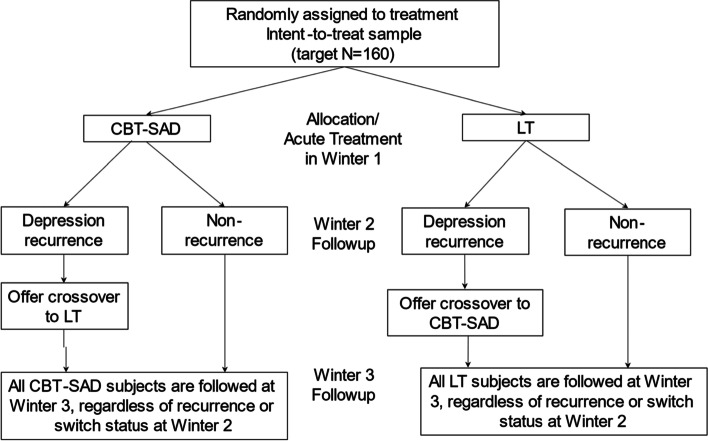
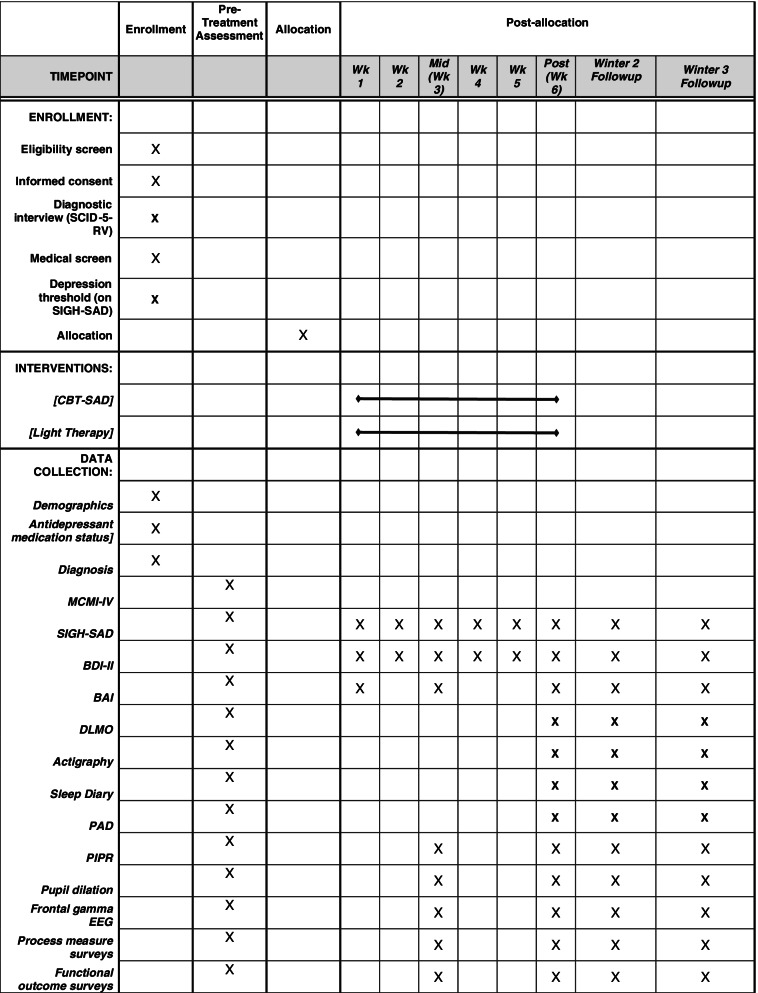
Adults with SAD (target N = 160) will be randomzied to 6-weeks of CBT-SAD or LT in winter 1; followed in winter 2; and, if a depression recurrence occurs, offered cross-over into the alternate treatment (i.e., switch from LT➔CBT-SAD or CBT-SAD➔LT). All subjects will be followed in winter 3. Biomarker assessments occur at pre-, mid-, and post-treatment in winter 1, at winter 2 follow-up (and again at mid-/post-treatment for those crossed-over), and at winter 3 follow-up. Primary efficacy analyses will test superiority of CBT-SAD over LT on depression recurrence status (the primary outcome). Mediation analyses will use parallel process latent growth curve modeling.
Consistent with the National Institute of Mental Health's priorities for demonstrating target engagement at the level of Research Domain Criteria-relevant biomarkers, this work aims to confirm the targets and mechanisms of LT and CBT-SAD to maximize the impact of future dissemination efforts.
ClinicalTrials.gov identifier: NCT03691792 . Registered on October 2, 2018.
本研究是对两种治疗冬季季节性情感障碍(SAD)的方法的疗效进行验证:针对 SAD 的团体认知行为疗法(CBT-SAD)和光照疗法(LT)。在我们之前的疗效试验中,CBT-SAD 和 LT 的治疗后结果非常相似,但 CBT-SAD 与 LT 相比,在随后的两个冬季中抑郁复发的情况更少(CBT-SAD 为 27.3%,LT 为 45.6%)。CBT-SAD 参与并改变了季节性信念这一特定的作用机制,而季节性信念介导了 CBT-SAD 的急性抗抑郁作用和 CBT-SAD 相对于 LT 的持久益处。季节性信念在理论上与 LT 的假设靶点和机制不同:纠正昼夜节律相位。本研究应用实验治疗方法来确定每种治疗方法在有效的情况下是如何发挥作用的,并确定每种治疗方法的最佳适用人群。LT 的靶点和效果的生物标志物包括昼夜节律相位角差和光照后瞳孔反应。CBT-SAD 的靶点和效果的生物标志物包括对季节性词语的瞳孔和持续额部伽马波段脑电图反应的减少,这些被假设为季节性信念的生物标志物,反映了 CBT-SAD 后对季节性刺激的参与减少。除了确定变化机制外,本研究还测试了“切换”决策规则在复发时的疗效,以在实践中为临床决策提供信息。
患有 SAD 的成年人(目标 N=160)将在冬季 1 中随机接受 6 周的 CBT-SAD 或 LT 治疗;在冬季 2 中进行随访;如果出现抑郁复发,将接受交叉治疗(即,从 LT 转为 CBT-SAD 或从 CBT-SAD 转为 LT)。所有受试者将在冬季 3 中进行随访。生物标志物评估在冬季 1 的治疗前、中期和后期进行,在冬季 2 的随访时进行(对于交叉治疗的受试者,在中期/后期再次进行),并在冬季 3 的随访时进行。主要疗效分析将测试 CBT-SAD 在抑郁复发状态上优于 LT(主要结局)。中介分析将使用平行过程潜变量增长曲线模型进行。
与美国国立精神卫生研究院优先证明与研究领域标准相关的生物标志物靶点参与的目标一致,这项工作旨在确认 LT 和 CBT-SAD 的靶点和机制,以最大限度地提高未来传播工作的效果。
ClinicalTrials.gov 标识符:NCT03691792。于 2018 年 10 月 2 日注册。